カルシウムとリンは血中で溶解度の限界近くにあるため、片方が上がればもう片方を下げなければ沈殿する。この制約が、副甲状腺ホルモンと線維芽細胞増殖因子23という2つのホルモンの役割分担を決めている。
マグネシウムは主役に見えないが、副甲状腺ホルモンの分泌にも作用にも必須で、これが足りないと他の是正がすべて効かなくなる。
- 2つのホルモンと、3つの臓器
- 高カルシウム血症と低カルシウム血症 — 原因を機序で分ける
- マグネシウム — 低いままだと、他の電解質が治らない
- リンの調節 — 3つ目のホルモンが、骨から出ている
- カルシウム感知受容体 — 副甲状腺と腎が、同じセンサーで濃度を読んでいる
- アルカリホスファターゼ — 石灰化を進めるために、邪魔者を壊す酵素
2つのホルモンと、3つの臓器
| 副甲状腺ホルモン | 活性型ビタミンD | 線維芽細胞増殖因子23 | |
|---|---|---|---|
| 骨 | 吸収を促す(Ca・Pを出す) | 吸収を促す | — |
| 腎 | Ca再吸収↑・P排泄↑・1α水酸化↑ | Ca・P再吸収↑ | P排泄↑・1α水酸化↓ |
| 腸 | 間接的(ビタミンD経由) | Ca・P吸収↑ | — |
| 結果 | Ca↑・P↓ | Ca↑・P↑ | P↓ |
- 副甲状腺ホルモンだけが「カルシウムを上げてリンを下げる」——沈殿を避けながらカルシウムを確保する唯一の手段
- 血中カルシウムの約半分は蛋白(アルブミン)と結合している。働くのはイオン化カルシウム
- 補正式:補正Ca = 実測Ca +(4 − アルブミン)
アルカローシスで手指のしびれとテタニーが出るのは、pHが上がるとアルブミンの負電荷が増え、カルシウムをより多く結合するためである。総カルシウムは変わらないのにイオン化カルシウムが下がる。過換気症候群の症状が、この一点で説明できる。
大量輸血でも低カルシウム血症が起きる——保存血の抗凝固剤であるクエン酸がカルシウムを結合するためである。肝で代謝されるので、肝障害や大量急速輸血では追いつかない。
低マグネシウム血症が「治らない低カルシウム血症」を作るのは、実務で必ず出会う落とし穴である。
- マグネシウムが低いと副甲状腺ホルモンの分泌が抑制される
- 同時に、標的臓器での副甲状腺ホルモンの作用も鈍る
- だからカルシウムを補充しても上がらない
- マグネシウムを是正すると、はじめて改善する
原因は、アルコール依存・下痢・利尿薬・プロトンポンプ阻害薬の長期使用・シスプラチンなど。低カリウム血症も同じ理由で難治になる(マグネシウム欠乏で腎からのカリウム喪失が増える)。「低カリウムと低カルシウムが同時に治らないときは、マグネシウムを測る」——これは覚えておく価値のある実務の型である。
線維芽細胞増殖因子23は骨から出るホルモンで、腫瘍性骨軟化症——腫瘍が産生して低リン血症性の骨軟化症を起こす——の原因として発見された。慢性腎臓病では最も早期から上昇する指標でもある。
English version
Core
| Parathyroid hormone | Active vitamin D | FGF23 | |
|---|---|---|---|
| Bone | Promotes resorption (releases Ca and P) | Promotes resorption | — |
| Kidney | Ca reabsorption ↑, P excretion ↑, 1α-hydroxylation ↑ | Ca and P reabsorption ↑ | P excretion ↑, 1α-hydroxylation ↓ |
| Gut | Indirectly (through vitamin D) | Ca and P absorption ↑ | — |
| Result | Ca ↑, P ↓ | Ca ↑, P ↑ | P ↓ |
- Only parathyroid hormone "raises calcium and lowers phosphate" — the only means of securing calcium while avoiding precipitation.
- About half the blood calcium is bound to protein (albumin). What acts is the ionised calcium.
- Correction formula: corrected Ca = measured Ca + (4 − albumin).
Going further
Tingling of the fingers and tetany in alkalosis occur because as the pH rises the negative charge of albumin increases and it binds more calcium. The total calcium is unchanged while the ionised calcium falls. The symptoms of the hyperventilation syndrome are explained by this single point.
Hypocalcaemia also occurs with massive transfusion — because the citrate anticoagulant of stored blood binds calcium. It is metabolised in the liver, so with liver disease or a rapid massive transfusion the liver cannot keep up.
That hypomagnesaemia creates a "hypocalcaemia that will not correct" is a pitfall met without fail in practice.
- With a low magnesium, the secretion of parathyroid hormone is suppressed.
- At the same time, the action of parathyroid hormone at its target organs is dulled.
- So calcium supplements do not raise it.
- Only when the magnesium is corrected does it improve.
The causes are alcohol dependence, diarrhoea, diuretics, long-term proton pump inhibitors, cisplatin and others. Hypokalaemia is refractory for the same reason (magnesium deficiency increases renal potassium loss). "When a low potassium and a low calcium will not correct together, measure the magnesium" — a pattern in practice worth remembering.
FGF23 is a hormone released from bone, discovered as the cause of tumour-induced osteomalacia — a tumour producing it and causing hypophosphataemic osteomalacia. It is also the index that rises earliest in chronic kidney disease.
高カルシウム血症と低カルシウム血症 — 原因を機序で分ける
高カルシウム血症——2つで9割を占める。
- 原発性副甲状腺機能亢進症(外来で最多)——副甲状腺ホルモンが高い
- 悪性腫瘍(入院で最多)——副甲状腺ホルモンは抑制されている
- 体液性(副甲状腺ホルモン関連蛋白)——扁平上皮癌・成人T細胞白血病
- 骨転移による局所的な骨破壊
- 活性型ビタミンD産生——リンパ腫・肉芽腫性疾患
症状:多尿・脱水・便秘・食欲不振・意識障害・QT短縮。治療は生理食塩水による輸液が第一、次にビスホスホネート・デノスマブ・カルシトニン。
低カルシウム血症——Chvostek徴候・Trousseau徴候・QT延長・けいれん。
高カルシウム血症で脱水が進む機序を押さえると、治療の順序が決まる。高カルシウムは腎の集合管でバソプレシンの作用を妨げる(腎性尿崩症)ので、尿が濃縮できず多尿になる。脱水すると腎からのカルシウム排泄が落ち、さらに上がる——悪循環である。
だから最優先は輸液である。ビスホスホネートは効果発現に2〜4日かかるので、それだけでは急性期をしのげない。ループ利尿薬は、十分な補液の後でのみ考慮する(脱水のまま使えば悪化させる)。
甲状腺手術後の低カルシウム血症は頻出の題材である。
- 一過性——副甲状腺の血流障害。数日〜数週で回復
- 永続性——4腺すべてが失われた場合
- 骨飢餓症候群——副甲状腺機能亢進症の術後、抑えられていた骨形成が一気に始まり、カルシウム・リン・マグネシウムが骨へ取り込まれる。大量の補充が要る
偽性副甲状腺機能低下症は、ホルモンは出ているのに受容体以降が効かない状態である。Gsαの異常によるもので、低カルシウム・高リンなのに副甲状腺ホルモンが高い。Albright遺伝性骨異栄養症(低身長・円形顔貌・短い第4・5中手骨)を伴う。「握りこぶしを作ると指の付け根のくぼみが目立つ」という所見で気づける。
English version
Core
Hypercalcaemia — two causes account for 90 per cent.
- Primary hyperparathyroidism (the commonest in outpatients) — parathyroid hormone is high.
- Malignancy (the commonest in inpatients) — parathyroid hormone is suppressed.
- Humoral (parathyroid hormone-related protein) — squamous carcinoma, adult T-cell leukaemia.
- Local bone destruction by metastases.
- Production of active vitamin D — lymphoma, granulomatous disease.
Symptoms: polyuria, dehydration, constipation, anorexia, impaired consciousness, a short QT. Treatment is fluid with normal saline first, then a bisphosphonate, denosumab or calcitonin.
Hypocalcaemia — Chvostek’s and Trousseau’s signs, a long QT, seizures.
Going further
Grasping the mechanism by which dehydration advances in hypercalcaemia settles the order of treatment. A high calcium impedes the action of vasopressin in the collecting duct (nephrogenic diabetes insipidus), so the urine cannot be concentrated and polyuria follows. Dehydrated, renal calcium excretion falls and it rises further — a vicious circle.
Hence fluid comes first. A bisphosphonate takes 2–4 days to act, so it cannot carry the acute phase alone. A loop diuretic is considered only after adequate volume repletion (used while still dehydrated it makes things worse).
Hypocalcaemia after thyroid surgery is a frequent subject.
- Transient — impaired blood supply to the parathyroids. Recovers over days to weeks.
- Permanent — when all four glands are lost.
- Hungry bone syndrome — after surgery for hyperparathyroidism, the suppressed bone formation begins all at once and calcium, phosphate and magnesium are taken into bone. Large replacement is needed.
Pseudohypoparathyroidism is the state in which the hormone is released and nothing works beyond the receptor. Caused by an abnormality of Gsα, it gives a low calcium and a high phosphate with a high parathyroid hormone. It is accompanied by Albright hereditary osteodystrophy (short stature, round face, short fourth and fifth metacarpals). It can be noticed from the finding that making a fist, the dimples at the knuckles stand out.
マグネシウム — 低いままだと、他の電解質が治らない
体内で4番目に多い陽イオン。約 60% が骨、残りの大半が細胞内にある——血清値は全身の在庫を反映しない。
働き——ATP はマグネシウムと錯体を作って初めて基質になる(300以上の酵素の補因子)・カルシウムチャネルを抑える・神経筋の興奮を抑える。
低マグネシウム血症の原因——下痢・アルコール依存・利尿薬・プロトンポンプ阻害薬の長期使用・シスプラチン・再栄養。
症状——テタニー・振戦・けいれん・QT 延長・torsades de pointes。
高マグネシウム血症——腎不全・酸化マグネシウムの内服・妊娠高血圧腎症の治療中。深部腱反射の消失 → 呼吸抑制 → 心停止の順に進む。
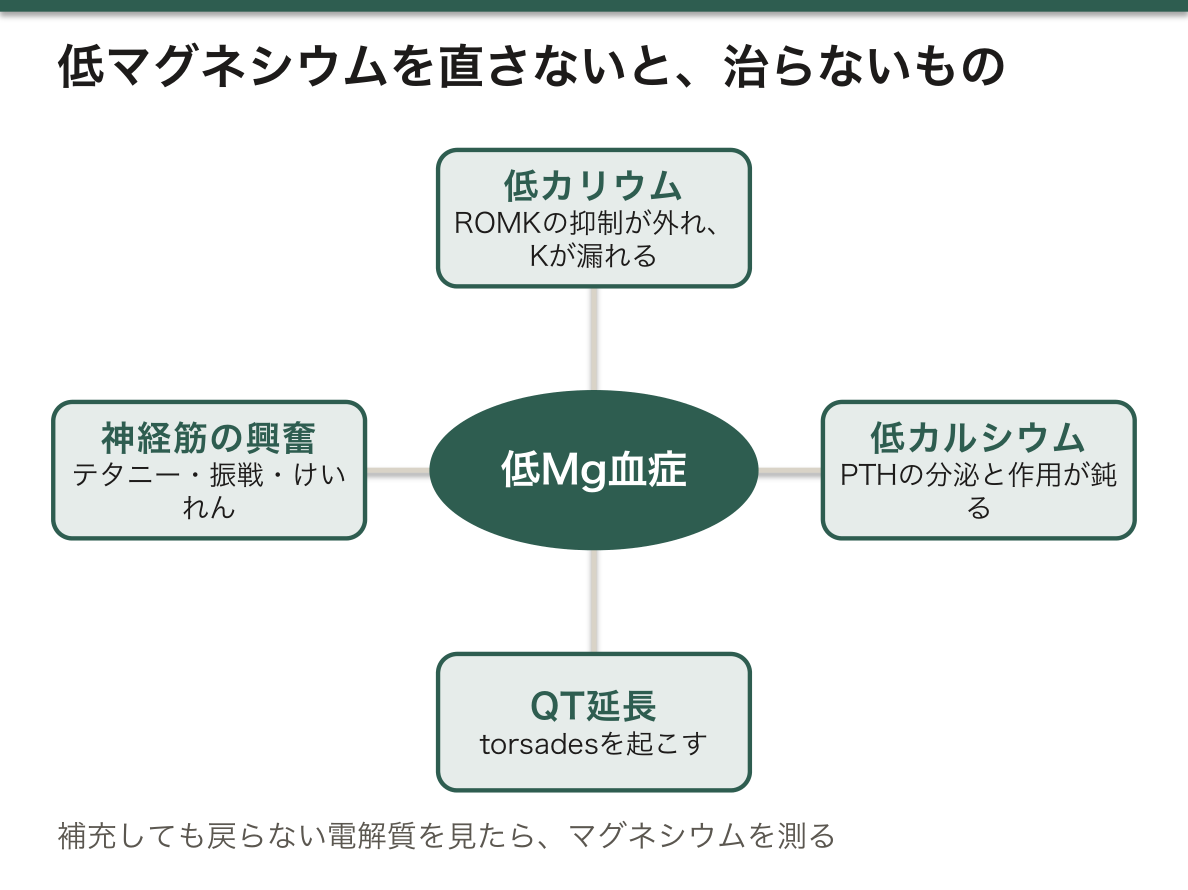
この項の要点は「低マグネシウムを直さないと、低カリウムも低カルシウムも直らない」ことにある。
- 低カリウム——マグネシウムが不足すると腎の ROMK チャネルの抑制が外れ、カリウムが漏れ続ける
- 低カルシウム——副甲状腺ホルモンの分泌と、その作用の両方が鈍る
(カリウムの章)——「補充しても戻らない電解質を見たら、マグネシウムを測る」。
ATP がマグネシウム錯体として働くことは、酵素学の前提になっている。キナーゼの基質は ATP ではなく Mg-ATP である(酵素の章)——「エネルギー代謝の全部が、この金属の上に乗っている」。
そしてカルシウム拮抗作用が、治療での使い方を決めている。子癇の予防と治療に硫酸マグネシウムを使うのは、抗けいれん薬としてではなく神経筋の興奮を抑える作用による(妊娠高血圧症候群の章)——「効きすぎの徴候を、深部腱反射で見張る」。
torsades de pointes に対してマグネシウムを投与するのも、血清値が正常でも意味がある(チャネル病の章)——「補充ではなく、膜の安定化として使っている」。
English version
Core
The fourth most abundant cation in the body. About 60 per cent is in bone and most of the rest within cells — the serum value does not reflect the body’s stock.
Functions — ATP becomes a substrate only as a complex with magnesium (a cofactor of over 300 enzymes), it suppresses calcium channels, it damps neuromuscular excitability.
Causes of hypomagnesaemia — diarrhoea, alcohol dependence, diuretics, long-term proton pump inhibitors, cisplatin, refeeding.
Symptoms — tetany, tremor, seizures, a long QT, torsades de pointes.
Hypermagnesaemia — renal failure, oral magnesium oxide, during treatment of pre-eclampsia. It progresses as loss of the deep tendon reflexes → respiratory depression → cardiac arrest.
Going further
The point of this section is that unless the low magnesium is corrected, neither the low potassium nor the low calcium will correct.
- Low potassium — with magnesium short, the inhibition of the renal ROMK channel is released and potassium goes on leaking.
- Low calcium — both the secretion and the action of parathyroid hormone are dulled.
(the chapter on potassium) — seeing an electrolyte that does not come back with replacement, measure the magnesium.
- That ATP works as a magnesium complex is a premise of enzymology. The substrate of a kinase is not ATP but Mg-ATP (the chapter on enzymes) — the whole of energy metabolism riding on this metal.
- And the calcium-antagonist action determines its therapeutic use. Magnesium sulphate is used to prevent and treat eclampsia not as an anticonvulsant but through damping neuromuscular excitability (the chapter on hypertensive disorders of pregnancy) — watch for signs of excess with the deep tendon reflexes.
- Giving magnesium for torsades de pointes has a purpose even with a normal serum level (the chapter on channelopathies) — used not as replacement but as stabilisation of the membrane.
リンの調節 — 3つ目のホルモンが、骨から出ている
リンは体重の約 1%。85% が骨、細胞内では ATP・核酸・リン脂質・リン酸化の材料になる。
調節するホルモンは3つ。
| ホルモン | 出どころ | 血中カルシウム | 血中リン |
|---|---|---|---|
| 副甲状腺ホルモン | 副甲状腺 | 上げる | 下げる(尿へ捨てさせる) |
| 活性型ビタミンD | 腎(1α-水酸化) | 上げる | 上げる(腸から一緒に吸う) |
| FGF23 | 骨細胞・骨芽細胞 | — | 下げる |
FGF23 は2つの働きを持つ——①腎でのリン再吸収を抑える ②1α-水酸化酵素を抑え、活性型ビタミンD を減らす。
働くには共受容体 Klotho が要る。Klotho は腎に多い。
「骨がホルモンを出して腎に指示する」という向きが、この項の新しさになる。骨は支える組織であると同時に、内分泌器官でもある(骨の生化学の章)——「リンを最も使う臓器が、リンの量を決めている」。
低リン血症性くる病が、FGF23 で説明できるようになった。X連鎖性低リン血症では PHEX の異常で FGF23 が過剰になり、リンが尿へ漏れ続ける(成長の異常の章)——「ビタミンD を足しても治らないくる病がある理由になる」。
だから抗 FGF23 抗体(ブロスマブ)が治療になる(分子標的薬の章)——「原因分子が分かると、補充から遮断へ治療が変わる」。
腫瘍性骨軟化症も同じ機序になる。小さな間葉系腫瘍が FGF23 を出し、原因不明の骨痛と筋力低下として現れる——「腫瘍を取れば治るので、探す価値がある」。
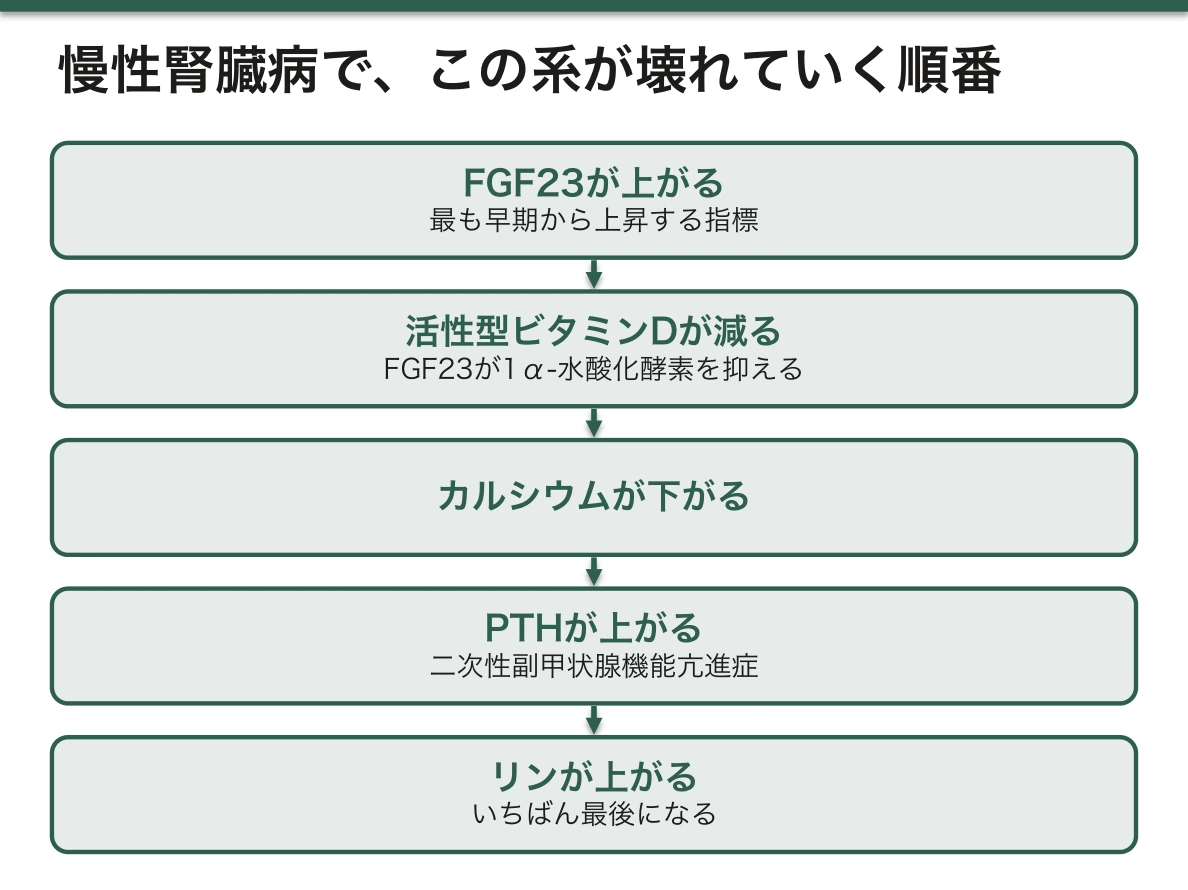
慢性腎臓病では、この系が順番に壊れていく。まず FGF23 が上がり、活性型ビタミンD が減り、カルシウムが下がり、副甲状腺ホルモンが上がる(二次性副甲状腺機能亢進症)(慢性腎臓病の合併症の章)——「リンが上がるのは、いちばん最後になる」。
English version
Core
Phosphorus is about 1 per cent of body weight. 85 per cent is in bone; within cells it is the material of ATP, nucleic acid, phospholipid and phosphorylation.
Three hormones regulate it.
| Hormone | Source | Blood calcium | Blood phosphate |
|---|---|---|---|
| Parathyroid hormone | Parathyroid | Raises | Lowers (makes it be discarded in the urine) |
| Active vitamin D | Kidney (1α-hydroxylation) | Raises | Raises (absorbed together from the gut) |
| FGF23 | Osteocyte, osteoblast | — | Lowers |
FGF23 has two actions — ① it suppresses phosphate reabsorption in the kidney ② it suppresses the 1α-hydroxylase and reduces active vitamin D.
To act it needs the co-receptor Klotho, which is abundant in the kidney.
Going further
- The novelty of this section is the direction — bone releasing a hormone and instructing the kidney. Bone is at once a supporting tissue and an endocrine organ (the chapter on the biochemistry of bone) — the organ that uses the most phosphate deciding how much there is.
- Hypophosphataemic rickets came to be explained by FGF23. In X-linked hypophosphataemia an abnormality of PHEX gives an excess of FGF23 and phosphate goes on leaking into the urine (the chapter on disorders of growth) — the reason there is a rickets that adding vitamin D does not cure.
- Hence an anti-FGF23 antibody (burosumab) is the treatment (the chapter on molecularly targeted drugs) — once the causative molecule is known, treatment changes from replacement to blockade.
- Tumour-induced osteomalacia has the same mechanism. A small mesenchymal tumour releases FGF23 and it presents as unexplained bone pain and weakness — removing the tumour cures it, so it is worth looking for.
- In chronic kidney disease this system breaks in order. FGF23 rises first, active vitamin D falls, calcium falls, and parathyroid hormone rises (secondary hyperparathyroidism) (the chapter on the complications of chronic kidney disease) — the phosphate rising last of all.
カルシウム感知受容体 — 副甲状腺と腎が、同じセンサーで濃度を読んでいる
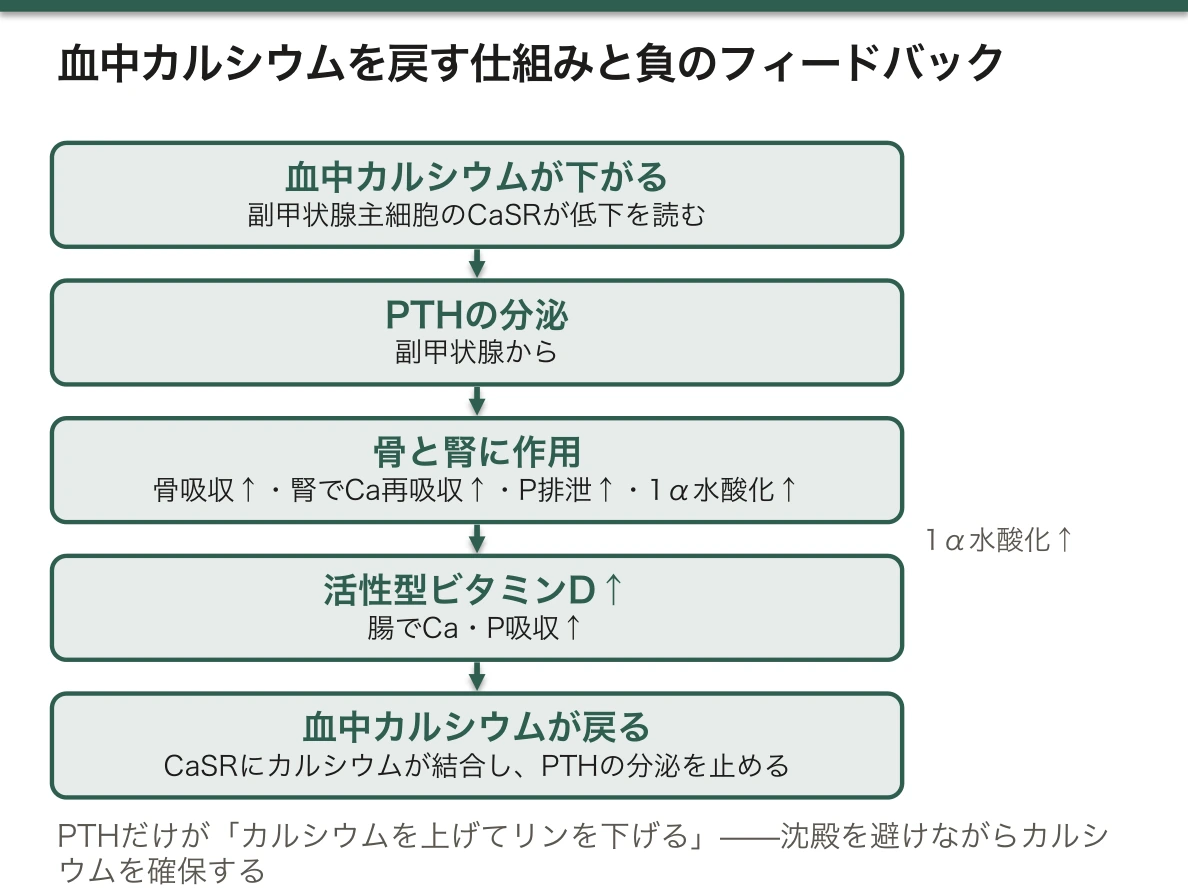
血中カルシウムの調節が成り立つには、まず濃度を測る仕組みが要る。それがカルシウム感知受容体(CaSR)で、細胞外のカルシウムそのものをリガンドとする珍しい受容体である。
2 か所に置かれていて、どちらも同じ向きに働く。
- 副甲状腺の主細胞——カルシウムが結合すると PTH の分泌を止める
- 腎の Henle 係蹄太い上行脚——カルシウムが結合すると 尿へのカルシウム排泄を増やす
受容体が働く=「カルシウムは足りている」という信号であると覚えると、機能亢進型と機能喪失型のどちらがどうなるかを毎回導ける。
感度が上がるか下がるかで、症状が正反対になる。
| 機能喪失変異(鈍くなる) | 機能獲得変異(敏感になる) | |
| 受容体の読み | 「カルシウムが足りない」と誤読する | 「足りている」と誤読する |
| PTH | 止まらない(正常〜軽度高値) | 抑えられる(正常〜低値) |
| 血中カルシウム | 高い | 低い |
| 尿中カルシウム | 低い(腎も鈍いので出さない) | 高い |
| 病名 | 家族性低カルシウム尿性高カルシウム血症(FHH) | 常染色体優性低カルシウム血症 |
FHH を原発性副甲状腺機能亢進症と間違えないことが臨床上いちばん重要である。どちらも高カルシウム血症+PTH が抑制されていないという同じ組合せを示すが、FHH は無症状で治療が要らず、副甲状腺を切っても治らない。不要な手術を防ぐために区別する。
分ける物差しが尿中カルシウムである。カルシウム/クレアチニンクリアランス比が0.01 未満なら FHH、0.02 を超えれば原発性副甲状腺機能亢進症を考える。「血中が高いのに尿に出ていない」という食い違いが手がかりになる。
受容体は薬の標的でもある。シナカルセトは CaSR の感受性を高める薬で、受容体に「もっと足りている」と錯覚させて PTH を下げる。二次性副甲状腺機能亢進症(透析患者)や副甲状腺癌に使う。作用の裏返しとして低カルシウム血症を起こす。
高カルシウム血症で PTH が抑制されていないとき、手術を考える前に尿中カルシウムと家族歴を確認する。若く、無症状で、家族に同じ人がいれば FHH を疑う。
English version
Core
For the regulation of blood calcium to work, there must first be a means of measuring the concentration. That is the calcium-sensing receptor (CaSR), an unusual receptor whose ligand is extracellular calcium itself.
It is placed in two locations and acts in the same direction in both.
- The chief cells of the parathyroid — calcium binding stops the secretion of PTH.
- The thick ascending limb of the loop of Henle — calcium binding increases the excretion of calcium in the urine.
Remember that the receptor acting = the signal "there is enough calcium", and one can derive every time which way the gain-of-function and loss-of-function forms go.
Going further
The symptoms are exactly opposite according to whether the sensitivity rises or falls.
| Loss-of-function mutation (blunted) | Gain-of-function mutation (over-sensitive) | |
|---|---|---|
| What the receptor reads | Misreads "calcium is short" | Misreads "there is enough" |
| PTH | Not switched off (normal to slightly high) | Suppressed (normal to low) |
| Blood calcium | High | Low |
| Urinary calcium | Low (the kidney is blunted too and does not excrete it) | High |
| Name | Familial hypocalciuric hypercalcaemia (FHH) | Autosomal dominant hypocalcaemia |
Clinically the most important thing is not to mistake FHH for primary hyperparathyroidism. Both show the same combination of hypercalcaemia with a PTH that is not suppressed, but FHH is asymptomatic, needs no treatment, and is not cured by removing the parathyroids. Distinguish them to prevent an unnecessary operation.
The measure that separates them is the urinary calcium. A calcium/creatinine clearance ratio below 0.01 means FHH; above 0.02, think of primary hyperparathyroidism. The discrepancy "high in the blood and not coming out in the urine" is the clue.
The receptor is also a drug target. Cinacalcet raises the sensitivity of the CaSR, making the receptor believe there is more than enough and lowering the PTH. Used in secondary hyperparathyroidism (dialysis patients) and parathyroid carcinoma. As the reverse of its action it causes hypocalcaemia.
In the clinic
When hypercalcaemia comes with a PTH that is not suppressed, check the urinary calcium and the family history before considering surgery. Young, asymptomatic, with the same in the family — suspect FHH.
アルカリホスファターゼ — 石灰化を進めるために、邪魔者を壊す酵素
骨の石灰化は「カルシウムとリンが集まれば起きる」という単純な話ではない。ピロリン酸という強力な阻害物質が、常に結晶化を止めているからである。
骨型アルカリホスファターゼ(ALP)の仕事は、このピロリン酸を分解して阻害を外すことである。同時に無機リン酸が増えるので、二重に石灰化が進む。
だから ALP が低いと、骨が石灰化しない。検査値は「高いと異常」と思われがちだが、ALP は低値のほうが決定的な意味を持つ数少ない酵素である。
- 低ホスファターゼ症——ALP の遺伝子異常。乳児型は重篤で、くる病様の骨変化・呼吸不全・けいれんを起こす
- けいれんの理由が独特で、ALP はピリドキサールリン酸(活性型ビタミン B6)を脱リン酸化して細胞内へ入れる役目も持つため、B6 が脳で使えなくなる。B6 依存性けいれんになる
ピロリン酸という物差しが、いくつもの病態を1本に繋ぐ。
| ピロリン酸が多すぎる | 石灰化しない | 低ホスファターゼ症。ビスホスホネートは禁忌(ピロリン酸の類似体だから) |
| ピロリン酸が関節に結晶化 | 偽痛風 | ピロリン酸カルシウム結晶。棒状・正の複屈折(尿酸と逆) |
| ピロリン酸を薬として使う | 骨吸収を止める | ビスホスホネートは分解されないピロリン酸の類似体。破骨細胞に取り込まれて働きを止める |
ビスホスホネートが「壊れないピロリン酸」だという一点を知っていれば、作用も、低ホスファターゼ症で禁忌である理由も、同時に説明できる。
ALP が高いときは、どのアイソザイムかを分ける。骨型(骨芽細胞の活動が盛んなとき——成長期・骨折後・骨転移・Paget 病・くる病)と肝・胆道型(胆汁うっ滞)が主で、妊娠では胎盤型が上がる。γ-GTP を併せて測れば、肝胆道由来かどうかが分かる。
⚠️ 小児の ALP は成人の 2〜3 倍が正常である。成長期の骨が作られているためで、成人の基準値で「異常高値」と判定しない。
原因不明のけいれんを起こす乳児で ALP が低いことに気づけるかが分かれ目になる。低値は見落とされやすい。
English version
Core
Mineralisation of bone is not the simple matter of "calcium and phosphate gathering". A powerful inhibitor, pyrophosphate, is constantly preventing crystallisation.
The job of bone-specific alkaline phosphatase (ALP) is to degrade this pyrophosphate and lift the inhibition. At the same time inorganic phosphate increases, so mineralisation advances doubly.
So when the ALP is low, bone does not mineralise. A laboratory value tends to be thought abnormal when high, but ALP is one of the few enzymes in which a low value carries the decisive meaning.
- Hypophosphatasia — an abnormality of the ALP gene. The infantile form is severe, causing rickets-like bone change, respiratory failure and seizures.
- The reason for the seizures is distinctive: ALP also has the role of dephosphorylating pyridoxal phosphate (active vitamin B6) so that it can enter the cell, so B6 cannot be used in the brain. It becomes a B6-dependent seizure.
Going further
The measure of pyrophosphate joins several conditions into one.
| Too much pyrophosphate | No mineralisation | Hypophosphatasia. Bisphosphonates are contraindicated (they are analogues of pyrophosphate) |
| Pyrophosphate crystallising in a joint | Pseudogout | Calcium pyrophosphate crystals. Rod-shaped, positively birefringent (the opposite of urate) |
| Pyrophosphate used as a drug | Stops bone resorption | A bisphosphonate is an analogue of pyrophosphate that cannot be degraded. Taken up by the osteoclast, it stops its work |
Knowing the single point that a bisphosphonate is "a pyrophosphate that does not break" explains at once both its action and why it is contraindicated in hypophosphatasia.
When the ALP is high, separate the isozyme. Chiefly bone (when osteoblasts are active — growth, after a fracture, bone metastasis, Paget’s disease, rickets) and hepatobiliary (cholestasis), while in pregnancy the placental form rises. Measuring γ-GT alongside says whether it is hepatobiliary.
⚠️ ALP in a child is normally two to three times the adult value. Growing bone is being made, so do not judge it "abnormally high" against the adult reference range.
In the clinic
Whether one notices that the ALP is low in an infant with unexplained seizures is what decides the case. A low value is easily missed.
まとめ
| 2つのホルモンと、3つの臓器 | 副甲状腺ホルモン活性型ビタミンD線維芽細胞増殖因子23骨吸収を促す(Ca・Pを出す)吸収を促す—腎Ca再吸収↑・P排泄↑・1α水酸化↑Ca・P再吸収↑P排泄↑・1α水酸化↓腸間接的… |
|---|---|
| 高カルシウム血症と低カルシウム血症 — 原因を機序で分ける | 高カルシウム血症——2つで9割を占める。 |
| マグネシウム — 低いままだと、他の電解質が治らない | 体内で4番目に多い陽イオン。約 60% が骨、残りの大半が細胞内にある——血清値は全身の在庫を反映しない。 |
| リンの調節 — 3つ目のホルモンが、骨から出ている | リンは体重の約 1%。85% が骨、細胞内では ATP・核酸・リン脂質・リン酸化の材料になる。 |
| カルシウム感知受容体 — 副甲状腺と腎が、同じセンサーで濃度を読んでいる | 血中カルシウムの調節が成り立つには、まず濃度を測る仕組みが要る。 |
| アルカリホスファターゼ — 石灰化を進めるために、邪魔者を壊す酵素 | 骨の石灰化は「カルシウムとリンが集まれば起きる」という単純な話ではない。 |
このノートは医学生が授業の内容を自分の言葉でまとめたもので、診療の判断に使うものではありません。誤りに気づいたらお知らせください。