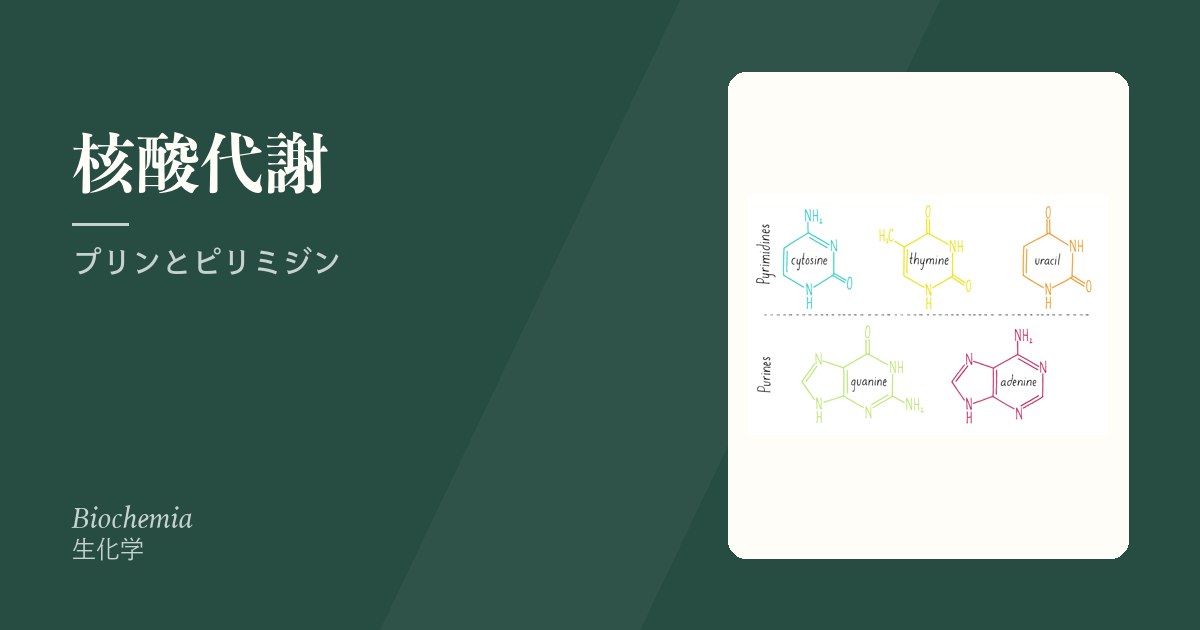
核酸代謝は「作る」と「壊す」と「再利用する」の3つで整理する。作るのは高くつくので、体は壊した部品をサルベージ経路で拾い直す。この節約が効かなくなったとき、痛風や Lesch-Nyhan 症候群が起きる。
そしてプリンとピリミジンでは終着点が違う。プリンは環を開けないので尿酸という不溶性の塊で捨てるしかない。ピリミジンは環を開けて水溶性の物質+アンモニアまで分解できる。「尿酸結晶で痛風になるのはプリンだけ」という臨床的事実は、この化学的な差から来ている。
抗癌薬・免疫抑制薬・抗ウイルス薬の多くがこの経路を狙う。「増える細胞ほど核酸を要る」という当たり前の性質を利用しているので、副作用も骨髄・消化管粘膜・毛根という増える組織に出る。
- プリンの合成と分解 — 尿酸で終わる
- ピリミジンと葉酸 — DNAを作る一歩
- 名前を正確に使う — 塩基・ヌクレオシド・ヌクレオチド
- リボヌクレオチド還元酵素 — DNA の材料を作る、唯一の道
- 尿酸は、ヒトでは抗酸化物質でもある
- アデノシン — 分解産物が、そのまま体の信号になっている
プリンの合成と分解 — 尿酸で終わる
de novo 合成——リボース5リン酸(ペントースリン酸経路由来)から PRPP を作り、そこへ原子を1つずつ足して環を組む。律速は PRPPアミドトランスフェラーゼ。葉酸(THF)を要求する。
サルベージ経路——分解された塩基を PRPP と再結合して拾い直す。
- HGPRT——ヒポキサンチン・グアニンを回収
- APRT——アデニンを回収
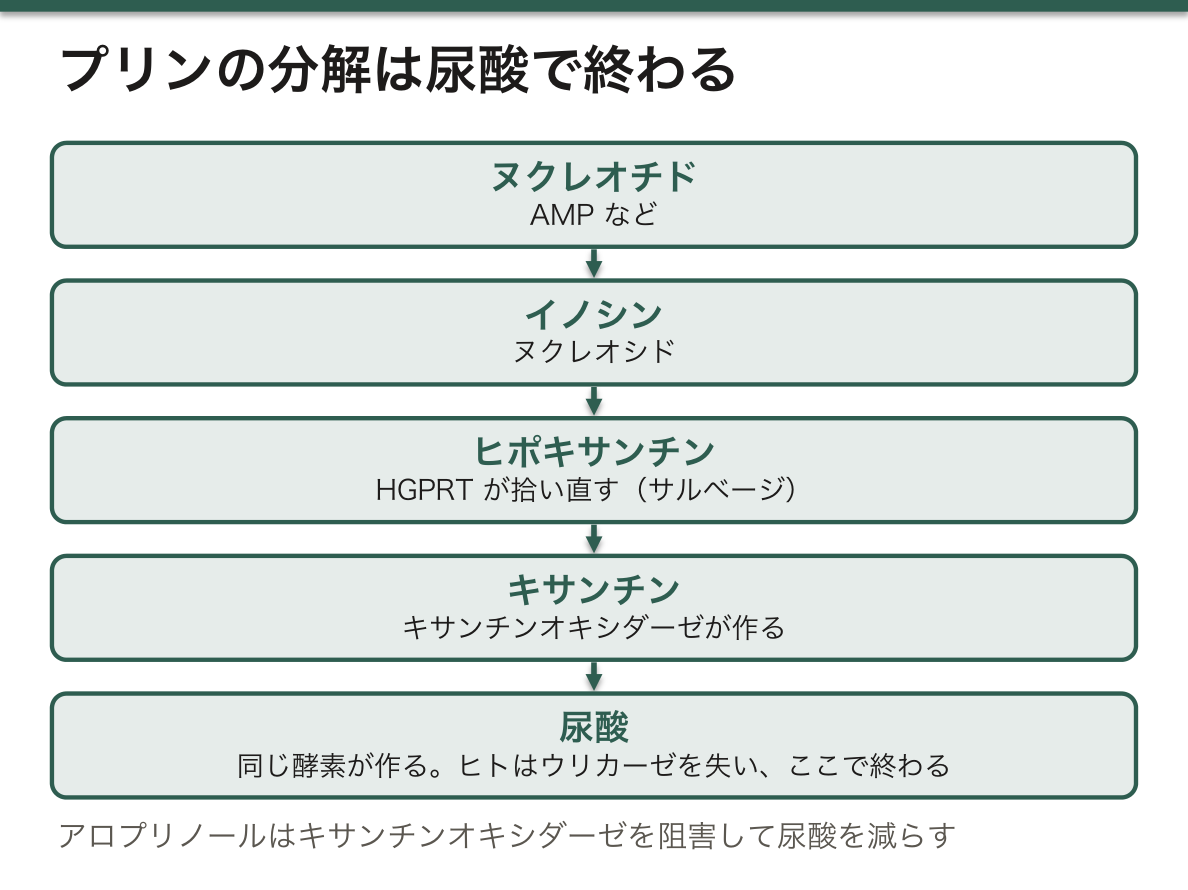
分解——ヌクレオチド → イノシン → ヒポキサンチン →(キサンチンオキシダーゼ)→ キサンチン → 尿酸。ヒトは尿酸を分解できない(ウリカーゼを失った)。
尿酸は水に溶けにくい——これが痛風のすべてである。血中濃度が飽和(約7 mg/dL)を超えると尿酸一ナトリウム結晶が析出する。低温と低pHで溶解度がさらに下がるため、体温の低い末梢の関節、とくに第1中足趾節関節(母趾)に好発する。
結晶を好中球が貪食するとNLRP3 インフラマソームが活性化し、IL-1β が放出されて激烈な急性炎症が起きる。コルヒチンは微小管を阻害して好中球の遊走・貪食を止める——尿酸値を下げるのではなく炎症を止める薬である点が重要で、発作時に尿酸降下薬を新規開始しないという原則もここから来る(尿酸値の急な変動が発作を誘発するため)。
偽痛風との鑑別は結晶の性質で決まる。尿酸=針状・負の複屈折、ピロリン酸カルシウム=菱形・正の複屈折。
Lesch-Nyhan 症候群——HGPRT の完全欠損(X連鎖潜性)。サルベージができないので、
- PRPP が消費されず溜まり、de novo 合成が暴走して尿酸が著増する
- 高尿酸血症・痛風・腎結石
- 知的障害・舞踏アテトーゼ・自傷行為(咬傷)——中枢のドパミン系障害による
治療は尿酸に対してはアロプリノール(キサンチンオキシダーゼ阻害)が効くが、神経症状には効かない——尿酸そのものが原因ではないためである。「同じ酵素欠損でも、症状ごとに機序が違えば治療も分かれる」ことを示す例。
English version
Core
De novo synthesis — PRPP is made from ribose 5-phosphate (from the pentose phosphate pathway) and the ring is assembled atom by atom on it. Rate-limiting: PRPP amidotransferase. Requires folate (THF).
Salvage — a degraded base is recombined with PRPP and picked up again.
- HGPRT — recovers hypoxanthine and guanine.
- APRT — recovers adenine.
Breakdown — nucleotide → inosine → hypoxanthine → (xanthine oxidase) → xanthine → uric acid. Humans cannot break down uric acid (we lost uricase).
Going further
Uric acid is poorly soluble — and that is the whole of gout. Above saturation in the blood (about 7 mg/dL) monosodium urate crystallises. Solubility falls further at low temperature and low pH, so it has a predilection for the cooler peripheral joints, above all the first metatarsophalangeal joint (the great toe).
When neutrophils phagocytose the crystals, the NLRP3 inflammasome is activated and IL-1β is released, producing a violent acute inflammation.
Colchicine inhibits the microtubules and stops the migration and phagocytosis of the neutrophil — it is a drug that stops the inflammation, not one that lowers the urate. This matters, and from it comes the rule not to start a urate-lowering drug during an attack (a sudden change in the urate level provokes one).
Pseudogout is distinguished by the properties of the crystal: urate = needle-shaped, negatively birefringent; calcium pyrophosphate = rhomboid, positively birefringent.
In the clinic
Lesch–Nyhan syndrome — complete deficiency of HGPRT (X-linked recessive). Salvage is impossible, so PRPP is not consumed and accumulates, de novo synthesis runs away and the urate rises markedly.
- Hyperuricaemia, gout, renal stones.
- Intellectual disability, choreoathetosis, self-mutilation (biting) — from a disorder of the central dopamine system.
Allopurinol (xanthine oxidase inhibition) works for the urate but not for the neurological features — because the urate itself is not their cause. An example showing that with the same enzyme deficiency, symptoms of different mechanism require different treatment.
ピリミジンと葉酸 — DNAを作る一歩
ピリミジンは先に環を作ってからリボースを付ける(プリンと順序が逆)。カルバミルリン酸から始まるが、こちらは細胞質の CPS-II(尿素回路の CPS-I はミトコンドリア)。
要となるのが dTMP の合成である。
dUMP →(チミジル酸合成酵素)→ dTMP。このときメチル基を渡すのがN5,N10-メチレンTHF(葉酸)で、葉酸は酸化されてジヒドロ葉酸になり、ジヒドロ葉酸還元酵素(DHFR)で再生される。
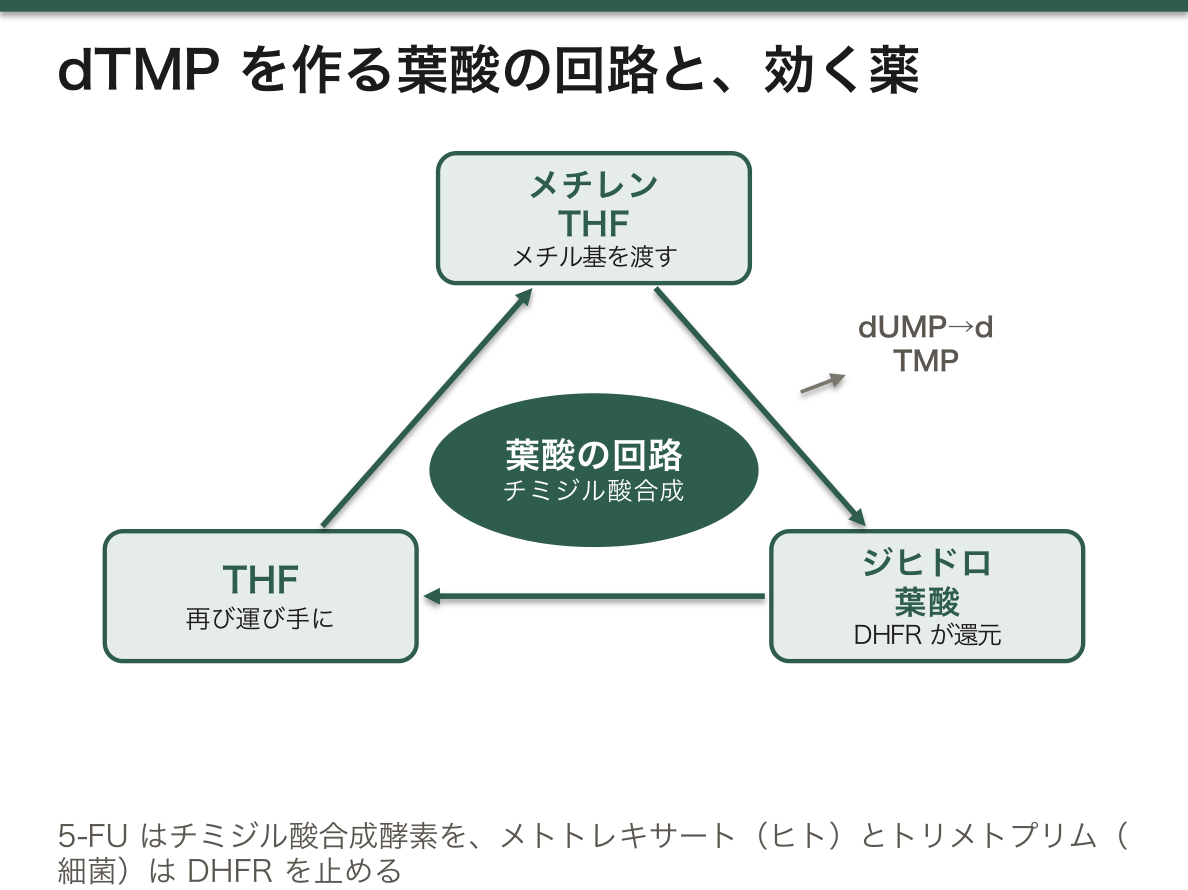
この1か所に薬が集中している。増殖する細胞はDNAを作るためにチミンを要するからである。
- メトトレキサート——DHFR を阻害(ヒト)。ロイコボリン(活性型葉酸)で救済できる
- トリメトプリム——細菌のDHFR を選択的に阻害
- サルファ剤——細菌の葉酸合成を阻害(ヒトは葉酸を作れず摂取するので効かない=選択毒性の根拠)
- 5-FU——チミジル酸合成酵素を阻害
- ヒドロキシウレア——リボヌクレオチド還元酵素を阻害
葉酸とビタミンB12 の欠乏がどちらも巨赤芽球性貧血を起こすのは、B12 がメチル基を葉酸へ受け渡す反応(メチオニン合成酵素)に必要で、B12 が無いと葉酸がメチルTHFの形で閉じ込められるためである(メチル葉酸トラップ)。
臨床上きわめて重要な帰結——B12欠乏に葉酸だけを投与すると、貧血は改善するが神経症状(亜急性連合性脊髄変性症)は進行する。B12 はもう一つの反応(メチルマロニルCoA ムターゼ)にも必要で、そちらは葉酸では代替できないためである。鑑別は血中メチルマロン酸——B12欠乏でのみ上昇する。
English version
Core
The pyrimidine ring is built first and the ribose added afterwards (the reverse order from the purines). It begins from carbamoyl phosphate, but here from the cytosolic CPS-II (the CPS-I of the urea cycle is mitochondrial).
The crux is the synthesis of dTMP. dUMP → (thymidylate synthase) → dTMP. The methyl group is handed over by N5,N10-methylene THF (folate), which is oxidised to dihydrofolate and regenerated by dihydrofolate reductase (DHFR).
Going further
The drugs are concentrated at this one point, because a proliferating cell needs thymine to make DNA.
- Methotrexate — inhibits human DHFR. Can be rescued with leucovorin (activated folate).
- Trimethoprim — selectively inhibits bacterial DHFR.
- Sulphonamides — inhibit bacterial folate synthesis (we cannot make folate and must eat it, so they do not affect us — the basis of the selective toxicity).
- 5-FU — inhibits thymidylate synthase.
- Hydroxyurea — inhibits ribonucleotide reductase.
Folate and B12 deficiency both give a megaloblastic anaemia because B12 is required for the reaction that hands the methyl group to folate (methionine synthase); without B12 the folate is trapped as methyl-THF (the methyl folate trap).
A consequence of the first clinical importance: give folate alone in B12 deficiency and the anaemia improves while the neurological disease (subacute combined degeneration) progresses. B12 is required for another reaction as well (methylmalonyl-CoA mutase), and folate cannot substitute there. The differential is the blood methylmalonic acid — raised only in B12 deficiency.
名前を正確に使う — 塩基・ヌクレオシド・ヌクレオチド
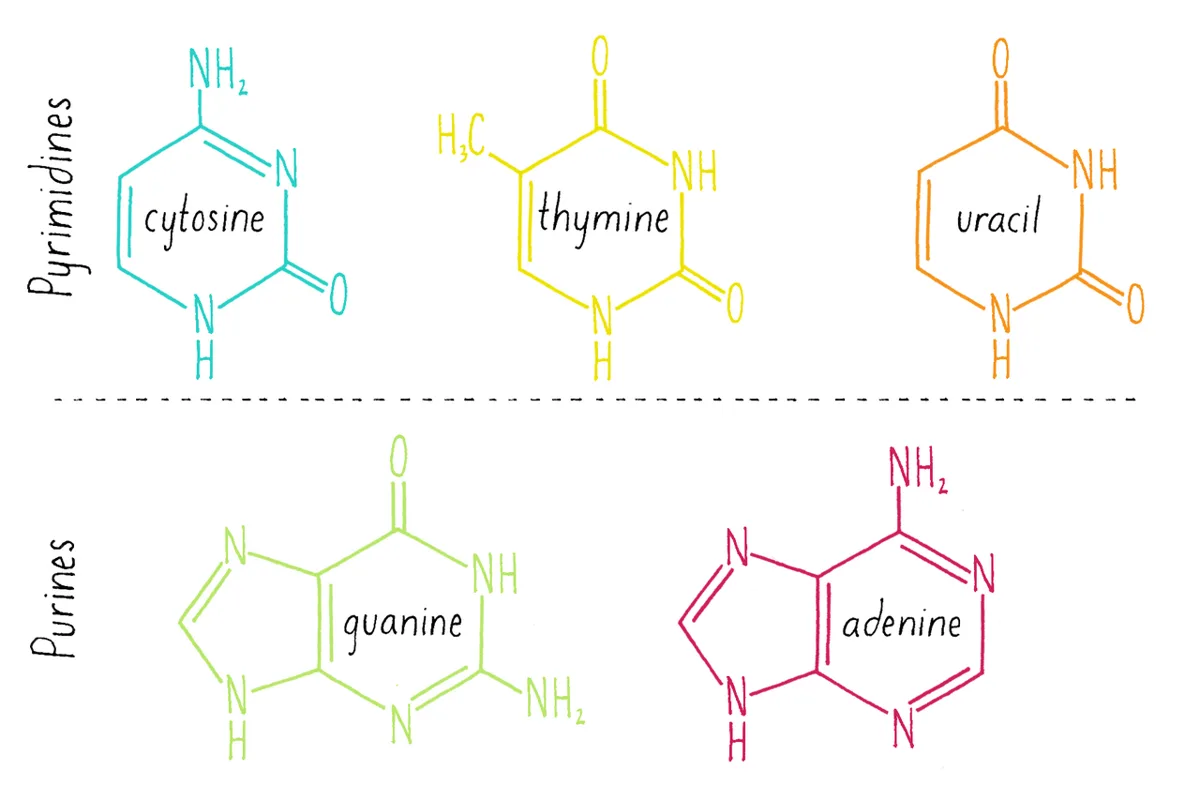
| 用語 | 中身 | 例 |
|---|---|---|
| 塩基 | プリンまたはピリミジン環のみ | アデニン・グアニン・シトシン・チミン・ウラシル |
| ヌクレオシド | 塩基+糖 | アデノシン・グアノシン・シチジン・チミジン・ウリジン |
| ヌクレオチド | 塩基+糖+リン酸 | AMP・ADP・ATP |
プリンは二環(アデニン・グアニン)、ピリミジンは単環(シトシン・チミン・ウラシル)。
DNA と RNA の違い——糖(デオキシリボース/リボース)と、塩基(チミン/ウラシル)。
ヌクレオチドは、核酸の材料以外の顔を持つ——エネルギー通貨(ATP)・補酵素(NAD⁺・FAD・CoA)・セカンドメッセンジャー(cAMP・cGMP)・信号(GTP)。
用語を正確に使えることが、薬の名前を読む力になる。核酸系の抗ウイルス薬は「ヌクレオシド類似体」で、細胞内でリン酸化されて初めて働く(抗ウイルス薬の章)——「なぜプロドラッグなのかが、名前の時点で分かる」。
ヌクレオチドのまま与えても細胞に入らないので、ヌクレオシドの形で投与する——「リン酸基が負電荷を持ち、膜を通れないからになる」。
補酵素の多くがヌクレオチドを含むことは、進化の名残とされる(補酵素の章)——「ビタミンB群の多くが、ヌクレオチドに組み込まれて働いている」。
チミンが DNA にしか無いことには、理由がある(DNA 修復の章)——「シトシンが脱アミノするとウラシルになる。ウラシルを『間違い』として見分けるために、DNA はチミンを使う」。
ATP が「通貨」と呼ばれるのは、加水分解のエネルギーが中くらいだからになる(代謝の見取り図の章)——「高すぎても低すぎても、受け渡しの仲介にならない」。
English version
Core
| Term | Contents | Examples |
|---|---|---|
| Base | The purine or pyrimidine ring alone | Adenine, guanine, cytosine, thymine, uracil |
| Nucleoside | Base + sugar | Adenosine, guanosine, cytidine, thymidine, uridine |
| Nucleotide | Base + sugar + phosphate | AMP, ADP, ATP |
Purines are bicyclic (adenine, guanine); pyrimidines monocyclic (cytosine, thymine, uracil). DNA and RNA differ in the sugar (deoxyribose / ribose) and in the base (thymine / uracil).
Nucleotides have faces other than being the material of nucleic acid — the energy currency (ATP), coenzymes (NAD⁺, FAD, CoA), second messengers (cAMP, cGMP) and signals (GTP).
Going further
Using the terms precisely is the ability to read the names of drugs. The nucleic acid antivirals are nucleoside analogues and work only after being phosphorylated within the cell — why they are prodrugs is evident from the name alone.
Given as a nucleotide they would not enter the cell, so they are given as nucleosides — the phosphate carries a negative charge and cannot cross the membrane.
That many coenzymes contain a nucleotide is regarded as a relic of evolution — most of the B vitamins work built into a nucleotide.
There is a reason thymine occurs only in DNA — deaminated cytosine becomes uracil, and DNA uses thymine so that uracil can be recognised as a mistake.
ATP is called the currency because the energy of its hydrolysis is intermediate — too high or too low and it could not act as the go-between.
リボヌクレオチド還元酵素 — DNA の材料を作る、唯一の道
デオキシリボヌクレオチドは、リボヌクレオチドの 2′ 位の OH を H に還元して作られる。この反応を行うのは、リボヌクレオチド還元酵素だけになる。
還元力はチオレドキシン(最終的には NADPH)から供給される。
厳密に調節されている——4種類のデオキシヌクレオチドが均等に揃うよう、アロステリック部位が2つあり、基質特異性と全体の活性を別々に決める。
ヒドロキシ尿素がこの酵素を阻害する。
チミジル酸だけは、さらに別の道が要る——dUMP →(チミジル酸合成酵素・葉酸)→ dTMP。
「4種類が均等でなければならない」という制約が、この酵素の複雑な調節を生んでいる。1つだけ多いと、DNA 合成の誤りが増える(変異の種類の章)——「プールの偏りそのものが、変異原になる」。
だから代謝拮抗薬は、この均衡を崩すことで効いている(核酸代謝を狙う薬の章)——「材料を絶つのではなく、比を狂わせる」。
ヒドロキシ尿素は、複数の疾患で使われる(造血器腫瘍の章)——「慢性骨髄性白血病・本態性血小板血症・真性多血症、そして鎌状赤血球症」。
鎌状赤血球症で効くのは、別の機序になる(鎌状赤血球症の章)——「胎児ヘモグロビン(HbF)の産生を増やし、鎌状化を妨げる」。
ヌクレオチドプールの異常は、先天性の免疫不全にもつながる(救済経路の異常の項)——「ADA 欠損症では、溜まった dATP がこの酵素を止めてリンパ球を殺す」。
English version
Core
Deoxyribonucleotides are made by reducing the 2′ OH of a ribonucleotide to H. Ribonucleotide reductase is the only enzyme that does it. The reducing power comes from thioredoxin (ultimately from NADPH).
It is tightly regulated — to keep the four deoxynucleotides in balance it has two allosteric sites, one setting the substrate specificity and one the overall activity.
Hydroxyurea inhibits this enzyme.
Thymidylate alone needs a further road — dUMP → (thymidylate synthase, folate) → dTMP.
Going further
The requirement that the four be in balance is what produces the complex regulation of this enzyme. An excess of one increases the errors of DNA synthesis — the imbalance of the pool is itself a mutagen.
So the antimetabolites work by upsetting that balance — not by cutting off the material but by distorting the ratio.
Hydroxyurea is used in several diseases — chronic myeloid leukaemia, essential thrombocythaemia, polycythaemia vera, and sickle cell disease.
In sickle cell disease it works by a different mechanism — it increases the production of fetal haemoglobin (HbF) and impedes sickling.
Abnormalities of the nucleotide pool also lead to inherited immunodeficiency — in ADA deficiency the accumulated dATP stops this enzyme and kills the lymphocytes.
尿酸は、ヒトでは抗酸化物質でもある
多くの哺乳類はウリカーゼを持っていて、尿酸をさらに分解して水に溶けやすいアラントインにする。ヒトと類人猿は、この酵素の遺伝子が壊れている(偽遺伝子になっている)。だから尿酸が最終産物になり、血中濃度が他の哺乳類の 10 倍近く高い。
この「壊れたまま残った」ことに意味があったと考えられている。尿酸は血漿の抗酸化能の半分以上を担う強い還元剤で、ヒトはビタミン C を作れない(グロノラクトン酸化酵素の欠損)ので、その穴を尿酸が埋めているという見方である。
つまり痛風は、抗酸化能と溶解度を引き換えにした結果である。
溶解度が、そのまま病態を決めている。尿酸の血中飽和濃度はおよそ 6.8 mg/dL。この線を超えると結晶化しうるので、治療目標が 6.0 mg/dL 未満に置かれている——根拠は統計ではなく物理化学である。
結晶ができやすい条件も溶解度で説明できる。
- 温度が低いと溶けにくい——足の母趾 MTP 関節(体温が最も低い末端)から始まる
- 酸性だと溶けにくい——尿が酸性だと尿酸結石ができる。だから尿をアルカリ化する(クエン酸製剤)
- 急な濃度の変動が発作を誘発する——上がるときだけでなく下げ始めにも起きるので、尿酸降下薬の開始時にはコルヒチンを併用する
ウリカーゼは薬になっている。ヒトが失った酵素を外から入れるという発想で、遺伝子組換えウリカーゼ(ラスブリカーゼ)が腫瘍崩壊症候群に使われる。既にある尿酸を直接分解できるので、産生を止めるだけのアロプリノールより速い。
⚠️ ラスブリカーゼは反応で過酸化水素を出すので、G6PD 欠損症では溶血を起こす。
尿酸値だけで痛風とは言えない。発作中はむしろ尿酸が下がることがあるので、確定は関節液の針状・負の複屈折の結晶で行う。
English version
Core
Most mammals have uricase and break uric acid down further to the more soluble allantoin. In humans and the apes that gene is broken (it has become a pseudogene). So uric acid is the end product, and the blood level is nearly ten times that of other mammals.
It is thought that leaving it broken had a purpose. Uric acid is a strong reducing agent providing more than half the antioxidant capacity of plasma, and humans cannot make vitamin C (we lack gulonolactone oxidase), so the view is that urate fills that gap.
That is, gout is the price paid for antioxidant capacity, traded against solubility.
Going further
Solubility decides the pathology directly. The saturation concentration is about 6.8 mg/dL. Above that line it can crystallise, which is why the target of treatment is set below 6.0 mg/dL — the basis is physical chemistry, not statistics.
The conditions that favour crystallisation are explained by solubility too.
- It dissolves less when cold — hence it begins at the first MTP joint of the foot (the coolest extremity).
- It dissolves less in acid — acid urine forms uric acid stones. So the urine is alkalinised (citrate preparations).
- A rapid change in concentration provokes an attack — not only a rise but the beginning of a fall, so colchicine is given alongside when a urate-lowering drug is started.
Uricase has become a drug. The idea of supplying from outside an enzyme we have lost: recombinant uricase (rasburicase) is used in tumour lysis syndrome. It can break down urate that is already there, and so works faster than allopurinol, which only stops production.
⚠️ Rasburicase releases hydrogen peroxide in the reaction and causes haemolysis in G6PD deficiency.
In the clinic
A urate level alone does not make the diagnosis of gout. During an attack it may in fact be low, so confirmation rests on the needle-shaped, negatively birefringent crystals in the joint fluid.
アデノシン — 分解産物が、そのまま体の信号になっている
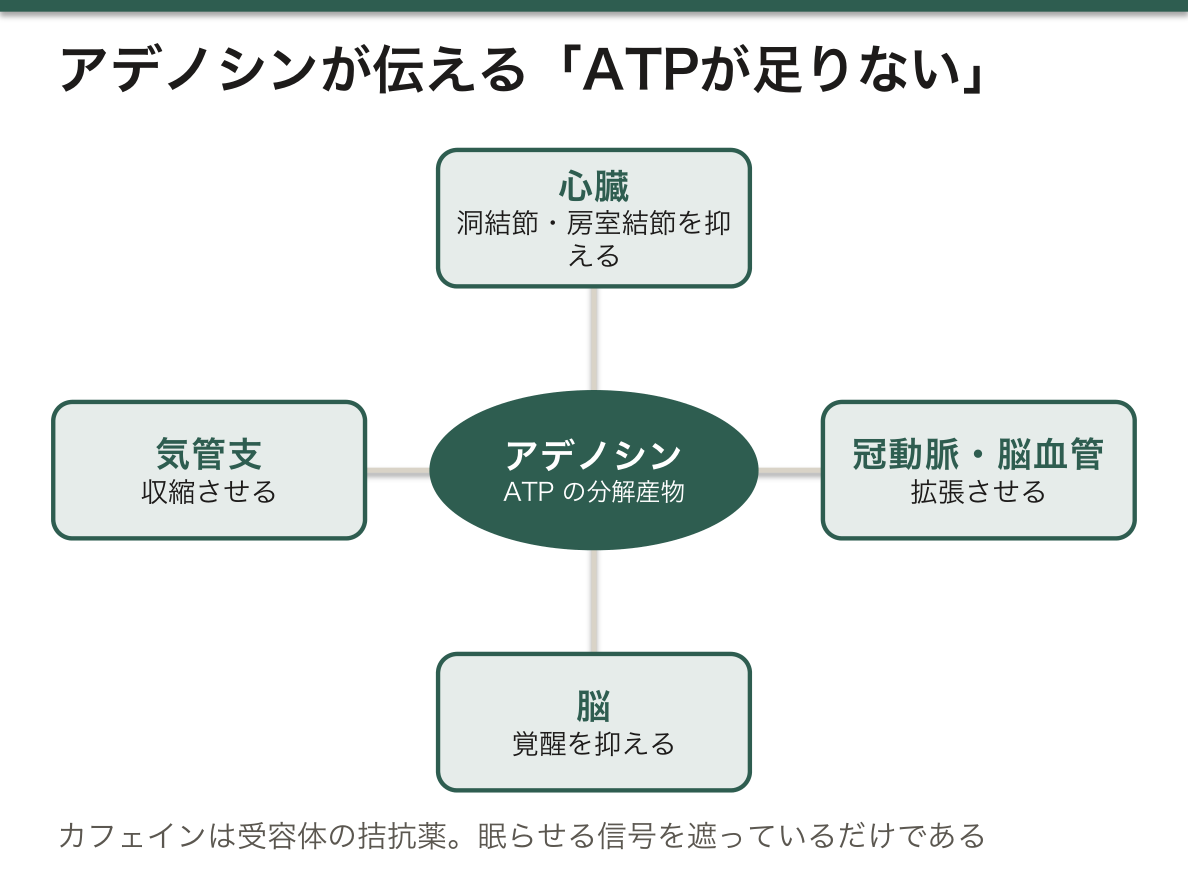
アデノシンは ATP の分解の途中にできる分子だが、細胞外では受容体に結合する信号物質として働く。「ATP が足りない」という状態が、そのまま外に伝わる仕組みになっている。
- 心臓——洞結節と房室結節を抑える。心拍が落ちる
- 冠動脈・脳血管——拡張させる。酸素が足りない場所に血を増やすという理にかなった反応
- 脳——覚醒を抑える。溜まるほど眠くなる
- 気管支——収縮させる(喘息では不利に働く)
カフェインはアデノシン受容体の拮抗薬である。眠気が飛ぶのは、覚醒物質を足しているのではなく眠らせる信号を遮っているだけである。
この性質が、そのまま3つの薬の使い方になっている。
| アデノシン静注 | 発作性上室頻拍を止める | 房室結節を数秒だけ完全に遮断する。半減期が 10 秒未満なので急速静注し、すぐ後押しの生食を入れる |
| 負荷心筋シンチ | 運動できない患者の心筋血流を評価する | 正常な冠動脈だけが拡張し、狭窄部の先は拡張できない。灌流の差を作り出す(冠盗流現象) |
| ジピリダモール | アデノシンの取り込みを阻害して濃度を上げる | 同じ理由で負荷試験に使う。喘息では気管支が締まるので禁忌 |
アデノシン静注の副作用は、そのまま作用の裏返しである——顔面紅潮(血管拡張)・胸部絞扼感・一過性の心停止・気管支攣縮。数秒で消えることを事前に説明しておく。
⚠️ 相互作用が大きい。ジピリダモールを飲んでいる患者ではアデノシンの効果が強く出すぎ、テオフィリンやカフェインを摂っていると効かない(同じ受容体を奪い合うため)。負荷試験の前にカフェインを止めるよう指示するのはこのためである。
アデノシンで頻拍が止まらなくても無駄ではない。房室結節が一瞬止まったあいだに心房の波が見えるので、心房粗動などの診断がつくことがある。
English version
Core
Adenosine is a molecule formed along the way in the breakdown of ATP, but outside the cell it acts as a signal binding to receptors. The state "ATP is running short" is thereby transmitted outwards.
- Heart — suppresses the sinuatrial and atrioventricular nodes. The rate falls.
- Coronary and cerebral vessels — dilates them. A reasonable response: more blood where oxygen is short.
- Brain — suppresses arousal. The more it accumulates, the sleepier one becomes.
- Bronchi — constricts them (unhelpful in asthma).
Caffeine is an adenosine receptor antagonist. Sleepiness lifts not because a wakefulness substance has been added but because the signal to sleep has been blocked.
Going further
This property is directly the use of three drugs.
| What it does | How | |
|---|---|---|
| Intravenous adenosine | Terminates paroxysmal supraventricular tachycardia | Blocks the AV node completely for a few seconds. Its half-life is under 10 seconds, so it is given as a rapid bolus followed immediately by a saline flush |
| Stress myocardial perfusion imaging | Assesses perfusion in a patient who cannot exercise | Only normal coronary arteries dilate; beyond a stenosis they cannot. This creates the difference in perfusion (coronary steal) |
| Dipyridamole | Raises the concentration by blocking the uptake of adenosine | Used in stress testing for the same reason. Contraindicated in asthma, since it constricts the bronchi |
The adverse effects of intravenous adenosine are simply the reverse of its action — flushing (vasodilatation), chest tightness, transient asystole, bronchospasm. Explain beforehand that they pass in seconds.
⚠️ The interactions are large. In a patient on dipyridamole the effect is excessive; in one taking theophylline or caffeine it does not work (they compete for the same receptor). This is why caffeine is stopped before a stress test.
In the clinic
Adenosine is not wasted even when it fails to terminate the tachycardia. In the moment the AV node is blocked, the atrial waves become visible and a diagnosis such as atrial flutter may be made.
まとめ
| プリンの合成と分解 — 尿酸で終わる | de novo 合成——リボース5リン酸(ペントースリン酸経路由来)から PRPP を作り、そこへ原子を1つずつ足して環を組む。 |
|---|---|
| ピリミジンと葉酸 — DNAを作る一歩 | ピリミジンは先に環を作ってからリボースを付ける(プリンと順序が逆)。 |
| 名前を正確に使う — 塩基・ヌクレオシド・ヌクレオチド | 用語中身例塩基プリンまたはピリミジン環のみアデニン・グアニン・シトシン・チミン・ウラシルヌクレオシド塩基+糖アデノシン・グアノシン・シチジン・チミジン・ウリジンヌクレオチド塩基+糖… |
| リボヌクレオチド還元酵素 — DNA の材料を作る、唯一の道 | デオキシリボヌクレオチドは、リボヌクレオチドの 2' 位の OH を H に還元して作られる。 |
| 尿酸は、ヒトでは抗酸化物質でもある | 多くの哺乳類はウリカーゼを持っていて、尿酸をさらに分解して水に溶けやすいアラントインにする。 |
| アデノシン — 分解産物が、そのまま体の信号になっている | アデノシンは ATP の分解の途中にできる分子だが、細胞外では受容体に結合する信号物質として働く。 |
このノートは医学生が授業の内容を自分の言葉でまとめたもので、診療の判断に使うものではありません。誤りに気づいたらお知らせください。