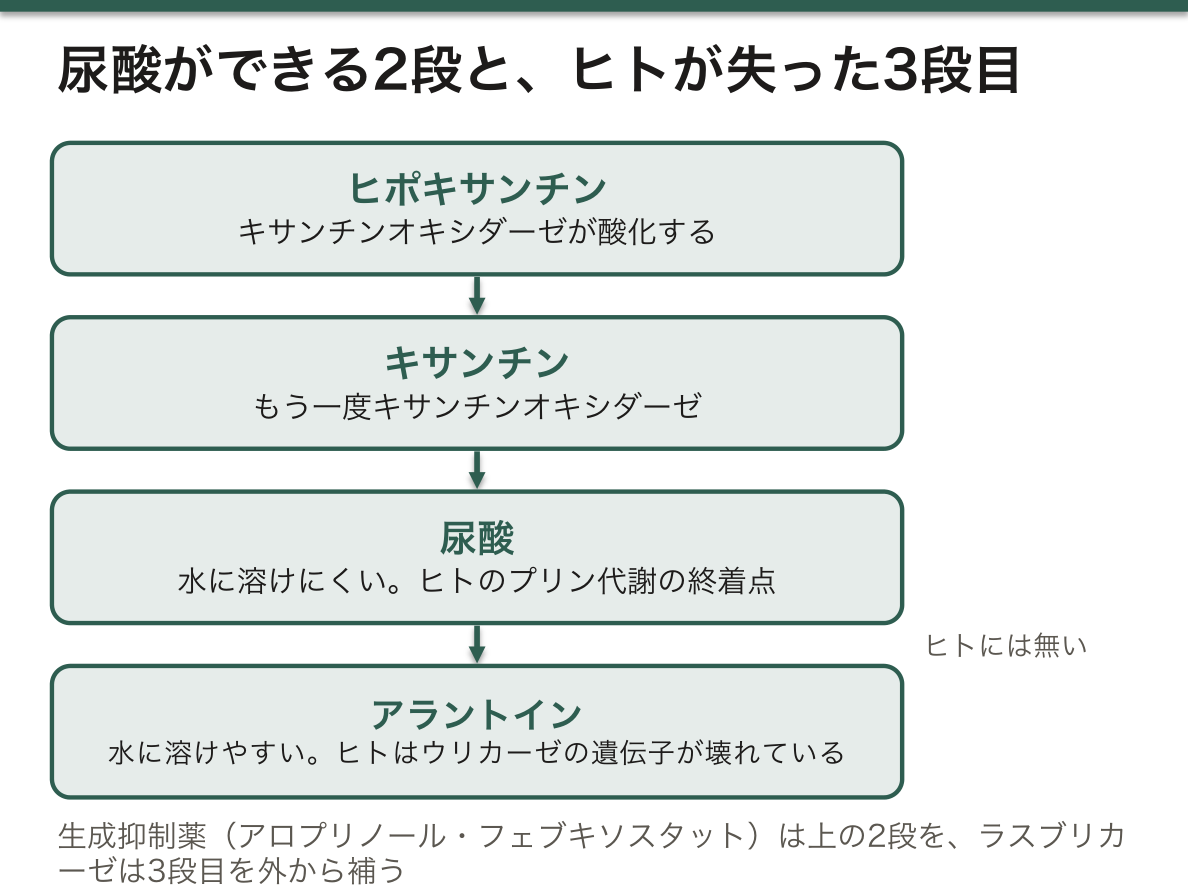
ヒトは尿酸オキシダーゼ(ウリカーゼ)を失った種である。多くの哺乳類は尿酸をさらに分解して水に溶けやすいアラントインにするが、ヒトと類人猿はその酵素の遺伝子が壊れている。
だからプリン代謝の終着点が、水に溶けにくい尿酸のままになる。痛風という病気は、この進化上の事故の上に成り立っている。
- 高尿酸血症 — 作りすぎと、捨てられないの2通り
- 救済経路の異常 — Lesch-Nyhan症候群とADA欠損症
- 尿酸塩結晶が炎症を起こす道筋 — 溶けなくなった分子が、免疫を起動する
- 尿酸を下げる薬 — 作らせないか、捨てさせるか
- 無症候性の高尿酸血症を、薬で下げるべきか
- 尿酸を上げているのは、しばしば薬である
高尿酸血症 — 作りすぎと、捨てられないの2通り
尿酸が上がる原因は2つに分かれる。
| 産生過剰型 | 排泄低下型 | |
|---|---|---|
| 割合 | 約10〜20% | 約60%(日本人に多い) |
| 尿中尿酸 | 多い | 少ない |
| 原因 | 細胞の崩壊(腫瘍崩壊症候群・溶血)・Lesch-Nyhan症候群・糖原病I型・過食と飲酒 | 腎機能低下・利尿薬・脱水・乳酸やケトン体との競合 |
| 薬 | アロプリノール・フェブキソスタット | ベンズブロマロン・プロベネシド |
- 尿酸生成の最終2段階はどちらもキサンチンオキシダーゼ:ヒポキサンチン → キサンチン → 尿酸
- アルコールは3方向から尿酸を上げる——プリン体そのもの、乳酸による排泄阻害、ATP消費による分解亢進
「乳酸やケトン体が尿酸の排泄を妨げる」のは、近位尿細管の有機アニオン輸送体を奪い合うためである。ここから、一見無関係な現象がまとめて説明できる。
- 飢餓・絶食で尿酸が上がる(ケトン体)
- 激しい運動の後に上がる(乳酸)
- 脱水で上がる(尿細管での再吸収が増える)
- 糖尿病性ケトアシドーシスで上がる
痛風発作は「尿酸値が高いこと」ではなく「動いたこと」で起きる。結晶が新たに析出するか、既存の結晶が剥がれ落ちると、好中球が貪食してインフラマソームが活性化し、インターロイキン1βが出る。だから尿酸を急に下げ始めた時期にも発作が起きる——発作中に尿酸降下薬を新規に開始しないという原則の根拠がここにある。
コルヒチンが効く理由も機序どおりである。微小管の重合を阻害して好中球の遊走と貪食を止める。尿酸値は下げない。
腎への影響は2種類ある。
- 尿酸結石——X線透過性で単純撮影に写らない。尿をアルカリ化すると溶ける(クエン酸製剤)
- 急性尿酸性腎症——腫瘍崩壊症候群で大量の尿酸が尿細管に析出する。予防にはラスブリカーゼ(遺伝子組換えの尿酸オキシダーゼ、つまりヒトが失った酵素を外から与える)
English version
Core
The causes of a raised urate divide into two.
| Overproduction | Underexcretion | |
|---|---|---|
| Proportion | About 10–20 per cent | About 60 per cent (commoner in Japanese people) |
| Urinary urate | High | Low |
| Causes | Cell breakdown (tumour lysis syndrome, haemolysis), Lesch–Nyhan syndrome, glycogen storage disease type I, overeating and alcohol | Reduced renal function, diuretics, dehydration, competition with lactate and ketone bodies |
| Drugs | Allopurinol, febuxostat | Benzbromarone, probenecid |
- The last two steps of urate production are both by xanthine oxidase: hypoxanthine → xanthine → urate.
- Alcohol raises urate from three directions — the purines themselves, impairment of excretion by lactate, and increased degradation from ATP consumption.
Going further
That lactate and ketone bodies impede the excretion of urate is because they compete for the organic anion transporters of the proximal tubule. From this, phenomena that look unrelated can be explained together.
- Urate rises with starvation and fasting (ketone bodies).
- It rises after hard exercise (lactate).
- It rises with dehydration (reabsorption in the tubule increases).
- It rises in diabetic ketoacidosis.
A gout attack occurs not because "the urate is high" but because it moved. When crystals precipitate anew, or existing crystals are shed, neutrophils phagocytose them, the inflammasome is activated and interleukin 1β is released. Hence attacks also occur in the period when the urate has just begun to be lowered — here is the ground for the principle not to start a urate-lowering drug during an attack.
The reason colchicine works follows the mechanism too. It inhibits the polymerisation of microtubules and stops the migration and phagocytosis of neutrophils. It does not lower the urate.
The effects on the kidney are of two kinds.
- Urate stones — radiolucent, invisible on a plain film. They dissolve if the urine is alkalinised (citrate preparations).
- Acute urate nephropathy — in tumour lysis syndrome a great deal of urate precipitates in the tubules. Rasburicase for prevention (recombinant urate oxidase — that is, giving from outside the enzyme humans have lost).
救済経路の異常 — Lesch-Nyhan症候群とADA欠損症
プリンヌクレオチドの作り方は2通りある。
- 新生経路——一から作る。エネルギーを多く使う
- 救済経路——分解産物を再利用する。脳では救済経路への依存が高い
Lesch-Nyhan症候群:ヒポキサンチングアニンホスホリボシルトランスフェラーゼの欠損。X連鎖潜性。
- 高尿酸血症(救済されないプリンが尿酸へ流れる)
- 脳性麻痺様の運動障害・不随意運動
- 自傷行為(口唇や指を噛む)——この疾患に特徴的
- 治療はアロプリノールで尿酸は下げられるが、神経症状には効かない
アデノシンデアミナーゼ欠損症:重症複合免疫不全症の原因の一つ。デオキシアデノシンが溜まり、リンパ球のDNA合成を止める。
なぜ救済経路の欠損で神経症状が出るのか。脳は新生経路の活性が低く、救済経路に強く依存している。ヒポキサンチングアニンホスホリボシルトランスフェラーゼが無いと、脳のプリンヌクレオチド供給が落ち、特に基底核のドパミン系が育たない。尿酸が高いことと神経症状は、原因が別である——だからアロプリノールでは神経症状が治らない。
自傷行為は「痛みを感じないから」ではない。患者は痛みを感じており、自分を傷つけたくないと訴えながら止められない。強迫的な運動障害として理解されている。この事実は、家族への説明と身体拘束の是非を考えるときに決定的に重要である。
アデノシンデアミナーゼ欠損症がリンパ球だけを侵す理由も明快である。この酵素が無いとデオキシアデノシンからデオキシATPが蓄積し、リボヌクレオチド還元酵素を阻害してDNA合成が止まる。リンパ球は分裂が盛んで、かつこの経路の代謝回転が最も速い細胞なので、真っ先に脱落する。
この疾患は医学史上の節目でもある。ヒトで最初に遺伝子治療が試みられた疾患であり、現在は造血幹細胞遺伝子治療が承認されている。新生児マススクリーニングで重症複合免疫不全症を拾う仕組み(T細胞受容体除去環の測定)も整いつつある——移植や遺伝子治療は早いほど成績が良いためである。
English version
Core
There are two ways of making purine nucleotides.
- The de novo pathway — making them from scratch. It uses much energy.
- The salvage pathway — reusing the products of degradation. The brain depends heavily on salvage.
Lesch–Nyhan syndrome: deficiency of hypoxanthine-guanine phosphoribosyltransferase. X-linked recessive.
- Hyperuricaemia (unsalvaged purine runs to urate).
- Motor disability resembling cerebral palsy, involuntary movements.
- Self-injury (biting the lips and fingers) — characteristic of this disease.
- Treatment: allopurinol lowers the urate but does not help the neurological signs.
Adenosine deaminase deficiency: one cause of severe combined immunodeficiency. Deoxyadenosine accumulates and stops DNA synthesis in lymphocytes.
Going further
Why does a defect of the salvage pathway give neurological signs? The brain has low de novo activity and depends strongly on salvage. Without hypoxanthine-guanine phosphoribosyltransferase, the supply of purine nucleotides to the brain falls and the dopaminergic system of the basal ganglia in particular fails to develop. The high urate and the neurological signs have different causes — hence allopurinol does not cure the neurological disease.
The self-injury is not "because they feel no pain". The patient feels pain and cannot stop while pleading not to want to hurt themselves. It is understood as a compulsive movement disorder. This fact is decisive when explaining to the family and considering whether to restrain.
Why adenosine deaminase deficiency attacks only lymphocytes is also plain. Without this enzyme, deoxyATP accumulates from deoxyadenosine, inhibits ribonucleotide reductase and stops DNA synthesis. The lymphocyte divides actively and has the fastest turnover in this pathway, so it is the first to fall.
This disease is also a landmark in medical history. It was the first disease in which gene therapy was attempted in humans, and haematopoietic stem cell gene therapy is now approved. A means of picking up severe combined immunodeficiency in newborn mass screening (measurement of T-cell receptor excision circles) is also being put in place — because transplantation and gene therapy do better the earlier they are done.
尿酸塩結晶が炎症を起こす道筋 — 溶けなくなった分子が、免疫を起動する
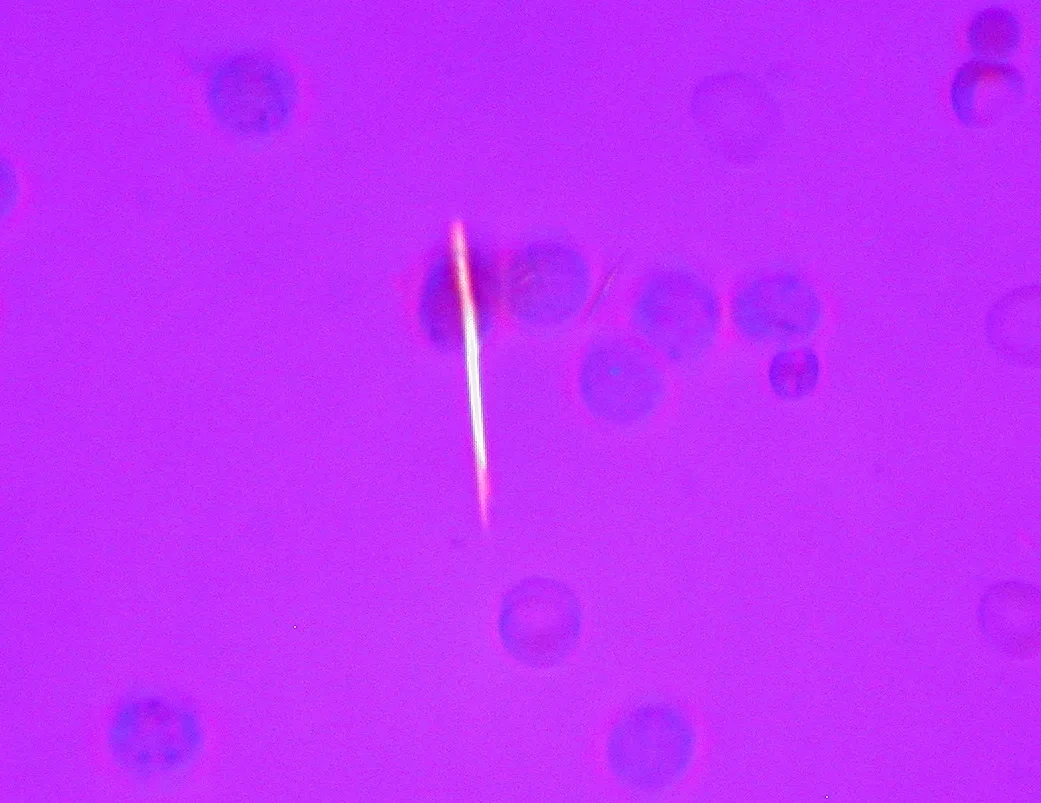
尿酸は血中で 6.8 mg/dL を超えると飽和し、結晶として析出する。
析出しやすい条件——低い温度・低い pH・組織の損傷。だから最も冷えやすく、動きの多い第1中足趾節関節から始まる(痛風結節・podagra)。
炎症の道筋——結晶をマクロファージが貪食 → NLRP3 インフラマソームが活性化 → カスパーゼ1 → IL-1β の放出 → 好中球が集まる。
関節液の偏光顕微鏡——針状・負の複屈折。細胞内に取り込まれた像が診断になる。
ピロリン酸カルシウム(偽痛風)は、菱形・正の複屈折で区別する。
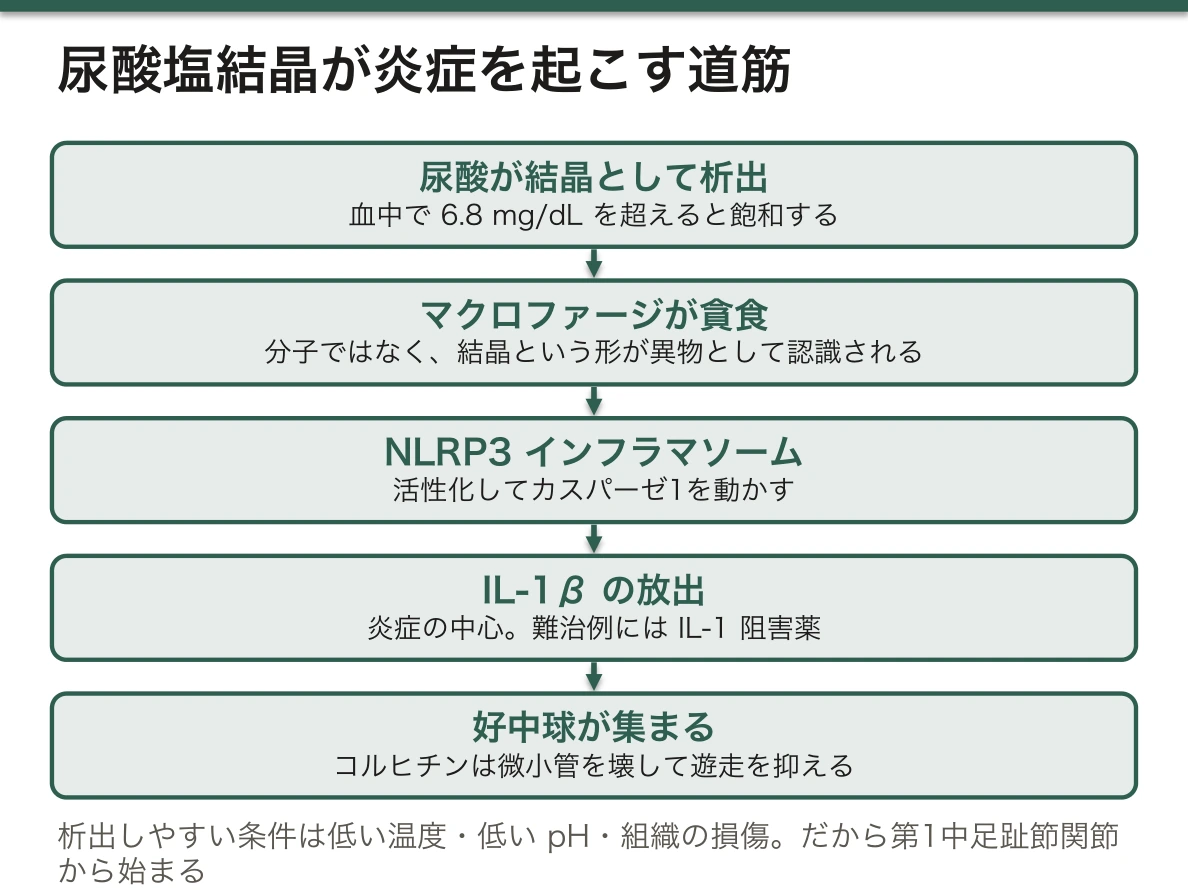
「溶解度を超えた」という物理の話が、免疫の話に変わる場所がこの項になる。異物として認識されるのは、分子そのものではなく結晶という形になる(自然免疫のセンサーの章)——「同じ尿酸でも、溶けていれば炎症は起きない」。
だから尿酸値を急に下げると、かえって発作が起きる。濃度が動くと沈着した結晶が溶け出したり新たに析出したりして、免疫が反応する(高尿酸血症の章)——「発作中に尿酸降下薬を始めない、始めたら中断しない」。
IL-1β が中心であることは、そのまま治療の選択肢になる。コルヒチンは微小管を壊して好中球の遊走とインフラマソームを抑え、難治例には IL-1 阻害薬が使われる(抗炎症薬の章)——「痛み止めではなく、炎症の起点を止めている」。
同じ NLRP3 の経路が、他の病気にも顔を出す。ピロリン酸カルシウム・コレステロール結晶・シリカ・アスベスト・アミロイドβ も同じ経路を踏む(炎症を動かす分子の章)——「結晶や凝集体という形が、共通の危険信号になっている」。
発作が夜間から明け方に多いのも、この物理から説明できる——「就寝中に末梢が冷え、脱水も進むので、溶解度が下がる」。
English version
Core
Urate saturates in the blood above 6.8 mg/dL and precipitates as crystals.
Conditions favouring precipitation — low temperature, low pH, tissue damage. Hence it begins at the first metatarsophalangeal joint, the coolest and most used (podagra).
The path of the inflammation — a macrophage phagocytoses the crystal → the NLRP3 inflammasome is activated → caspase 1 → release of IL-1β → neutrophils gather.
Polarised microscopy of joint fluid — needle-shaped, negatively birefringent. The image of one taken into a cell is the diagnosis.
Calcium pyrophosphate (pseudogout) is distinguished as rhomboid and positively birefringent.
Going further
- This section is where a matter of physics, "the solubility was exceeded", turns into a matter of immunity. What is recognised as foreign is not the molecule itself but the form of a crystal (the chapter on the sensors of innate immunity) — the same urate, dissolved, causes no inflammation.
- Hence lowering the urate suddenly brings on an attack instead. As the concentration moves, deposited crystals dissolve or new ones precipitate and immunity responds (the chapter on hyperuricaemia) — do not start a urate-lowering drug during an attack; if it has been started, do not interrupt it.
- That IL-1β is central becomes, directly, the choice of treatment. Colchicine breaks the microtubules and suppresses neutrophil migration and the inflammasome, and in refractory cases an IL-1 inhibitor is used (the chapter on anti-inflammatory drugs) — stopping the starting point of the inflammation rather than the pain.
- The same NLRP3 pathway appears in other diseases. Calcium pyrophosphate, cholesterol crystals, silica, asbestos and amyloid β all tread the same path (the chapter on the molecules that drive inflammation) — the form of a crystal or an aggregate being a common danger signal.
- That attacks are commonest from the night into the early hours is explained by the same physics — the periphery cools during sleep and dehydration advances, so the solubility falls.
尿酸を下げる薬 — 作らせないか、捨てさせるか
血清尿酸は、産生と排泄の差で決まる。薬もその2つに分かれる。
| 種類 | 薬 | 作用点 |
|---|---|---|
| 尿酸生成抑制薬 | アロプリノール・フェブキソスタット | キサンチンオキシダーゼ |
| 尿酸排泄促進薬 | ベンズブロマロン・プロベネシド・ドチヌラド | 近位尿細管の URAT1(再吸収の輸送体) |
| 尿酸分解酵素 | ラスブリカーゼ | 尿酸をアラントインへ分解(ヒトには無い酵素) |
選び方——尿中尿酸排泄量を測り、産生過剰型か排泄低下型かで決める。尿路結石がある人には排泄促進薬を使わない。
治療の目標は 6.0 mg/dL 以下。
キサンチンオキシダーゼを止めることは、他の薬の代謝も止めることになる。アザチオプリンと 6-メルカプトプリンは、この酵素で分解される(核酸代謝を狙う薬の章)——「併用すると骨髄抑制が起こる。避けるか、大幅に減量する」。
腫瘍崩壊症候群では、産生の速さが桁違いになる。大量の細胞が一度に壊れ、核酸・カリウム・リンが放出される。高尿酸・高カリウム・高リン・低カルシウム・急性腎障害(造血器腫瘍の章)——「治療がよく効くほど起こる合併症になる」。
だからここではラスブリカーゼが要る。すでにある尿酸を壊せるのはこの薬だけで、生成抑制薬は「これから作られる分」しか止められない——「時間の向きが違う薬を、使い分けている」。
ただし G6PD 欠損症では禁忌になる。分解の過程で過酸化水素ができ、還元できずに溶血する(活性酸素の章)——「酵素を足す治療が、別の酵素の欠損で害になる」。
アロプリノールの重症薬疹(Stevens-Johnson 症候群・DIHS)は HLA-B*58:01 と強く関連する(薬物代謝の個人差の項)——「無症候性高尿酸血症に安易に出さない理由の1つになる」。
English version
Core
The serum urate is set by the difference of production and excretion, and the drugs divide the same way.
| Class | Drug | Point of action |
|---|---|---|
| Urate synthesis inhibitors | Allopurinol, febuxostat | Xanthine oxidase |
| Uricosurics | Benzbromarone, probenecid, dotinurad | URAT1 of the proximal tubule (the reabsorption transporter) |
| Urate-degrading enzyme | Rasburicase | Degrades urate to allantoin (an enzyme humans do not have) |
Choosing between them — measure the urinary urate excretion and decide by overproduction or underexcretion. Do not use a uricosuric in someone with urinary stones.
The target of treatment is 6.0 mg/dL or below.
Going further
- Stopping xanthine oxidase also stops the metabolism of other drugs. Azathioprine and 6-mercaptopurine are degraded by this enzyme (the chapter on drugs aimed at nucleic acid metabolism) — given together, marrow suppression follows. Avoid the combination or reduce the dose greatly.
- In tumour lysis syndrome the speed of production is of another order. A great many cells break at once and nucleic acid, potassium and phosphate are released. High urate, high potassium, high phosphate, low calcium, acute kidney injury (the chapter on haematological malignancy) — a complication that occurs the better the treatment works.
- Hence rasburicase is needed here. It is the only drug that can destroy the urate already present; a synthesis inhibitor stops only what is yet to be made — drugs pointing in different directions in time, used for different purposes.
- But it is contraindicated in G6PD deficiency. Hydrogen peroxide is formed in the degradation and, unable to be reduced, causes haemolysis (the chapter on reactive oxygen) — a treatment that adds an enzyme doing harm through the deficiency of another.
- Severe drug eruptions with allopurinol (Stevens–Johnson syndrome, DIHS) are strongly associated with HLA-B*58:01 (the section on individual variation in drug metabolism) — one of the reasons not to prescribe casually in asymptomatic hyperuricaemia.
無症候性の高尿酸血症を、薬で下げるべきか
健診で尿酸が高い人は多い。症状が無いまま数値だけ高い状態を、どこまで治療するかは長く議論されてきた。
分かっていること。
- 尿酸値が高いほど、痛風発作を起こす確率は上がる。ただし高尿酸血症の人の大半は、生涯発作を起こさない
- 高尿酸血症は高血圧・慢性腎臓病・心血管疾患と強く相関する
- しかし、尿酸を薬で下げても、腎機能や心血管イベントが改善するという明確な証拠は無い——複数の無作為化試験で否定的な結果が出ている
相関はあるが、下げても良くならない——HDL やホモシステインと同じ構図である。肥満・インスリン抵抗性・利尿薬・腎機能低下が共通の背景として尿酸を押し上げている、という説明が有力になっている。
だから治療の判断は、数値ではなく「何が起きているか」で決める。
| 治療する | 痛風発作を繰り返す/痛風結節がある/尿酸結石がある/腫瘍崩壊症候群の予防 | 利益がはっきりしている |
| 状況で考える | 著しい高値(おおむね 9 mg/dL 以上)が続く | 日本のガイドラインは治療を考慮するとしているが、国際的には一致していない |
| まず生活を見る | それ以外 | 体重・飲酒・利尿薬・果糖の摂取。背景の是正が本筋になる |
⚠️ 薬に固有の危険も、判断に入れる。アロプリノールは重症薬疹(Stevens-Johnson 症候群・DIHS)を起こしうる。HLA-B*58:01 をもつ人でリスクが高く、台湾・韓国・タイでは投与前の検査が推奨されている(日本人での保有率は数 % と低い)。症状の無い人に、致死的な副作用のある薬を出すという構図になることを意識する。
発作の予防にも順序がある。尿酸を急に下げると、かえって発作が誘発される(結晶が溶け出すため)。だから少量から始めてゆっくり増やし、数か月はコルヒチンを併用する。発作の最中に尿酸降下薬を新規に始めない——すでに飲んでいる場合は、中断せずに続ける。
健診で「尿酸が高い」と言われて来た患者には、発作の既往・結石・薬・飲酒・体重を聞く。数値だけで処方しない。
English version
Core
Many people are found to have a high urate at a health check. How far to treat a state in which only the number is high and there are no symptoms has long been debated.
What is known.
- The higher the urate, the greater the probability of a gout attack. But most people with hyperuricaemia never have an attack in their lifetime.
- Hyperuricaemia correlates strongly with hypertension, chronic kidney disease and cardiovascular disease.
- But there is no clear evidence that lowering the urate with a drug improves renal function or cardiovascular events — several randomised trials have been negative.
There is a correlation and lowering it does not help — the same structure as HDL and homocysteine. The leading explanation is that obesity, insulin resistance, diuretics and reduced renal function are the common background driving the urate up.
Going further
So the decision to treat is made not on the number but on what is happening.
| Treat | Repeated gout attacks / a tophus / urate stones / prevention of tumour lysis syndrome | The benefit is clear |
| Judge by the situation | A markedly high value (roughly 9 mg/dL or more) that persists | The Japanese guideline says to consider treatment; internationally there is no agreement |
| Look at the way of living first | Everything else | Weight, alcohol, diuretics, fructose intake. Correcting the background is the main line |
⚠️ Include the drug’s own risk in the judgement. Allopurinol can cause severe drug eruptions (Stevens–Johnson syndrome, DIHS). The risk is high in people carrying HLA-B*58:01, and testing before prescribing is recommended in Taiwan, Korea and Thailand (the frequency in Japanese people is a few per cent, which is low). Be aware of the structure: giving a drug with a potentially fatal adverse effect to someone with no symptoms.
Prevention of attacks has an order too. Lower the urate suddenly and an attack is provoked instead (the crystals dissolve out). So start at a small dose, increase slowly, and give colchicine alongside for some months. Do not start a urate-lowering drug during an attack — if one is already being taken, continue it without interruption.
In the clinic
In a patient who comes because a health check said "the urate is high", ask about past attacks, stones, drugs, alcohol and weight. Do not prescribe on the number alone.
尿酸を上げているのは、しばしば薬である
高尿酸血症の原因を探すとき、体質と食事より先に、薬と病態を見るほうが実りが多い。
| 利尿薬 | サイアザイド・ループ利尿薬 | 循環血液量が減ると近位尿細管の再吸収が増える。頻度が最も高い |
| 低用量アスピリン | 尿酸の排泄を抑える | 高用量では逆に排泄を促す——用量で向きが変わる |
| 免疫抑制薬 | シクロスポリン・タクロリムス | 移植後の高尿酸血症と痛風の主因 |
| 抗結核薬 | ピラジナミド・エタンブトール | 尿酸の排泄を強く抑える。治療中の関節痛の原因になる |
| 細胞が壊れる治療 | 抗癌剤・放射線 | 腫瘍崩壊症候群。予防が要る |
共通する機序は2つしかない——作りすぎ(核酸の分解)と捨てられない(尿細管での再吸収の亢進)。薬はほとんどが後者である。
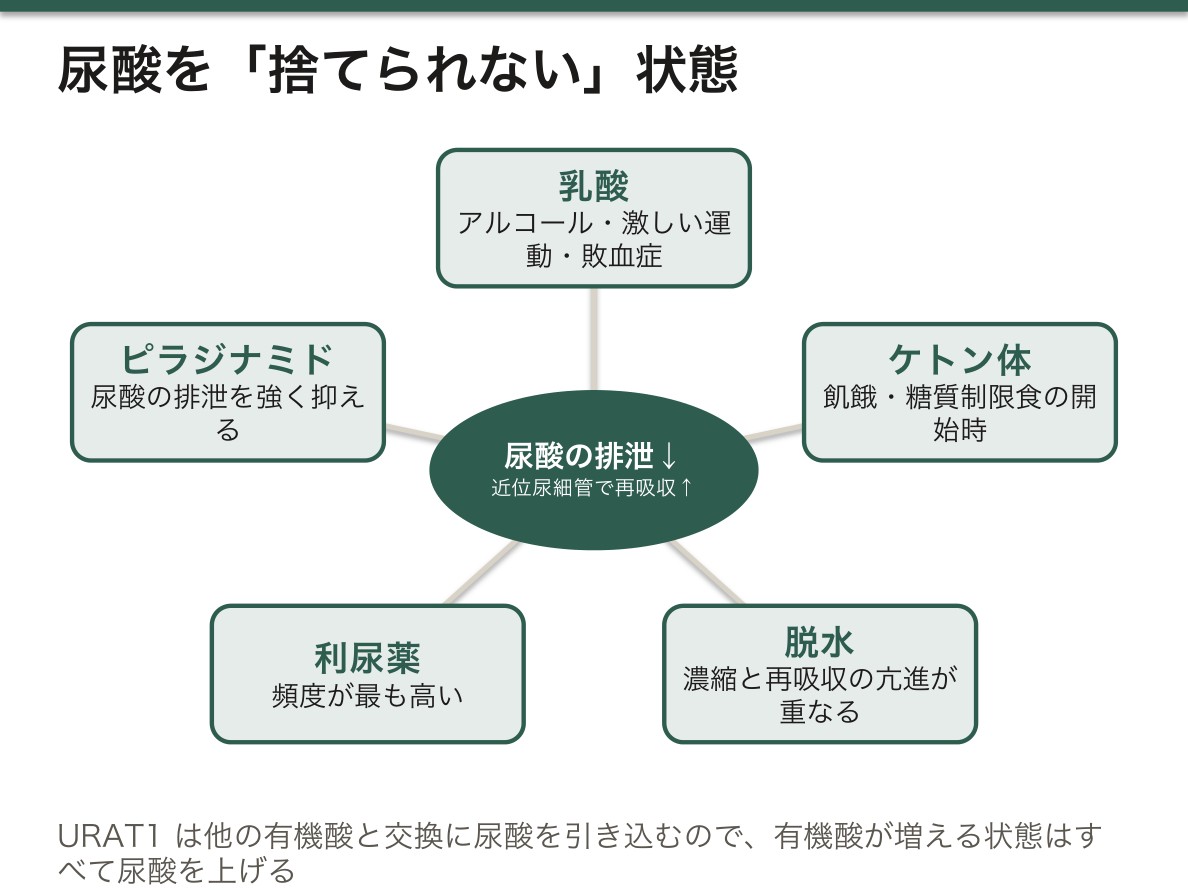
「捨てられない」側は、有機酸との競合で説明できる。尿酸は近位尿細管の URAT1 で再吸収されるが、この輸送体は他の有機酸と交換に尿酸を引き込む。だから体内に有機酸が増える状態は、すべて尿酸を上げる。
- 乳酸——アルコール・激しい運動・敗血症・けいれん
- ケトン体——飢餓・糖尿病性ケトアシドーシス・糖質制限食(開始時に尿酸が上がる)
- 脱水——濃縮と、再吸収の亢進が重なる
だから痛風発作は「宴会・脱水・激しい運動・絶食」の後に集中する——どれも有機酸が増える状況である。
逆に尿酸を下げる薬・状態も知っておく。ロサルタン(URAT1 を阻害する作用がある)・SGLT2 阻害薬・フェノフィブラート・高用量サリチル酸。高血圧に利尿薬ではなくロサルタンを選ぶ、というように、合併症に合わせて薬を選ぶ根拠になる。
⚠️ 尿酸が異常に低い場合も意味がある。腎性低尿酸血症(URAT1 の変異、日本人に多い)では、運動後に急性腎障害を起こすことがある。健診で尿酸が 2 mg/dL 未満なら、激しい運動の後の異変に注意するよう伝える。
尿酸を下げる薬を足す前に、いま飲んでいる薬で上げているものが無いかを見る。利尿薬を替えるだけで解決することがある。
English version
Core
When looking for the cause of hyperuricaemia, it is more fruitful to look at drugs and conditions before constitution and diet.
| Diuretics | Thiazides, loop diuretics | As the circulating volume falls, proximal tubular reabsorption increases. The commonest |
| Low-dose aspirin | Suppresses the excretion of urate | At a high dose it promotes excretion instead — the direction changes with the dose |
| Immunosuppressants | Ciclosporin, tacrolimus | The chief cause of hyperuricaemia and gout after transplantation |
| Antituberculous drugs | Pyrazinamide, ethambutol | Strongly suppress the excretion of urate. A cause of joint pain during treatment |
| Treatments that break cells | Antitumour drugs, radiation | Tumour lysis syndrome. Prevention is required |
There are only two shared mechanisms — making too much (degradation of nucleic acid) and failing to discard it (increased tubular reabsorption). Nearly all the drugs are the latter.
Going further
The "failing to discard" side can be explained by competition with organic acids. Urate is reabsorbed by URAT1 in the proximal tubule, and this transporter draws urate in in exchange for other organic acids. So every state that increases organic acids in the body raises the urate.
- Lactate — alcohol, hard exercise, sepsis, seizures.
- Ketone bodies — starvation, diabetic ketoacidosis, a low-carbohydrate diet (the urate rises when it is started).
- Dehydration — concentration and increased reabsorption together.
Hence gout attacks cluster after "a banquet, dehydration, hard exercise, fasting" — every one a state in which organic acids increase.
Know also the drugs and states that lower urate. Losartan (it has an action inhibiting URAT1), SGLT2 inhibitors, fenofibrate, high-dose salicylate. It gives the ground for choosing a drug to match the comorbidity, as in choosing losartan rather than a diuretic for hypertension.
⚠️ An abnormally low urate has meaning too. In renal hypouricaemia (a mutation of URAT1, common in Japanese people), acute kidney injury after exercise can occur. If a health check shows a urate below 2 mg/dL, tell the person to be alert to trouble after hard exercise.
In the clinic
Before adding a drug to lower the urate, look for a drug already being taken that is raising it. Changing a diuretic alone sometimes settles it.
まとめ
| 高尿酸血症 — 作りすぎと、捨てられないの2通り | 尿酸が上がる原因は2つに分かれる。 |
|---|---|
| 救済経路の異常 — Lesch-Nyhan症候群とADA欠損症 | プリンヌクレオチドの作り方は2通りある。 |
| 尿酸塩結晶が炎症を起こす道筋 — 溶けなくなった分子が、免疫を起動する | 尿酸は血中で 6.8 mg/dL を超えると飽和し、結晶として析出する。 |
| 尿酸を下げる薬 — 作らせないか、捨てさせるか | 血清尿酸は、産生と排泄の差で決まる。薬もその2つに分かれる。 |
| 無症候性の高尿酸血症を、薬で下げるべきか | 健診で尿酸が高い人は多い。症状が無いまま数値だけ高い状態を、どこまで治療するかは長く議論されてきた。 |
| 尿酸を上げているのは、しばしば薬である | 高尿酸血症の原因を探すとき、体質と食事より先に、薬と病態を見るほうが実りが多い。 |
このノートは医学生が授業の内容を自分の言葉でまとめたもので、診療の判断に使うものではありません。誤りに気づいたらお知らせください。