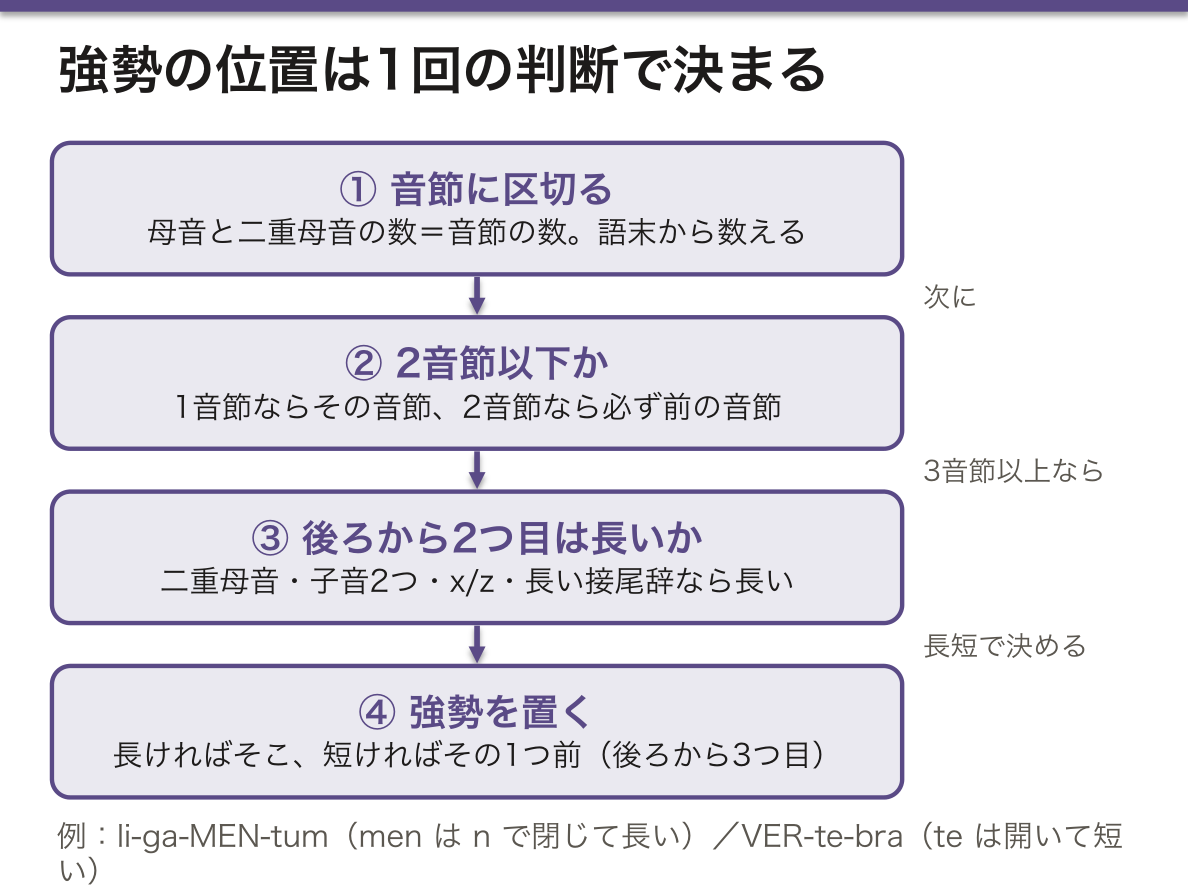
ラテン語の強勢には例外がほとんど無い。決め手は1つだけ——後ろから2つ目の音節が「長い」か「短い」かである。長ければそこを、短ければその1つ前を強く読む。最後の音節に強勢が来ることは無い。
この判断ができれば、初めて見る長い用語でも迷わず声に出せる。このサイトのカタカナで「ー」が入る位置は、多くの場合この強勢の位置になっている(ラテラーリス、フラクトゥーラ)。ただし全部の語に付けてはいないので、「ー」が無いから強勢が無いとは読まないこと。
- 音節 — 母音の数だけあり、後ろから数える
- 強勢の規則 — 後ろから2つ目が長ければそこ、短ければ1つ前
- 長い音節 — 4つの条件
- 短い音節 — 4つの条件と、縮小辞
- 辞書で覚える語 — 子音1つの前の母音
音節 — 母音の数だけあり、後ろから数えるSyllaba
音節の数は、母音と二重母音の数に等しい。二重母音(ae, oe, au, eu)は2文字で1音節と数える。数えるのは語末からで、最後の音節が1、その前が2(後ろから2つ目)、その前が3になる。
| 語 | 区切り | 音節数 |
|---|---|---|
| aorta | a-or-ta | 3 |
| vertebrae | ver-te-brae | 3(ae は1つ) |
| mandibula | man-di-bu-la | 4 |
| articulatio | ar-ti-cu-la-ti-o | 6 |
| deltoideus | del-to-i-de-us | 5(oi は二重母音ではない) |
区切り方の規則は3つ。①母音の間の子音1つは後ろの音節へ(ve-na, ti-bi-a)。②子音2つは間で切る(col-lum, ar-te-ri-a)。③ただし b・p・d・t・c・g + l・r の組は切らずに後ろへ(ver-te-bra, pal-pe-bra)。ch・ph・th・rh・qu は子音1つとして扱う(sto-ma-chus)。
なぜ区切り方が大事か。次の項目で見るように、後ろから2つ目の音節が子音で閉じているか(col-、men-)、母音で開いているか(te-、bu-)が長短を決めるからである。ligamentum の men は n で閉じているので長く、vertebra の te は br を後ろに渡して開いているので短い。区切りを間違えると強勢の位置も間違える。
隣り合う母音は、二重母音でなければ別々の音節になる。ti-bi-a、fo-ve-a、nu-cle-us、os-se-us はどれも最後の2母音が別の音節で、ここを1つに縮めると音節の数がずれる。
English version
Core
A word has as many syllables as it has vowels and diphthongs. A diphthong (ae, oe, au, eu) is two letters but one syllable. Count from the end: the last syllable is 1, the one before is 2 (the penultimate), and the one before that is 3.
| Word | Division | Syllables |
|---|---|---|
| aorta | a-or-ta | 3 |
| vertebrae | ver-te-brae | 3 (ae is one) |
| mandibula | man-di-bu-la | 4 |
| articulatio | ar-ti-cu-la-ti-o | 6 |
| deltoideus | del-to-i-de-us | 5 (oi is not a diphthong) |
Three rules for dividing. (1) A single consonant between vowels goes with the next syllable (ve-na, ti-bi-a). (2) Two consonants are split (col-lum, ar-te-ri-a). (3) But b, p, d, t, c, g + l or r stay together and go with the next syllable (ver-te-bra, pal-pe-bra). Ch, ph, th, rh and qu count as one consonant (sto-ma-chus).
Going further
Why division matters: as the next item shows, whether the penultimate syllable is closed by a consonant (col-, men-) or open (te-, bu-) decides whether it is long. In ligamentum, men is closed by n and is long; in vertebra, te passes br to the next syllable, stays open and is short. Divide wrongly and you stress wrongly.
Two vowels side by side are separate syllables unless they form a diphthong. Ti-bi-a, fo-ve-a, nu-cle-us and os-se-us all end in two vowels that belong to different syllables; squeezing them into one throws off the count.
強勢の規則 — 後ろから2つ目が長ければそこ、短ければ1つ前Paenultima
規則は3行で済む。
| 語の長さ | 強勢の位置 | 例 |
|---|---|---|
| 1音節 | その音節 | OS, PES |
| 2音節 | 必ず前の音節 | VE-na, CO-sta, CA-put |
| 3音節以上 | 後ろから2つ目が長ければそこ | a-OR-ta, li-ga-MEN-tum |
| 3音節以上 | 後ろから2つ目が短ければ、その1つ前 | man-DI-bu-la, VER-te-bra |
つまり、強勢は後ろから2つ目か3つ目のどちらかにしか来ない。4つ目より前に来ることも、最後に来ることも無い。判断は「後ろから2つ目は長いか」の1回だけである。
語尾が変わると強勢が動く。規則が語末から数える仕組みなので、語尾が1音節増えれば数え直しになる。
| 主格 | 強勢 | 属格 | 強勢 |
|---|---|---|---|
| caput | CA-put | capitis | CA-pi-tis(pi が短い) |
| cervix | CER-vix | cervicis | cer-VI-cis(vī が長い) |
| radix | RA-dix | radicis | ra-DI-cis(dī が長い) |
| apex | A-pex | apicis | A-pi-cis(pi が短い) |
| articulatio | ar-ti-cu-LA-ti-o | articulationis | ar-ti-cu-la-ti-O-nis(ō が長い) |
radicis と apicis は同じ -icis なのに強勢が違う。母音の長短は綴りに出ないので、ここは辞書(長音の印)で確かめるしかない。次の2項目で、綴りから長短がわかる場合とわからない場合を分ける。
English version
Core
The rule fits in three lines.
| Length of word | Where the stress falls | Example |
|---|---|---|
| 1 syllable | on it | OS, PES |
| 2 syllables | always on the first | VE-na, CO-sta, CA-put |
| 3 or more | on the penultimate if it is long | a-OR-ta, li-ga-MEN-tum |
| 3 or more | on the one before it if the penultimate is short | man-DI-bu-la, VER-te-bra |
So the stress is always on the second or third syllable from the end — never further back, and never on the last. There is only one decision: is the penultimate long?
Going further
When the ending changes, the stress can move. Because the rule counts from the end, an extra syllable in the ending means counting again.
| Nominative | Stress | Genitive | Stress |
|---|---|---|---|
| caput | CA-put | capitis | CA-pi-tis (short pi) |
| cervix | CER-vix | cervicis | cer-VI-cis (long vī) |
| radix | RA-dix | radicis | ra-DI-cis (long dī) |
| apex | A-pex | apicis | A-pi-cis (short pi) |
| articulatio | ar-ti-cu-LA-ti-o | articulationis | ar-ti-cu-la-ti-O-nis (long ō) |
Radicis and apicis both end in -icis, yet their stress differs. Vowel length is not shown in normal spelling, so here only the dictionary (with its long marks) can tell you. The next two items separate cases where the spelling shows the length from cases where it does not.
長い音節 — 4つの条件Syllaba longa
後ろから2つ目の音節は、次のどれかに当てはまれば長い。長ければそこに強勢が来る。
| 条件 | 例(強勢を大文字で) |
|---|---|
| ①二重母音を含む | di-AE-ta, gan-GRAE-na, a-MOE-ba |
| ②母音のあとに子音が2つ以上続く | li-ga-MEN-tum, co-LUM-na, ex-TER-nus, pro-CES-sus |
| ③母音のあとに x か z | re-FLE-xus |
| ④長い接尾辞 -āl- -ār- -īn- -ūr- -ōs- -īv- -āt- | la-te-RA-lis, ar-ti-cu-LA-ris, me-di-CI-na, frac-TU-ra, fi-BRO-sus, ac-TI-vus |
③は、x と z がそれ自体で子音2つ分(x=ks)に数えられるので、実は②の一種である。
解剖用語の形容詞が同じリズムになるのは④のせいである。形容詞を作る代表的な接尾辞 -alis・-aris・-osus・-inus・-ivus はすべて長いので、強勢はいつも語尾の直前に来る——femo-RA-lis、verte-BRA-lis、pal-MA-ris、ve-NO-sus、pala-TI-nus。「〜アーリス」「〜オースス」という響きがそろうのはこのためで、カタカナではフェモラーリス・ヴェノーススのように「ー」がそこに入る。
名詞の -ura(fractura, sutura, apertura)と -ina(medicina, vagina)も同じで、フラクトゥーラ・ストゥーラと読む。
English version
Core
The penultimate syllable is long if any of the following applies. If it is long, it takes the stress.
| Condition | Example (stress in capitals) |
|---|---|
| (1) It contains a diphthong | di-AE-ta, gan-GRAE-na, a-MOE-ba |
| (2) Its vowel is followed by two or more consonants | li-ga-MEN-tum, co-LUM-na, ex-TER-nus, pro-CES-sus |
| (3) Its vowel is followed by x or z | re-FLE-xus |
| (4) It is a long suffix -āl- -ār- -īn- -ūr- -ōs- -īv- -āt- | la-te-RA-lis, ar-ti-cu-LA-ris, me-di-CI-na, frac-TU-ra, fi-BRO-sus, ac-TI-vus |
Rule (3) is really a case of rule (2): x and z each count as two consonants (x = ks).
Going further
Rule (4) is why anatomical adjectives share one rhythm. The usual adjective suffixes -alis, -aris, -osus, -inus, -ivus are all long, so the stress always falls just before the ending: femo-RA-lis, verte-BRA-lis, pal-MA-ris, ve-NO-sus, pala-TI-nus. That is why so many terms sound like “-A-lis” or “-O-sus”, and why katakana puts ー there (フェモラーリス, ヴェノースス).
Nouns in -ura (fractura, sutura, apertura) and -ina (medicina, vagina) work the same way: frac-TU-ra, su-TU-ra.
短い音節 — 4つの条件と、縮小辞Syllaba brevis
後ろから2つ目の音節が次のどれかなら短い。強勢はその1つ前(後ろから3つ目)へ移る。
| 条件 | 例(強勢を大文字で) |
|---|---|
| ①母音の前の母音 | su-PE-ri-or, FA-ci-es, ar-TE-ri-a, TI-bi-a |
| ②b・p・d・t・c・g + l・r の前 | VER-te-bra, PAL-pe-bra, CE-re-brum |
| ③ch・ph・th・rh・qu の前 | STO-ma-chus |
| ④短い接尾辞 -ic- -ul- -cul- -ol- -ac- | GAS-tri-cus, tho-RA-ci-cus, MUS-cu-lus, GLAN-du-la, i-LI-a-cus |
②は前の項目の「子音2つ」に見えるが、この組は切らずに後ろの音節へ渡すので、前の音節は開いたまま短い。ここが長い音節の②との境目である。
④の -ul-・-cul-・-ol- は縮小辞(「小さな〜」)で、解剖学でいちばん働く接尾辞の一つである。
| 縮小辞のついた語 | 元の語 | 意味 |
|---|---|---|
| ventriculus | venter(腹) | 小さな腹 → 室(脳室・心室) |
| auricula | auris(耳) | 小さな耳 → 耳介・心耳 |
| clavicula | clavis(鍵) | 小さな鍵 → 鎖骨 |
| tuberculum | tuber(こぶ) | 小さなこぶ → 結節 |
| foveola | fovea(くぼみ) | 小さなくぼみ |
| glandula | glans(どんぐり) | 小さなどんぐり → 腺 |
縮小辞はすべて短いので、付けると強勢は必ず1つ前に下がる——ven-TRI-cu-lus、au-RI-cu-la、cla-VI-cu-la、tu-BER-cu-lum。だからカタカナでもヴェントリクルス・クラヴィクラのように「クル」「クラ」の部分は伸ばさない。
結核 tuberculosis は tuberculum(小さな結節)から名付けられた病気である。肺などにできる小さな結節(結核結節)が病名の由来で、病理で見る類上皮細胞肉芽腫がその実体である。縮小辞が読めれば、病名が病変の見た目を言っていることがわかる。
English version
Core
The penultimate syllable is short in the following cases. The stress then moves one syllable back (third from the end).
| Condition | Example (stress in capitals) |
|---|---|
| (1) A vowel before another vowel | su-PE-ri-or, FA-ci-es, ar-TE-ri-a, TI-bi-a |
| (2) Before b, p, d, t, c, g + l or r | VER-te-bra, PAL-pe-bra, CE-re-brum |
| (3) Before ch, ph, th, rh, qu | STO-ma-chus |
| (4) Short suffixes -ic- -ul- -cul- -ol- -ac- | GAS-tri-cus, tho-RA-ci-cus, MUS-cu-lus, GLAN-du-la, i-LI-a-cus |
Rule (2) looks like “two consonants”, but these pairs are not split; they go together to the next syllable, so the syllable before stays open and short. This is the borderline with long-syllable rule (2).
Going further
The -ul-, -cul- and -ol- of rule (4) are diminutives (“little …”), among the busiest suffixes in anatomy.
| Diminutive | Base word | Meaning |
|---|---|---|
| ventriculus | venter (belly) | little belly → ventricle |
| auricula | auris (ear) | little ear → auricle |
| clavicula | clavis (key) | little key → clavicle |
| tuberculum | tuber (swelling) | little swelling → tubercle |
| foveola | fovea (pit) | little pit |
| glandula | glans (acorn) | little acorn → gland |
All diminutive suffixes are short, so adding one always pushes the stress back: ven-TRI-cu-lus, au-RI-cu-la, cla-VI-cu-la, tu-BER-cu-lum. This is why katakana does not lengthen the “-ku-” part (ヴェントリクルス, クラヴィクラ).
In the clinic
Tuberculosis is named after the tuberculum, the “little swelling”. The small nodules it forms in the lung and elsewhere (tubercles) gave the disease its name; under the microscope they are granulomas of epithelioid cells. If you can read the diminutive, you can see that the name describes what the lesion looks like.
辞書で覚える語 — 子音1つの前の母音Medicus et medicina
後ろから2つ目の母音のあとに子音が1つだけあり、前の2項目のどの条件にも当てはまらないとき、長短は綴りからはわからない。辞書の長音の印(ī など)で確かめて、強勢ごと覚えるしかない。
| 短い(3つ目に強勢) | 長い(2つ目に強勢) |
|---|---|
| ME-di-cus(医師) | me-di-CI-na(医学) |
| TU-ni-ca(膜) | ve-SI-ca(膀胱) |
| LA-mi-na(板) | va-GI-na(腟・鞘) |
| CA-pi-tis(頭の) | ra-DI-cis(根の) |
| U-te-rus(子宮) | u-RI-na(尿) |
medicus と medicina は同じ語根なのに強勢の位置が違う。これは -īn- が長い接尾辞(前々項の④)であるのに対し、medicus の i は短いからである。
覚え方のこつは、強勢つきで一度声に出すことである。目で見ただけでは長短の情報が残らない。ここに挙げた語はどれも解剖・臨床で毎日出るので、最初の1回で正しい位置を口に覚えさせるほうが、あとで直すより楽である。
英語の発音は当てにならない。英語は独自の規則で強勢を置き直しているので、medicine(MED-i-cine)と medicina(me-di-CI-na)のようにずれる語が多い。ラテン語の用語はラテン語の規則で読むこと。
English version
Core
When the penultimate vowel is followed by only one consonant and none of the conditions in the last two items apply, the spelling does not tell you its length. You have to check the long mark (ī etc.) in a dictionary and learn the word with its stress.
| Short (stress on the third) | Long (stress on the second) |
|---|---|
| ME-di-cus (doctor) | me-di-CI-na (medicine) |
| TU-ni-ca (coat) | ve-SI-ca (bladder) |
| LA-mi-na (plate) | va-GI-na (vagina, sheath) |
| CA-pi-tis (of the head) | ra-DI-cis (of the root) |
| U-te-rus (uterus) | u-RI-na (urine) |
Medicus and medicina share a root but not a stress. The -īn- of medicina is a long suffix (rule 4 two items back), while the i of medicus is short.
Going further
The trick is to say each word aloud once, with its stress. Looking at a word does not store its vowel length. All of these words appear every day in anatomy and clinical work, so getting the stress into your mouth the first time is easier than correcting it later.
English pronunciation is no guide. English moves the stress by its own rules, so many words differ, as medicine (MED-i-cine) and medicina (me-di-CI-na) do. Read Latin terms by Latin rules.
まとめ
| 音節 — 母音の数だけあり、後ろから数える | 音節の数は、母音と二重母音の数に等しい。 |
|---|---|
| 強勢の規則 — 後ろから2つ目が長ければそこ、短ければ1つ前 | 規則は3行で済む。語の長さ強勢の位置例1音節その音節OS, PES2音節必ず前の音節VE-na, CO-sta, CA-put3音節以上後ろから2つ目が長ければそこa-OR-ta,… |
| 長い音節 — 4つの条件 | 後ろから2つ目の音節は、次のどれかに当てはまれば長い。 |
| 短い音節 — 4つの条件と、縮小辞 | 後ろから2つ目の音節が次のどれかなら短い。 |
| 辞書で覚える語 — 子音1つの前の母音 | 後ろから2つ目の母音のあとに子音が1つだけあり、前の2項目のどの条件にも当てはまらないとき、長短は綴りからはわからない。 |
このノートは医学生が授業の内容を自分の言葉でまとめたもので、診療の判断に使うものではありません。誤りに気づいたらお知らせください。