糖尿病の合併症は「血糖が高い」だけでは説明できない。なぜ神経・網膜・腎・水晶体という特定の組織ばかりが傷むのか。答えは、これらがグルコースの取り込みにインスリンを必要としない組織だという点にある。
インスリン非依存性の組織は、血糖が上がればそのまま細胞内も上がる。行き場を失ったグルコースが2つの化学に流れ込む——ポリオール経路と非酵素的糖化である。
- ポリオール経路 — 糖アルコールが水を引き込む
- 終末糖化産物 — 時間をかけて、戻れなくなる
- 糖尿病合併症の4つの分子機構 — そして、それを1つに束ねる仮説
- 代謝記憶 — 過去の血糖が、あとから効いてくる
- 高血糖は、感染に弱くする — 機序を分けて考える
- 糖化の主犯は、ブドウ糖そのものではない — メチルグリオキサール
ポリオール経路 — 糖アルコールが水を引き込む
2段階の経路である。
- アルドース還元酵素:グルコース → ソルビトール(NADPHを消費)
- ソルビトール脱水素酵素:ソルビトール → 果糖(NAD⁺を消費)
害は2つの経路から出る。
- ソルビトールが溜まる——細胞膜を通れないので細胞内に水を引き込み、膨化させる。白内障・神経の浮腫
- NADPHが枯れる——還元型グルタチオンが作れなくなり、抗酸化能が落ちる
強く働くのは水晶体・網膜・腎糸球体・末梢神経(Schwann細胞)——いずれもアルドース還元酵素を多く持ち、かつインスリン非依存性の組織である。
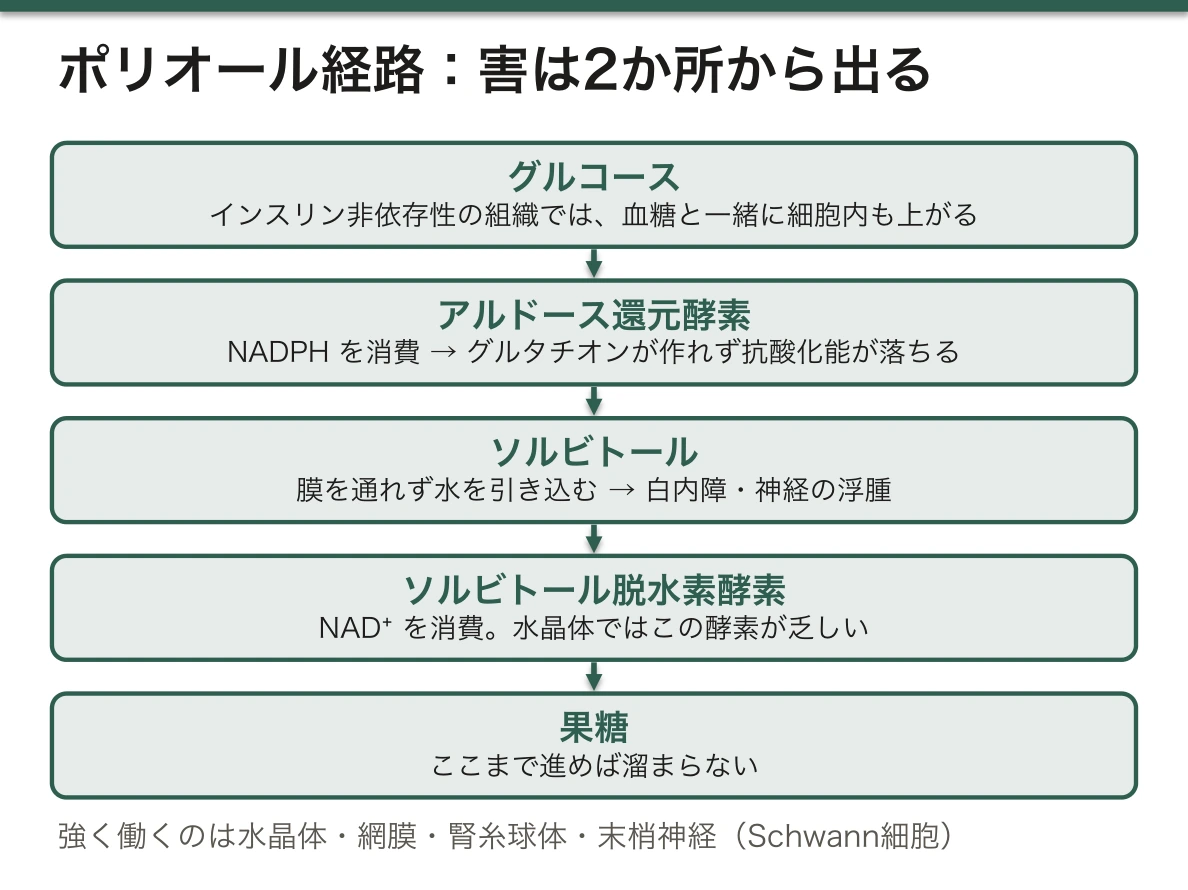
ソルビトール脱水素酵素の活性が組織によって違うことが、傷害部位を決めている。水晶体はこの酵素が乏しいため、ソルビトールが出口なく溜まる。糖尿病白内障とガラクトース血症の白内障が同じ機序(果糖とガラクトースの章)になるのはこのためである。
NADPHの枯渇はもっと広く効く。NADPHはペントースリン酸経路が供給する唯一の還元力で、使い道は3つある——グルタチオン還元・脂肪酸合成・活性酸素の産生(好中球)。ポリオール経路がNADPHを奪うと、グルタチオンが再生できず酸化ストレスに無防備になる。高血糖が「酸化ストレスの病気」と言われる根拠の一つである。
アルドース還元酵素阻害薬(エパルレスタット)は、この経路を直接止める薬として糖尿病性多発神経障害に用いられる。機序から治療が出てくる数少ない例だが、効果は限定的で、血糖管理に代わるものではない。
臨床像との対応。神経障害が下肢遠位から、左右対称に、感覚優位で始まるのは、長い軸索ほど代謝的な負担が大きいためである。足の裏の感覚が最初に失われ、患者は痛みで気づかない——だから足病変の診察が要る。
English version
Core
It is a pathway of two steps.
- Aldose reductase: glucose → sorbitol (consuming NADPH)
- Sorbitol dehydrogenase: sorbitol → fructose (consuming NAD⁺)
The harm comes by two routes.
- Sorbitol accumulates — unable to cross the membrane, it draws water into the cell and swells it. Cataract, oedema of the nerve.
- NADPH runs out — reduced glutathione cannot be made and antioxidant capacity falls.
It works strongly in lens, retina, renal glomerulus and peripheral nerve (Schwann cell) — all tissues rich in aldose reductase and insulin-independent.
Going further
That the activity of sorbitol dehydrogenase differs between tissues decides where the injury falls. The lens is poor in this enzyme, so sorbitol accumulates with no exit. This is why diabetic cataract and the cataract of galactosaemia share a mechanism (the chapter on fructose and galactose).
The exhaustion of NADPH tells more widely. NADPH is the only reducing power supplied by the pentose phosphate pathway, with three uses — reduction of glutathione, fatty acid synthesis, and production of reactive oxygen (in the neutrophil). When the polyol pathway takes the NADPH, glutathione cannot be regenerated and the cell is defenceless against oxidative stress. One of the grounds for calling hyperglycaemia a disease of oxidative stress.
Aldose reductase inhibitors (epalrestat) are used in diabetic polyneuropathy as drugs that stop this pathway directly. One of the few instances of a treatment coming out of a mechanism, but the effect is limited and it is no substitute for glycaemic control.
The correspondence with the clinical picture. That the neuropathy begins distally in the legs, symmetrically and predominantly in sensation is because the longer the axon the greater its metabolic burden. Sensation is lost first on the sole and the patient does not notice by pain — hence the need to examine the feet.
終末糖化産物 — 時間をかけて、戻れなくなる
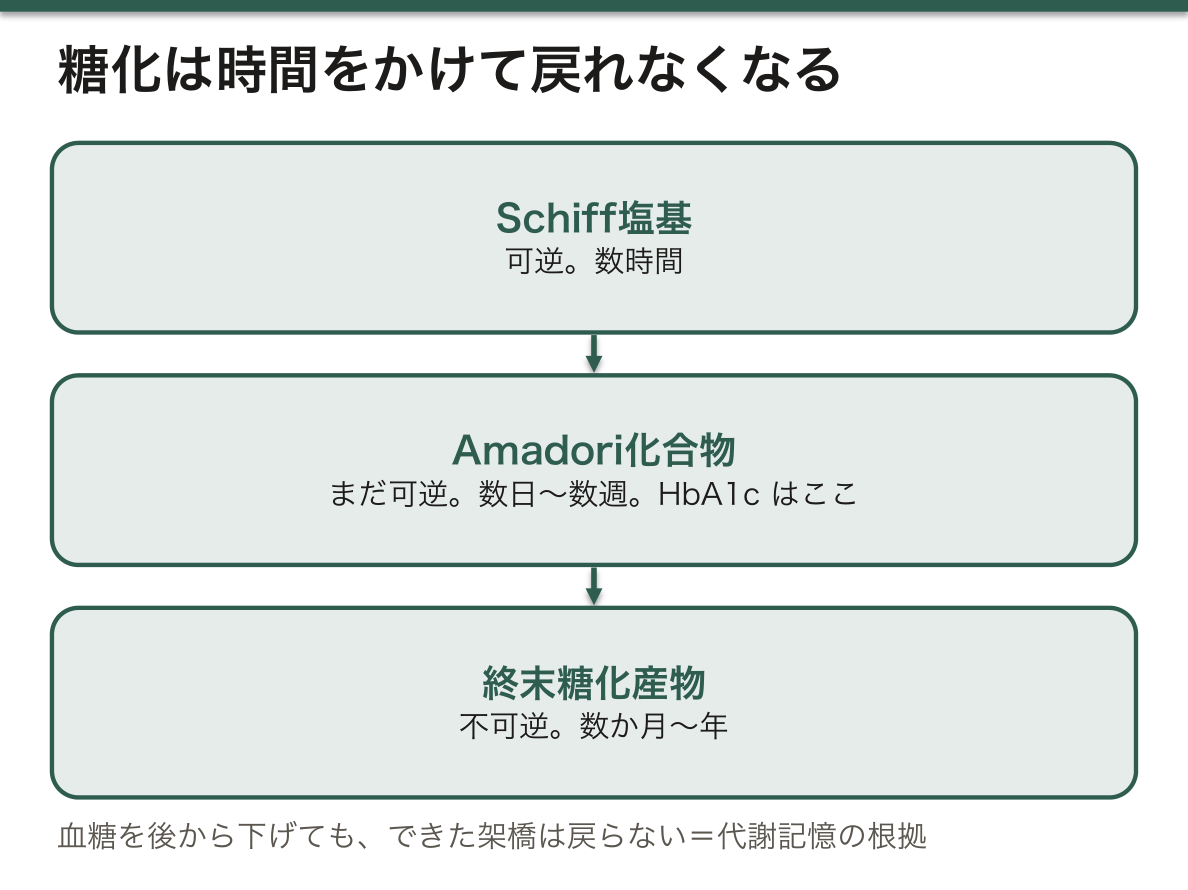
非酵素的糖化(グリケーション)は酵素を介さずに進む。
- グルコースが蛋白のアミノ基と結合 → Schiff塩基(可逆、数時間)
- 転位して Amadori化合物(まだ可逆、数日〜数週)。HbA1c はここ
- さらに反応が進み 終末糖化産物(不可逆、数か月〜年)
| 指標 | 反映する期間 | 結合する蛋白 |
|---|---|---|
| HbA1c | 過去1〜2か月 | ヘモグロビン(寿命120日) |
| グリコアルブミン | 過去2〜3週 | アルブミン(半減期17日) |
| 1,5-アンヒドログルシトール | 過去数日 | (尿糖排泄で低下する) |
指標がずれる状況を、必ず蛋白の寿命から考える。
- HbA1cが実際より低く出る——赤血球の寿命が短い状況。溶血性貧血・出血・鉄剤やエリスロポエチン投与後(若い赤血球が増える)・肝硬変・透析
- HbA1cが高く出る——赤血球が長生きする状況。鉄欠乏性貧血の治療前・脾摘後
- グリコアルブミンがずれる——ネフローゼ症候群では低く(アルブミンが漏れて回転が速い)、甲状腺機能低下症では高く出る
終末糖化産物が組織を壊す道筋は2つある。
- 細胞外での架橋——コラーゲンどうしを橋渡しして硬くする。血管が硬くなり、基底膜が厚くなる。関節が硬くなる(手掌の合掌ができない)のもこれ
- 受容体を介した炎症——終末糖化産物受容体に結合すると、核内因子κBを介して炎症性サイトカインと接着分子が出る。動脈硬化が進む
「不可逆」であることの意味は重い。血糖を後から下げても、すでにできた架橋は元に戻らない。これが代謝記憶——初期の血糖管理が、何年も後の合併症の頻度を決めるという現象——の生化学的な根拠である。診断直後の数年間の管理が、生涯の合併症を左右する。この一点は患者に伝える価値がある。
English version
Core
Non-enzymatic glycation proceeds without an enzyme.
- Glucose binds an amino group of a protein → a Schiff base (reversible, hours)
- It rearranges to an Amadori compound (still reversible, days to weeks). HbA1c is here.
- The reaction proceeds further to advanced glycation end-products (irreversible, months to years)
| Index | Period reflected | Protein bound |
|---|---|---|
| HbA1c | The past 1–2 months | Haemoglobin (lifespan 120 days) |
| Glycated albumin | The past 2–3 weeks | Albumin (half-life 17 days) |
| 1,5-Anhydroglucitol | The past few days | (falls with urinary glucose excretion) |
Going further
Always think from the lifespan of the protein about the situations in which an index misleads.
- HbA1c reads lower than the truth — when the red cell lifespan is short. Haemolytic anaemia, bleeding, after iron or erythropoietin (young red cells increase), cirrhosis, dialysis.
- HbA1c reads high — when red cells live long. Iron deficiency anaemia before treatment, after splenectomy.
- Glycated albumin misleads — low in nephrotic syndrome (albumin leaks and turns over fast), high in hypothyroidism.
Advanced glycation end-products damage tissue by two routes.
- Cross-linking outside the cell — bridging collagen to collagen and stiffening it. Vessels stiffen and basement membranes thicken. Stiff joints (the hands cannot be put flat together) are this too.
- Inflammation through a receptor — binding the receptor for AGEs, inflammatory cytokines and adhesion molecules are released through nuclear factor κB. Atherosclerosis advances.
The meaning of irreversible is grave. Lower the blood glucose afterwards and the cross-links already made do not come undone. This is the biochemical ground of metabolic memory — the phenomenon whereby early glycaemic control decides the frequency of complications many years later. The management of the first few years after diagnosis governs a lifetime of complications. This single point is worth telling the patient.
糖尿病合併症の4つの分子機構 — そして、それを1つに束ねる仮説
高血糖が組織を壊す道筋は、古典的に4つに整理される。
| 機構 | 起きること |
|---|---|
| ①ポリオール経路 | ソルビトールが溜まり、NADPH を消費して還元力が落ちる |
| ②終末糖化産物(AGEs) | 蛋白が架橋され、RAGE を介して炎症が起きる |
| ③プロテインキナーゼC の活性化 | ジアシルグリセロールが増え、血流と透過性が変わる |
| ④ヘキソサミン経路 | 転写因子の O-GlcNAc 修飾が増える |
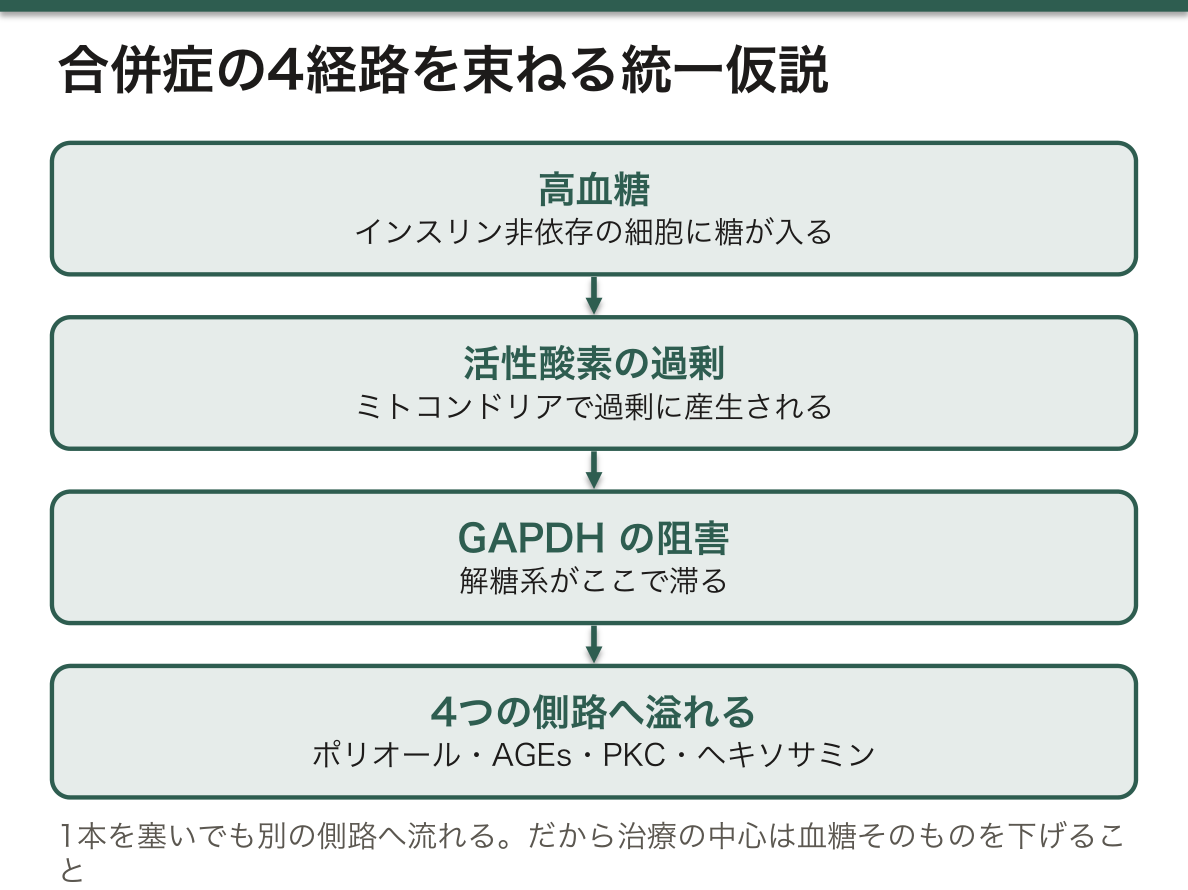
統一仮説——いずれの上流にも、ミトコンドリアでの活性酸素の過剰産生がある。それが解糖系の酵素(GAPDH)を阻害し、上流の中間体が4つの側路へ溢れる。
侵されるのは、糖の取り込みがインスリンに依らない細胞になる——血管内皮・神経・水晶体・腎メサンギウム。
「なぜその臓器なのか」に答えるのが、この項の要点になる。糖の取り込みを自分で調節できない細胞は、血糖が上がったぶんだけ中に入ってくる(GLUT の項)——「守れない細胞だけが、傷つく」。
だから合併症の分布が、細胞の性質から予測できる(糖尿病の足と神経の章)——「網膜・腎・神経・血管という並びに、共通の理由がある」。
統一仮説は、なぜ個々の経路を止める薬が期待ほど効かなかったかも説明する(活性酸素の章)——「1本を塞いでも、上流が溢れていれば別の側路へ流れる」。
だから治療の中心は、いまも血糖そのものを下げることになる(糖尿病の各論の章)——「上流を減らすことが、4本すべてを細くする」。
AGEs は代謝回転の遅い蛋白ほど蓄積する(コラーゲンの章)——「コラーゲンや水晶体クリスタリンのように、入れ替わらない蛋白が最も傷む」。
English version
Core
The routes by which hyperglycaemia damages tissue are classically arranged as four.
| Mechanism | What happens |
|---|---|
| ① The polyol pathway | Sorbitol accumulates and NADPH is consumed, so reducing power falls |
| ② Advanced glycation end-products (AGEs) | Proteins are cross-linked and inflammation arises through RAGE |
| ③ Activation of protein kinase C | Diacylglycerol increases and blood flow and permeability change |
| ④ The hexosamine pathway | O-GlcNAc modification of transcription factors increases |
The unifying hypothesis — upstream of all of them is an excess production of reactive oxygen in the mitochondrion. It inhibits an enzyme of glycolysis (GAPDH) and the upstream intermediates overflow into the four side roads.
What is attacked are the cells whose glucose uptake does not depend on insulin — vascular endothelium, nerve, lens, renal mesangium.
Going further
- The point of this section is to answer why those organs. A cell that cannot regulate its own uptake receives whatever the blood glucose rises by (the section on GLUT) — only the cells that cannot protect themselves are damaged.
- Hence the distribution of complications can be predicted from the character of the cells (the chapter on the diabetic foot and nerve) — the sequence retina, kidney, nerve, vessel has a common reason.
- The unifying hypothesis also explains why drugs stopping the individual pathways worked less well than hoped (the chapter on reactive oxygen) — block one road and, with the upstream overflowing, it runs into another.
- Hence the centre of treatment is still lowering the blood glucose itself (the chapter on the particulars of diabetes) — reducing the upstream narrows all four.
- AGEs accumulate the more, the slower the protein turns over (the chapter on collagen) — proteins that are not replaced, like collagen and the lens crystallins, are damaged most.
代謝記憶 — 過去の血糖が、あとから効いてくる
大規模試験で、早期に厳格な血糖管理を行った群は、その後に血糖が同等になっても合併症が少ないことが示された——これを代謝記憶(legacy effect)と呼ぶ。
説明として挙げられているもの。
- AGEs の蓄積が不可逆で、代謝回転の遅い蛋白に長く残る
- ミトコンドリア DNA の損傷が積み重なる
- エピジェネティックな変化(ヒストン修飾)が持続する
一方で、進行した患者に後から厳格な管理を行っても、大血管障害の抑制は限定的で、低血糖による害が上回りうる。
だから目標値は、年齢・罹病期間・合併症・低血糖の危険で個別に決める。
「早く始めるほど効く」という時間の要素が、この項の核心になる。同じ介入でも、いつ行うかで結果が変わる(糖尿病を生活として治療する章)——「診断直後の数年が、その後数十年を決めている」。
エピジェネティックな説明は、可逆と不可逆の境目を考えさせる(エピジェネティクスの章)——「配列は変わっていないのに、読み方の変化が長く残る」。
高齢者で目標を緩めるのは、手を抜いているのではない(高齢者の医療の章)——「低血糖が、転倒・認知機能低下・心血管事故を通じて害になるからになる」。
細小血管障害と大血管障害で、血糖管理の効き方が違う(代謝症候群の章)——「大血管では、血圧と脂質の管理のほうが寄与が大きい」。
この概念は、他の慢性疾患にも当てはめて考えられている——「早期の介入に価値があるという主張の、生化学的な裏づけになっている」。
English version
Core
In large trials, the group given strict glycaemic control early had fewer complications even after the blood glucose later became equal — this is called metabolic memory (the legacy effect).
The explanations offered.
- The accumulation of AGEs is irreversible and remains long in slowly turning-over proteins.
- Damage to mitochondrial DNA accumulates.
- Epigenetic change (histone modification) persists.
On the other hand, imposing strict control later on an advanced patient suppresses macrovascular disease only to a limited degree and the harm from hypoglycaemia may outweigh it.
So the target is set individually by age, duration of disease, complications and the risk of hypoglycaemia.
Going further
- The core of this section is the element of time — the earlier it is begun the better it works. The same intervention gives a different result according to when it is done (the chapter on treating diabetes as a way of living) — the few years after diagnosis deciding the decades that follow.
- The epigenetic explanation makes one think about the boundary of reversible and irreversible (the chapter on epigenetics) — the sequence is unchanged and yet a change in how it is read persists.
- Relaxing the target in the elderly is not cutting corners (the chapter on medicine for the elderly) — because hypoglycaemia does harm through falls, cognitive decline and cardiovascular events.
- Glycaemic control works differently on microvascular and macrovascular disease (the chapter on the metabolic syndrome) — in the large vessels, the control of blood pressure and lipids contributes more.
- This concept is being applied in thought to other chronic diseases — it is the biochemical support for the claim that early intervention has value.
高血糖は、感染に弱くする — 機序を分けて考える
糖尿病患者に感染が多く、重くなるのは経験的に知られているが、理由は1つではない。層に分けて考えると、対策の当てどころが見える。
- 好中球の機能が落ちる——遊走・貪食・呼吸バーストが鈍る。血糖 200 mg/dL を超えると明らかになるとされる
- 補体と免疫グロブリンが糖化される——オプソニン化の働きが落ちる
- 組織への血流と酸素が乏しい——細小血管症のため、白血球も抗菌薬も現場に届きにくい
- 神経障害で入口ができる——足の傷に気づかない。尿の停滞
- 糖そのものが細菌と真菌の栄養になる——尿路と皮膚で特に効く
特定の感染症と結びつきが強いものは、機序まで説明できる。
| ムーコル症(鼻脳型) | ケトアシドーシスで激増する | 酸性かつ鉄が遊離した環境を好む。アシドーシスでトランスフェリンから鉄が外れるため。数日で眼窩・脳へ進む。黒色の壊死組織を見たら緊急 |
| 悪性外耳道炎 | 緑膿菌 | 高齢の糖尿病患者。頭蓋底骨髄炎へ進む |
| 気腫性腎盂腎炎・気腫性胆嚢炎 | ガス産生菌 | 組織のブドウ糖が発酵されてガスになる。画像でガスを見たら糖尿病を疑う |
| 足の感染 | 神経障害+血流障害+高血糖 | 3 つが重なる。切断の最大の原因 |
逆向きの関係もある。感染そのものがストレスホルモンとサイトカインで血糖を上げるので、感染と高血糖は互いを悪化させる。「急に血糖が乱れた」ことが感染の最初の徴候になることは珍しくない。
だから急性期の血糖管理には意味がある——ただし厳格すぎる管理は低血糖で害になることが大規模試験で示されており、おおむね 140〜180 mg/dL を目標にするのが現在の考え方である。「下げれば下げるほどよい」ではない。
糖尿病患者の血糖が理由なく乱れたら、感染を探す。薬を増やす前に、熱・足・尿・歯を見る。
English version
Core
That diabetic patients have more infections and more severe ones is known from experience, but the reason is not one thing. Divided into layers, where to aim the measures becomes visible.
- Neutrophil function falls — chemotaxis, phagocytosis and the respiratory burst dull. Held to become evident above a blood glucose of 200 mg/dL.
- Complement and immunoglobulin are glycated — opsonisation works less well.
- Blood flow and oxygen to the tissue are poor — from microangiopathy, neither leucocytes nor antibiotics reach the scene readily.
- Neuropathy makes an entrance — a wound on the foot goes unnoticed. Stasis of urine.
- The sugar itself feeds bacteria and fungi — telling especially in the urinary tract and the skin.
Going further
Those with a strong link to a particular infection can be explained down to the mechanism.
| Mucormycosis (rhinocerebral) | Greatly increased in ketoacidosis | It likes an acid environment with free iron, iron coming off transferrin in acidosis. It advances into the orbit and brain within days. Black necrotic tissue is an emergency |
| Malignant otitis externa | Pseudomonas | An elderly diabetic patient. It advances to skull base osteomyelitis |
| Emphysematous pyelonephritis and cholecystitis | Gas-forming organisms | Tissue glucose is fermented into gas. Seeing gas on an image, suspect diabetes |
| Infection of the foot | Neuropathy + poor flow + hyperglycaemia | Three things together. The largest cause of amputation |
The relation runs the other way too. Infection itself raises the blood glucose through stress hormones and cytokines, so infection and hyperglycaemia worsen one another. It is not unusual for "the glucose suddenly became erratic" to be the first sign of infection.
So glycaemic control in the acute phase does matter — but too strict a control does harm through hypoglycaemia, as large trials have shown, and the present view is to aim roughly at 140–180 mg/dL. It is not "the lower the better".
In the clinic
If a diabetic patient’s blood glucose becomes erratic without reason, look for infection. Before increasing the drug, look at the temperature, the feet, the urine and the teeth.
糖化の主犯は、ブドウ糖そのものではない — メチルグリオキサール
終末糖化産物(AGEs)を作る反応で、実際に最も強く働いているのはブドウ糖ではなく、その代謝の途中でこぼれる副産物である。
メチルグリオキサールは解糖系の中間体から自然に生じる高反応性の分子で、ブドウ糖の数百〜数千倍の速さで蛋白と反応する。濃度はごく低いのに、AGEs 形成への寄与は大きい。
体はこれを処理する専用の系を持っている。
- グリオキサラーゼ系——2 つの酵素で乳酸に変えて無害化する
- グルタチオンを必要とする——反応の第一段階でグルタチオンが要る
ここで、糖尿病合併症の話が1本に繋がる。
高血糖ではポリオール経路が NADPH を使い果たし、還元型グルタチオンが減る。するとグリオキサラーゼが働けず、メチルグリオキサールが処理されずに残る。残れば AGEs が増え、蛋白が架橋され、受容体(RAGE)を介した炎症も起きる。
つまり「解毒の在庫が尽きること」が、糖化を加速させている。ポリオール経路と糖化は別々の機構として並べられることが多いが、グルタチオンを通して繋がっている。
研究と実用の現状を、正確に押さえておく。
| グリオキサラーゼの活性を上げる | 研究段階 | 合併症を減らせるかを検証中 |
| メトホルミン | メチルグリオキサールを捕捉する作用が報告されている | 血糖降下以外の効果として議論されている |
| 食事由来の AGEs | 高温調理(焼く・揚げる)で増える | 体内の AGEs にどれだけ寄与するかはまだ定まっていない |
メチルグリオキサールは加齢・尿毒症・アルコール・脂質異常でも増えるので、糖尿病だけの問題ではない。「糖化=血糖が高い人の話」という理解は、少し狭い。
HbA1c が同じでも合併症の進み方が違う理由の 1 つとして、解毒側の個人差が考えられている。数値だけで予後を決めつけない。
English version
Core
In the reaction making advanced glycation end-products (AGEs), what actually acts most strongly is not glucose but a by-product spilling out in the course of its metabolism.
Methylglyoxal is a highly reactive molecule arising spontaneously from the intermediates of glycolysis, reacting with protein hundreds to thousands of times faster than glucose. Its concentration is very low and yet its contribution to the formation of AGEs is large.
The body has a dedicated system to dispose of it.
- The glyoxalase system — two enzymes convert it to lactate and render it harmless.
- It requires glutathione — the first step of the reaction needs it.
Going further
Here the account of diabetic complications joins into one.
In hyperglycaemia the polyol pathway uses up the NADPH and reduced glutathione falls. Glyoxalase then cannot work and methylglyoxal is left unprocessed. Left, it increases AGEs, cross-links protein, and causes inflammation through the receptor (RAGE) as well.
That is, the stock of detoxification running out is what accelerates glycation. The polyol pathway and glycation are usually listed as separate mechanisms, but they are joined through glutathione.
Note accurately where research and practice stand.
| Raising glyoxalase activity | At the research stage | Whether it reduces complications is being tested |
| Metformin | An action trapping methylglyoxal has been reported | Discussed as an effect beyond lowering blood glucose |
| Dietary AGEs | Increased by high-temperature cooking (grilling, frying) | How much they contribute to the AGEs in the body is not yet settled |
Methylglyoxal also increases with age, uraemia, alcohol and dyslipidaemia, so it is not a problem of diabetes alone. Understanding glycation as "a matter for people with a high blood glucose" is a little too narrow.
In the clinic
One reason complications advance differently at the same HbA1c is thought to be individual difference on the detoxifying side. Do not settle the prognosis on a number alone.
まとめ
| ポリオール経路 — 糖アルコールが水を引き込む | 2段階の経路である。アルドース還元酵素:グルコース → ソルビトール(NADPHを消費)ソルビトール脱水素酵素:ソルビトール → 果糖(NAD⁺を消費)害は2つの経路から出る。 |
|---|---|
| 終末糖化産物 — 時間をかけて、戻れなくなる | 非酵素的糖化(グリケーション)は酵素を介さずに進む。 |
| 糖尿病合併症の4つの分子機構 — そして、それを1つに束ねる仮説 | 高血糖が組織を壊す道筋は、古典的に4つに整理される。 |
| 代謝記憶 — 過去の血糖が、あとから効いてくる | 大規模試験で、早期に厳格な血糖管理を行った群は、その後に血糖が同等になっても合併症が少ないことが示された——これを代謝記憶(legacy effect)と呼ぶ。 |
| 高血糖は、感染に弱くする — 機序を分けて考える | 糖尿病患者に感染が多く、重くなるのは経験的に知られているが、理由は1つではない。 |
| 糖化の主犯は、ブドウ糖そのものではない — メチルグリオキサール | 終末糖化産物(AGEs)を作る反応で、実際に最も強く働いているのはブドウ糖ではなく、その代謝の途中でこぼれる副産物である。 |
このノートは医学生が授業の内容を自分の言葉でまとめたもので、診療の判断に使うものではありません。誤りに気づいたらお知らせください。