微量元素の欠乏症は、覚えにくいと言われる。だが「その元素を使っている酵素は何か」から入ると、症状が導ける。
- 亜鉛——300以上の酵素と、転写因子(亜鉛フィンガー)に使われる。だから欠乏で「作る場所」が全部止まる——皮膚・味蕾・免疫・創傷治癒・成長
- 銅——リシルオキシダーゼ(膠原線維の架橋)とセルロプラスミン(鉄の酸化)
- セレン——グルタチオンペルオキシダーゼと、脱ヨウ素酵素
そして鉄は、量ではなく「どこにあるか」で読む——血清鉄・フェリチン・TIBC・トランスフェリン飽和度の4つが、それぞれ別のことを言っている。
この4つの読み分けが、貧血の鑑別で最も実務に直結する。
貧血は鉄欠乏性貧血の章、ビタミンはビタミンの章、電解質は電解質の章にある。
- 鉄代謝 — 4つの検査値が、それぞれ別のことを言う
- 亜鉛・銅・ヨウ素・セレン — 欠乏症を酵素から導く
- ヘプシジン — 鉄を体に閉じ込めるホルモン
- 重金属が止める酵素 — 中毒は、どの反応を潰したかで読む
- 静脈栄養では、足りなくなるものと溜まるものが同時に起きる
- 血中濃度が、体の中の量を映さない元素がある
鉄代謝 — 4つの検査値が、それぞれ別のことを言う
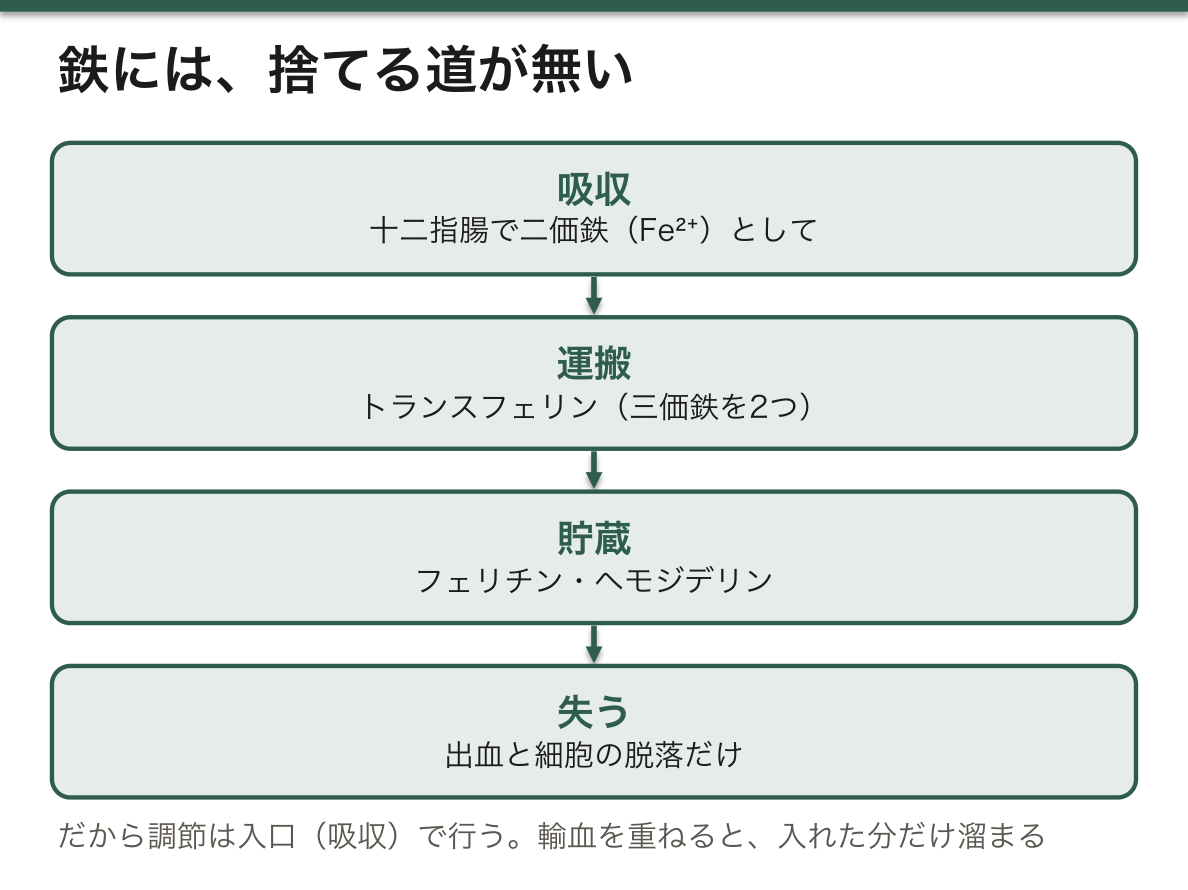
吸収——十二指腸と空腸上部。二価鉄(Fe²⁺)が吸収される。ビタミンCと胃酸が還元を助け、タンニン・フィチン酸・制酸薬が妨げる。
運搬——トランスフェリン(三価鉄を2つ結合)。貯蔵——フェリチン(肝・脾・骨髄)とヘモジデリン。
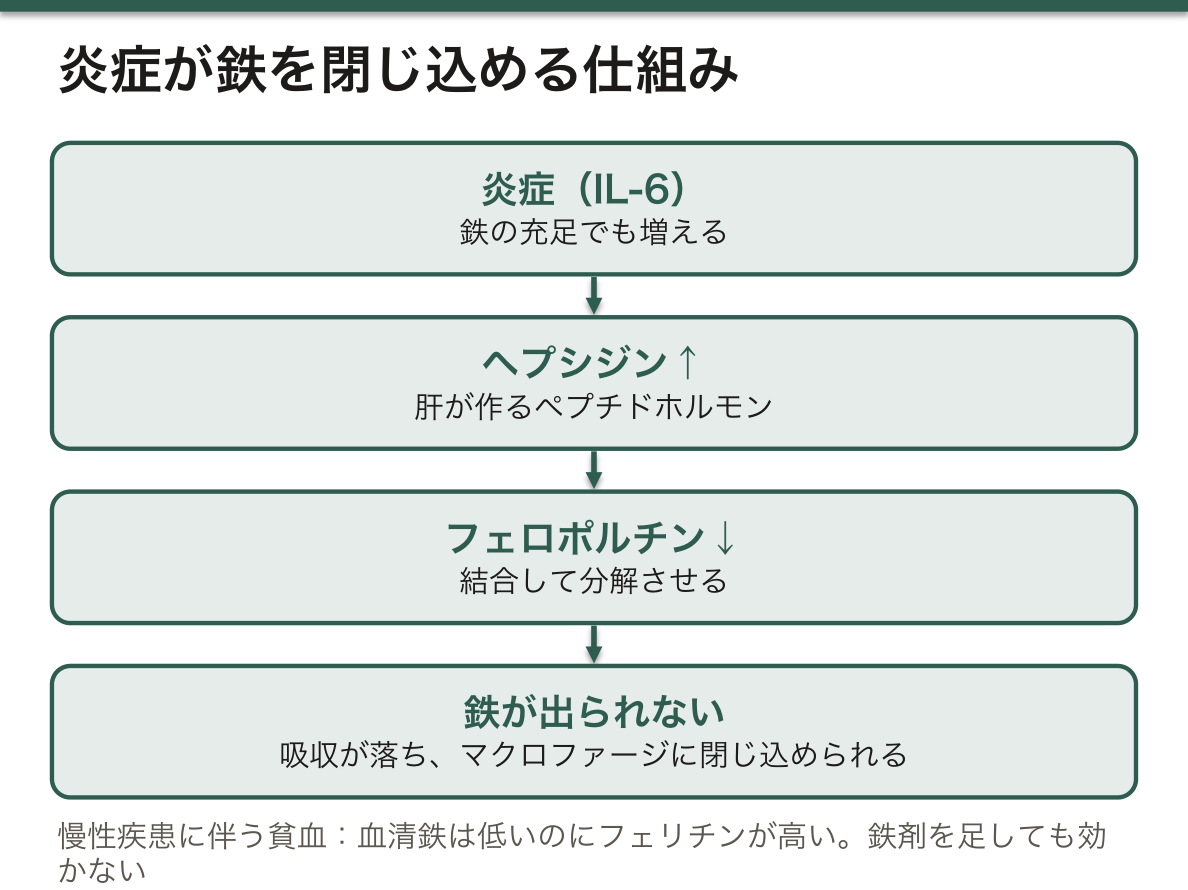
ヘプシジン——肝が作る調節ホルモン。フェロポーチンを分解し、吸収と放出を止める。炎症で増える。
| 血清鉄 | フェリチン | TIBC | 飽和度 | |
|---|---|---|---|---|
| 鉄欠乏性貧血 | ↓ | ↓ | ↑ | ↓ |
| 慢性疾患に伴う貧血 | ↓ | ↑または正常 | ↓ | ↓〜正常 |
| 鉄過剰・ヘモクロマトーシス | ↑ | ↑↑ | ↓ | ↑↑ |
体外への排泄経路は無い——失われるのは出血と細胞の脱落だけ。
鉄欠乏と慢性疾患の貧血を分けるのは、TIBC とフェリチンの向きになる(貧血の鑑別の章)——「血清鉄はどちらも低いので、それだけでは決まらない」。
ただしフェリチンは急性期蛋白でもある。炎症があると、鉄欠乏があっても上がる(検査値を動かす条件の章)——「炎症の下では、フェリチンの低値だけが意味を持つ」。
ヘプシジンが炎症で増えることが、慢性疾患の貧血の実体になる。鉄はあるのに、貯蔵庫から出せない(関節リウマチの貧血の章)——「鉄を足しても治らない貧血がある」。
そして排泄経路が無いことが、輸血依存の患者で鉄過剰を招く。心・肝・膵に沈着する(サラセミアと輸血の章)——「出す道が無いので、入れた分だけ溜まる」。
遺伝性ヘモクロマトーシスは、ヘプシジンの調節が壊れて吸収が止まらない病気になる。肝硬変・糖尿病・皮膚色素沈着(ブロンズ糖尿病)・心筋症(肝の鉄沈着の章)——「臓器の組み合わせが奇妙に見えるとき、沈着する物質を考える」。
成人男性と閉経後女性の鉄欠乏は、消化管出血を疑う理由になる(消化管出血の章)——「鉄欠乏は診断ではなく、原因を探す合図になる」。
English version
Core
Absorption — duodenum and upper jejunum. Ferrous iron (Fe²⁺) is absorbed. Vitamin C and gastric acid assist the reduction; tannins, phytate and antacids hinder it.
Transport — transferrin (binding two ferric ions). Storage — ferritin (liver, spleen, marrow) and haemosiderin.
Hepcidin — the regulatory hormone made by the liver. It degrades ferroportin and stops absorption and release. It rises with inflammation.
| Serum iron | Ferritin | TIBC | Saturation | |
|---|---|---|---|---|
| Iron deficiency | ↓ | ↓ | ↑ | ↓ |
| Anaemia of chronic disease | ↓ | ↑ or normal | ↓ | ↓–normal |
| Iron overload, haemochromatosis | ↑↑ | ↑↑ | ↓ | ↑↑ |
There is no route of excretion — iron is lost only by bleeding and by the shedding of cells.
Going further
What separates iron deficiency from the anaemia of chronic disease is the direction of the TIBC and the ferritin — the serum iron is low in both and does not settle it.
But ferritin is also an acute-phase protein. With inflammation it rises even when iron is deficient — under inflammation only a low ferritin carries meaning.
That hepcidin rises with inflammation is the substance of the anaemia of chronic disease: the iron is there but cannot be released from the store — an anaemia that iron will not cure.
And that there is no route of excretion causes iron overload in the transfusion-dependent patient, depositing in heart, liver and pancreas — with no way out, what is put in accumulates.
Hereditary haemochromatosis is a disease in which the regulation of hepcidin is broken and absorption does not stop: cirrhosis, diabetes, skin pigmentation (bronze diabetes), cardiomyopathy — when a combination of organs looks strange, think of a substance being deposited.
Iron deficiency in an adult man or a postmenopausal woman is a reason to suspect gastrointestinal bleeding — iron deficiency is not a diagnosis but a signal to look for the cause.
亜鉛・銅・ヨウ素・セレン — 欠乏症を酵素から導く
| 元素 | 使う酵素・蛋白 | 欠乏で起きること |
|---|---|---|
| 亜鉛 | アルカリホスファターゼ・炭酸脱水酵素・亜鉛フィンガー | 皮膚炎(開口部と四肢末端)・脱毛・下痢・味覚障害・創傷治癒遅延・成長障害・易感染 |
| 銅 | リシルオキシダーゼ・セルロプラスミン・チトクロムc酸化酵素・チロシナーゼ | 貧血(鉄剤に反応しない)・好中球減少・骨の脆弱・毛髪の異常 |
| ヨウ素 | 甲状腺ホルモン | 甲状腺腫・クレチン症 |
| セレン | グルタチオンペルオキシダーゼ・脱ヨウ素酵素 | 心筋症(克山病)・筋症 |
| マンガン | SOD(ミトコンドリア型)・アルギナーゼ | まれ。過剰で錐体外路症状 |
| クロム | インスリン作用の補助 | 耐糖能異常 |
腸性肢端皮膚炎——亜鉛の吸収障害による遺伝性疾患。開口部周囲と四肢末端の皮疹。
Wilson 病——銅の排泄障害。肝障害・錐体外路症状・Kayser-Fleischer 輪。セルロプラスミン低値。
亜鉛が転写因子(亜鉛フィンガー)に使われることが、欠乏症の症状の幅広さを説明する。細胞が速く入れ替わる場所から順に症状が出る(味蕾の章)——「皮膚・粘膜・味蕾・免疫という並びに、共通項がある」。
だから経静脈栄養が長引く患者では、微量元素を補充する(栄養管理の章)——「主要栄養素だけを入れていると、数週で欠乏症が出る」。
亜鉛と銅は吸収で競合する。亜鉛の大量投与が、銅欠乏性の貧血と好中球減少を起こす——「補充した元素が、別の欠乏症を作る」。
だから鉄剤に反応しない貧血で、銅を測る場面がある(貧血の鑑別の章)——「治療への反応が無いことが、次の検査を決める」。
Wilson 病は、若年の肝障害と精神神経症状の組み合わせで疑う(Wilson病の章)——「治療可能な神経変性疾患なので、見落としの代償が大きい」。
セレンが脱ヨウ素酵素に使われることが、甲状腺との接点になる。欠乏で T4 から T3 への変換が落ちる(甲状腺ホルモンの章)——「ヨウ素だけでなく、セレンも甲状腺の機能に関わる」。
English version
Core
| Element | Enzymes and proteins | Deficiency |
|---|---|---|
| Zinc | Alkaline phosphatase, carbonic anhydrase, zinc fingers | Dermatitis (around the orifices and the extremities), alopecia, diarrhoea, disturbance of taste, delayed wound healing, growth failure, susceptibility to infection |
| Copper | Lysyl oxidase, caeruloplasmin, cytochrome c oxidase, tyrosinase | Anaemia (unresponsive to iron), neutropenia, fragile bone, abnormal hair |
| Iodine | Thyroid hormone | Goitre, cretinism |
| Selenium | Glutathione peroxidase, deiodinases | Cardiomyopathy (Keshan disease), myopathy |
| Manganese | Mitochondrial SOD, arginase | Rare. Excess gives extrapyramidal signs |
| Chromium | Assists the action of insulin | Impaired glucose tolerance |
Acrodermatitis enteropathica — an inherited defect of zinc absorption; a rash around the orifices and on the extremities.
Wilson’s disease — defective excretion of copper. Liver disease, extrapyramidal signs, Kayser–Fleischer rings. Low caeruloplasmin.
Going further
That zinc is used in transcription factors (zinc fingers) explains the breadth of its deficiency syndrome. Symptoms appear first where the cells turn over fastest — skin, mucosa, taste buds and immunity have that in common.
So a patient on prolonged parenteral nutrition is given trace elements — put in the macronutrients alone and deficiency appears within weeks.
Zinc and copper compete for absorption. A large dose of zinc causes copper-deficient anaemia and neutropenia — an element given as a supplement creating another deficiency. So there are occasions to measure copper in an anaemia unresponsive to iron — the absence of a response deciding the next test.
Suspect Wilson’s disease from the combination of liver disease and neuropsychiatric symptoms in a young person — a treatable neurodegenerative disease, so the cost of missing it is high.
That selenium is used in the deiodinases is its point of contact with the thyroid: deficiency reduces the conversion of T4 to T3 — not only iodine but selenium bears on thyroid function.
ヘプシジン — 鉄を体に閉じ込めるホルモン
ヒトには鉄を能動的に捨てる仕組みが無い——失われるのは剥落と出血だけ。だから調節は「入れる量」で行う。
ヘプシジンは肝が作るペプチドホルモン。フェロポルチン(鉄を細胞外へ出す唯一の輸送体)に結合して分解させる。
| ヘプシジン | フェロポルチン | 結果 |
|---|---|---|
| 増える | 減る | 腸からの吸収が落ち、マクロファージ内に鉄が閉じ込められる |
| 減る | 増える | 吸収が進み、貯蔵鉄が動員される |
ヘプシジンを増やすもの——鉄の充足・炎症(IL-6)。減らすもの——鉄欠乏・造血の亢進(エリスロフェロン)・低酸素。
「捨てられないから、入口で守る」という設計が、鉄に関する病態の全部を貫いている。過剰になれば逃げ場が無い(この章の鉄代謝の項)——「輸血を繰り返す患者に、鉄キレート薬が要る理由になる」。
炎症でヘプシジンが上がることが、慢性疾患に伴う貧血の正体になる。体内に鉄はあるのに、マクロファージから出せない(貧血の各論の章)——「血清鉄は低いのにフェリチンが高い、という組み合わせが決め手になる」。
だから鉄剤を出しても効かない。吸収も動員も止まっているので、原因の炎症を治すのが先になる——「検査値だけを見て鉄を足すと、害になる」。
感染に対する防御としても働いている。細菌も鉄を必要とするので、炎症時に鉄を隠すことは栄養の面での免疫になる(nutritional immunity)(細菌の武器の章)——「鉄を投与することが、感染を悪化させうる」。
遺伝性ヘモクロマトーシスは、この調節が効かない状態になる。HFE 遺伝子の異常でヘプシジンが十分に出ず、吸収が止まらない。肝硬変・糖尿病・皮膚色素沈着・心筋症(肝の貯蔵の章)——「治療は瀉血。捨てる道が無いなら、血ごと抜く」。
English version
Core
Humans have no mechanism for actively discarding iron — it is lost only by shedding and bleeding. So regulation is by how much is let in.
Hepcidin is a peptide hormone made by the liver. It binds ferroportin (the only transporter that moves iron out of a cell) and has it degraded.
| Hepcidin | Ferroportin | Result |
|---|---|---|
| Increased | Decreased | Absorption from the gut falls and iron is shut inside the macrophages |
| Decreased | Increased | Absorption proceeds and stored iron is mobilised |
Raised by — iron sufficiency, inflammation (IL-6). Lowered by — iron deficiency, active erythropoiesis (erythroferrone), hypoxia.
Going further
The design of "since it cannot be discarded, guard the entrance" runs through the whole pathology of iron. Once in excess there is nowhere for it to go — the reason a repeatedly transfused patient needs an iron chelator.
That hepcidin rises with inflammation is the substance of the anaemia of chronic disease: the iron is in the body but cannot leave the macrophage — a low serum iron with a high ferritin is the decisive combination.
So iron given as a drug does not work. Absorption and mobilisation are both stopped, and the inflammation that causes it must be treated first — adding iron on the strength of the numbers alone does harm.
It also works as a defence against infection. Bacteria need iron too, so hiding iron during inflammation is immunity in a nutritional sense (nutritional immunity) — and giving iron can worsen an infection.
Hereditary haemochromatosis is this regulation failing. An abnormality of the HFE gene means insufficient hepcidin and absorption that does not stop: cirrhosis, diabetes, pigmentation, cardiomyopathy — the treatment is venesection. If there is no way to discard it, take it out with the blood.
重金属が止める酵素 — 中毒は、どの反応を潰したかで読む
| 金属 | 止める反応 | 症状 |
|---|---|---|
| 鉛 | ヘム合成(ALA脱水酵素・フェロキラターゼ) | 小球性貧血・好塩基性斑点・腹痛(鉛疝痛)・末梢神経障害(橈骨神経麻痺)・小児の発達障害・歯肉の鉛縁 |
| 水銀(有機) | チオール基(SH)に結合し、多くの酵素を阻害 | 感覚障害・運動失調・求心性視野狭窄・難聴(水俣病) |
| カドミウム | 近位尿細管の障害 | 骨軟化症・多発骨折(イタイイタイ病)・低分子蛋白尿 |
| ヒ素 | ピルビン酸脱水素酵素のリポ酸に結合 | 消化器症状・末梢神経障害・皮膚角化・Mees 線 |
治療は多くがキレート剤——鉛にはエデト酸カルシウム・ジメルカプロール、水銀とヒ素にはジメルカプロール。
「金属はチオール基を掴む」という一点が、毒性の共通の機序になる。酵素の活性中心にあるシステインを塞ぐので、影響が多くの反応に及ぶ(酵素の章)——「だからキレート剤も、チオール基を持つ分子で作られている」。
鉛だけが、症状から酵素を特定できる。ヘム合成の2か所が止まるので、鉄はあるのに小球性貧血になり、ポルフィリン前駆体が溜まる(ヘム合成の章)——「小球性貧血で鉄が正常なら、鉛とサラセミアを考える」。
好塩基性斑点(好塩基性斑点赤血球)は、リボソーム RNA が分解されずに残った像になる(血算を読む章)——「塗抹の1つの所見が、職業歴を聞く理由になる」。
公害の3つは、日本の公衆衛生の出題で必ず問われる(疾病別の対策の章)——「水俣病=メチル水銀・イタイイタイ病=カドミウム・四日市喘息=亜硫酸ガス」。
カドミウムが尿細管を壊すことは、検査所見に直結する。β2-ミクログロブリンなどの低分子蛋白が再吸収されずに尿へ出る(尿を読む章)——「アルブミン尿ではないので、試験紙では拾えない」。
English version
Core
| Metal | Reaction blocked | Symptoms |
|---|---|---|
| Lead | Haem synthesis (ALA dehydratase, ferrochelatase) | Microcytic anaemia, basophilic stippling, abdominal pain (lead colic), peripheral neuropathy (wrist drop), developmental delay in children, a lead line on the gums |
| Mercury (organic) | Binds thiol (SH) groups and inhibits many enzymes | Sensory disturbance, ataxia, concentric constriction of the visual fields, deafness (Minamata disease) |
| Cadmium | Damages the proximal tubule | Osteomalacia, multiple fractures (itai-itai disease), low molecular weight proteinuria |
| Arsenic | Binds the lipoic acid of pyruvate dehydrogenase | Gastrointestinal symptoms, peripheral neuropathy, hyperkeratosis, Mees’ lines |
Treatment is largely by chelation — calcium EDTA and dimercaprol for lead, dimercaprol for mercury and arsenic.
Going further
The single point that metals seize thiol groups is the common mechanism of their toxicity. They block the cysteine at the active centre of an enzyme, so the effect extends to many reactions — and the chelators too are built as molecules bearing thiol groups.
Lead alone allows the enzyme to be identified from the symptoms. Two steps of haem synthesis are blocked, so there is a microcytic anaemia despite adequate iron, and porphyrin precursors accumulate — a microcytic anaemia with normal iron means lead or thalassaemia.
Basophilic stippling is the picture of ribosomal RNA left undegraded — one finding on a film being the reason to ask about the occupation.
The three great pollution diseases are always asked in Japanese public health — Minamata = methylmercury, itai-itai = cadmium, Yokkaichi asthma = sulphur dioxide.
That cadmium destroys the proximal tubule bears directly on the findings: low molecular weight proteins such as β2-microglobulin are not reabsorbed and appear in the urine — it is not albuminuria, so the dipstick does not detect it.
静脈栄養では、足りなくなるものと溜まるものが同時に起きる
口から食べていれば、腸が吸収量を調節してくれる。静脈から入れると、その関門を素通りするので、不足と過剰が同時に起こりうる。
| 足りなくなるもの | セレン・亜鉛・銅・鉄・ビタミン B1 | 市販の微量元素製剤に含まれない元素がある |
| 溜まるもの | マンガン・アルミニウム | 胆汁から捨てる元素は、胆汁うっ滞があると排泄できない |
マンガンの蓄積が代表的な問題である。基底核に溜まり、MRI の T1 強調像で淡蒼球が高信号になる。パーキンソニズム・精神症状を起こし、投与を止めても改善に数か月かかる。
⚠️ ビタミン B1 を入れずにブドウ糖を投与すると、数日で Wernicke 脳症を起こす。糖の代謝に消費されるためで、静脈栄養で最も避けなければならない事故の1つである。
欠乏症は「その元素を使う酵素が止まった姿」として現れる。だから症状から元素を逆算できる。
| セレン | グルタチオンペルオキシダーゼ | 心筋症(克山病)・筋痛。長期の静脈栄養と経腸栄養剤で報告される |
| 亜鉛 | 200 を超える酵素と転写因子 | 口囲と肛門周囲の皮膚炎・脱毛・下痢・味覚障害・創傷治癒の遅れ |
| 銅 | リシルオキシダーゼ・チトクロム c 酸化酵素 | 貧血と白血球減少(鉄剤に反応しない)・脊髄症。亜鉛の過剰補充で起きることがある |
| クロム | インスリンの作用を助ける | 耐糖能の悪化・末梢神経障害 |
| モリブデン | 亜硫酸酸化酵素 | 頻脈・頭痛・意識障害(亜硫酸の蓄積)。極めて稀 |
実務での押さえどころ。
- 静脈栄養が 2 週間を超えるなら、微量元素製剤とビタミン製剤を必ず併用する
- 胆汁うっ滞があればマンガンと銅を減らす——検査値ではなく、経路で判断する
- 経腸栄養剤だけを長期に使う場合も欠乏は起きる——特にセレンとカルニチン。「食事の代わり」だから安全とは限らない
長期の栄養管理では、何日目に何を足したかを記録に残す。欠乏症は数か月かけて現れるので、後から経過を追えることが役に立つ。
English version
Core
When food is eaten, the gut regulates how much is absorbed. Given intravenously it bypasses that gate, so deficiency and excess can occur at the same time.
| What happens | Why | |
|---|---|---|
| Runs short | Selenium, zinc, copper, iron, vitamin B1 | Some elements are not in the commercial trace element preparations |
| Accumulates | Manganese, aluminium | Elements excreted in the bile cannot be excreted when there is cholestasis |
Manganese accumulation is the classic problem. It deposits in the basal ganglia and gives a high signal from the globus pallidus on T1-weighted MRI, causing parkinsonism and psychiatric symptoms; improvement takes months after it is stopped.
⚠️ Give glucose without thiamine and Wernicke’s encephalopathy follows within days, the thiamine being consumed in the metabolism of the sugar. One of the accidents most to be avoided in parenteral nutrition.
Going further
A deficiency appears as the picture of the enzyme that uses the element having stopped. So the element can be worked backwards from the symptoms.
| Element | Enzyme | Deficiency |
|---|---|---|
| Selenium | Glutathione peroxidase | Cardiomyopathy (Keshan disease), myalgia. Reported with long-term parenteral and enteral feeding |
| Zinc | Over 200 enzymes and transcription factors | Perioral and perianal dermatitis, alopecia, diarrhoea, disturbance of taste, delayed wound healing |
| Copper | Lysyl oxidase, cytochrome c oxidase | Anaemia and leucopenia (unresponsive to iron), myelopathy. May follow over-supplementation with zinc |
| Chromium | Assists insulin | Worsening glucose tolerance, peripheral neuropathy |
| Molybdenum | Sulphite oxidase | Tachycardia, headache, impaired consciousness (accumulation of sulphite). Extremely rare |
The practical points.
- If parenteral nutrition will exceed two weeks, always give trace element and vitamin preparations with it.
- With cholestasis, reduce the manganese and copper — judge by the route, not by the laboratory value.
- Deficiency also occurs with long-term enteral feeds alone, especially selenium and carnitine. Being "a substitute for food" does not make it safe.
In the clinic
In long-term nutritional care, record what was added and on what day. Deficiency appears over months, and being able to trace the course afterwards is useful.
血中濃度が、体の中の量を映さない元素がある
ミネラルの多くは細胞の中や骨にあり、血中にはごく一部しかない。だから血清値は、体内の量というより「いま血の中にどれだけあるか」を測っているにすぎない。
| マグネシウム | 体内の 約 1% しか血中に無い | 血清値が正常でも欠乏していることがある。低カリウム・低カルシウムが治らないときに疑う |
| 亜鉛 | アルブミンに結合。日内変動があり朝が高い | 低アルブミン血症・炎症・食後で低く出る。早朝空腹時に測る |
| 鉄 | 日内変動が大きい | 血清鉄だけでは判断できない。フェリチンと飽和度で見る |
| カルシウム | 約半分がアルブミンに結合 | 補正するか、イオン化カルシウムを測る |
マグネシウムが最も臨床的に効く例になる。
低マグネシウム血症があると、カリウムもカルシウムも補正できない。
- カリウム——Mg が低いと腎の ROMK チャネルの抑制が外れ、カリウムが尿へ漏れ続ける。いくら補充しても追いつかない
- カルシウム——Mg が低いとPTH の分泌そのものが止まり、しかも PTH への反応も鈍る。機能的な副甲状腺機能低下症になる
だから「治らない低カリウム血症・低カルシウム血症を見たら、まず Mg を測って補う」——順序が決まっている。
Mg が下がる原因も押さえておく。プロトンポンプ阻害薬・利尿薬・アルコール・下痢・シスプラチン・アミノグリコシド・低栄養。とくに PPI による低 Mg 血症は、数か月から数年かけて起こり、原因として見落とされやすい。
⚠️ 逆に、値が高く出る仕掛けもある。溶血した検体ではカリウム・マグネシウム・リン・LDH が偽性に高く出る(いずれも赤血球内に多い)。「その値は、採血の途中で作られていないか」を毎回考える。
補正しても戻らない電解質異常では、Mg を測る。測らずに補うという運用をしている施設もあるほど、頻度が高い。
English version
Core
Most minerals lie within cells or in bone, and only a fraction is in the blood. So a serum value measures how much is in the blood at that moment rather than how much is in the body.
| Element | Where it is | Consequence |
|---|---|---|
| Magnesium | Only about 1 per cent is in the blood | A normal serum level does not exclude deficiency. Suspect it when hypokalaemia or hypocalcaemia will not correct |
| Zinc | Bound to albumin; diurnal, higher in the morning | Reads low with hypoalbuminaemia, inflammation or after a meal. Measure fasting, early in the morning |
| Iron | Large diurnal variation | Serum iron alone will not do. Judge by ferritin and saturation |
| Calcium | About half bound to albumin | Correct it, or measure ionised calcium |
Going further
Magnesium is the example that tells most clinically. With hypomagnesaemia neither potassium nor calcium can be corrected.
- Potassium — with a low Mg the inhibition of the renal ROMK channel is released and potassium goes on leaking into the urine. No amount of replacement keeps up.
- Calcium — with a low Mg the secretion of PTH itself stops, and the response to PTH is blunted as well: a functional hypoparathyroidism.
So "when hypokalaemia or hypocalcaemia will not correct, measure and replace the magnesium first" — the order is fixed.
Know the causes of a low Mg: proton pump inhibitors, diuretics, alcohol, diarrhoea, cisplatin, aminoglycosides, malnutrition. Hypomagnesaemia from PPIs develops over months to years and is readily missed as a cause.
⚠️ There are also devices that make a value read high. In a haemolysed sample, potassium, magnesium, phosphate and LDH all read falsely high (all being abundant within red cells). Ask every time whether the value was manufactured during the venepuncture.
In the clinic
In an electrolyte disturbance that will not correct with replacement, measure the magnesium. It is frequent enough that some units simply replace it without measuring.
まとめ
| 鉄代謝 — 4つの検査値が、それぞれ別のことを言う | 吸収——十二指腸と空腸上部。二価鉄(Fe²⁺)が吸収される。 |
|---|---|
| 亜鉛・銅・ヨウ素・セレン — 欠乏症を酵素から導く | 元素使う酵素・蛋白欠乏で起きること亜鉛アルカリホスファターゼ・炭酸脱水酵素・亜鉛フィンガー皮膚炎(開口部と四肢末端)・脱毛・下痢・味覚障害・創傷治癒遅延・成長障害・易感染銅リシルオ… |
| ヘプシジン — 鉄を体に閉じ込めるホルモン | ヒトには鉄を能動的に捨てる仕組みが無い——失われるのは剥落と出血だけ。 |
| 重金属が止める酵素 — 中毒は、どの反応を潰したかで読む | 金属止める反応症状鉛ヘム合成(ALA脱水酵素・フェロキラターゼ)小球性貧血・好塩基性斑点・腹痛(鉛疝痛)・末梢神経障害(橈骨神経麻痺)・小児の発達障害・歯肉の鉛縁水銀(有機)チオー… |
| 静脈栄養では、足りなくなるものと溜まるものが同時に起きる | 口から食べていれば、腸が吸収量を調節してくれる。 |
| 血中濃度が、体の中の量を映さない元素がある | ミネラルの多くは細胞の中や骨にあり、血中にはごく一部しかない。 |
このノートは医学生が授業の内容を自分の言葉でまとめたもので、診療の判断に使うものではありません。誤りに気づいたらお知らせください。