多細胞生物では、「増えないこと」と「必要なときに死ぬこと」が、増えることと同じくらい重要である。癌はこの2つが同時に破綻した状態と言える。
細胞周期には関門(チェックポイント)があり、DNAに損傷があれば止め、直せなければ死なせる。この判断を担う中心がp53で、ヒトの癌の約半数でp53が壊れている。
- 細胞周期の関門 — サイクリンと、癌抑制遺伝子
- アポトーシスとネクローシス — 静かに死ぬか、周りを巻き込むか
- p53 — ゲノムの守護者が下す、3つの結末
- 増殖の速さを測る — Ki-67 が見ているのは、細胞周期のどこか
- 細胞周期のどこにいるかで、薬と放射線の効き方が変わる
- 癌になる遺伝子と、癌を防ぐ遺伝子は、壊れ方が対称ではない
細胞周期の関門 — サイクリンと、癌抑制遺伝子
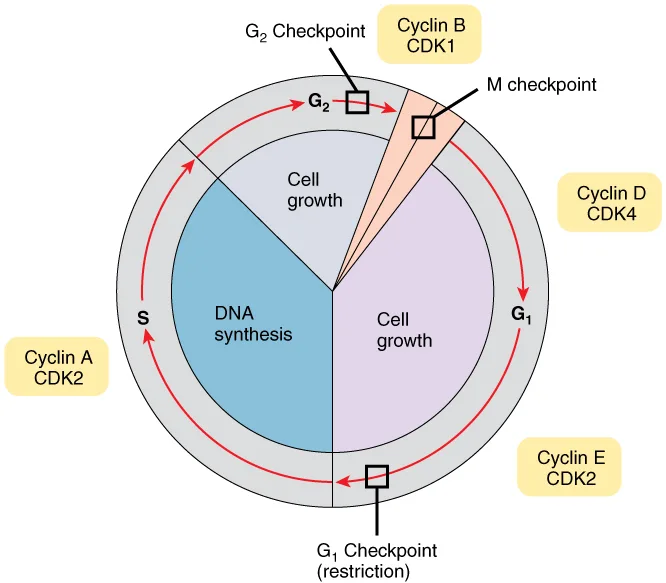
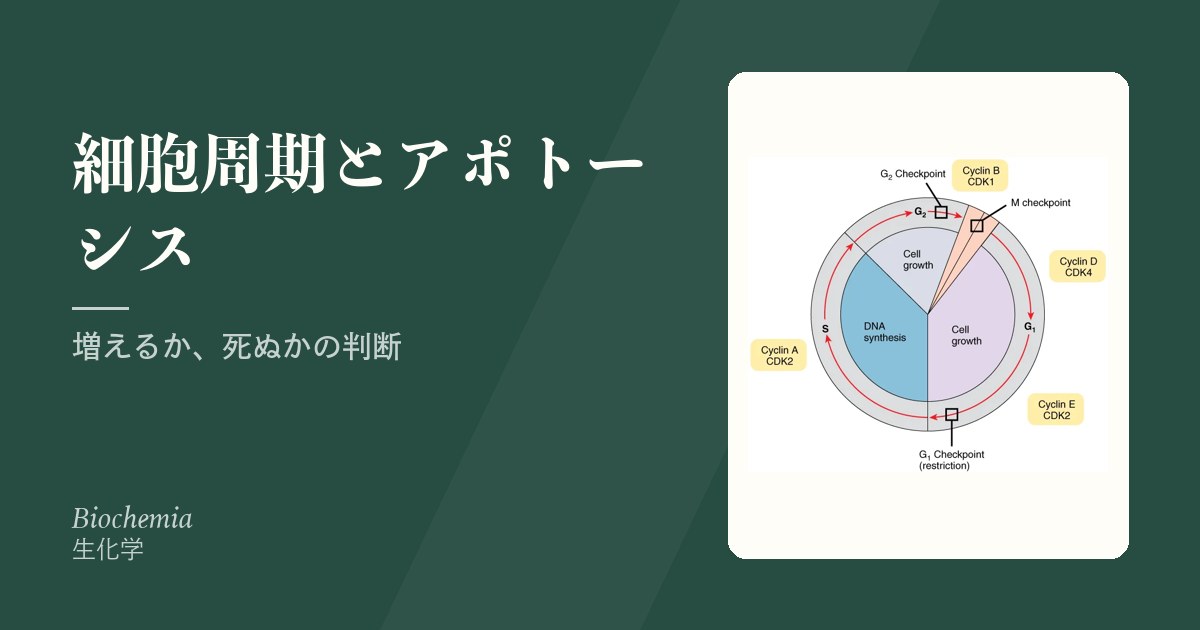
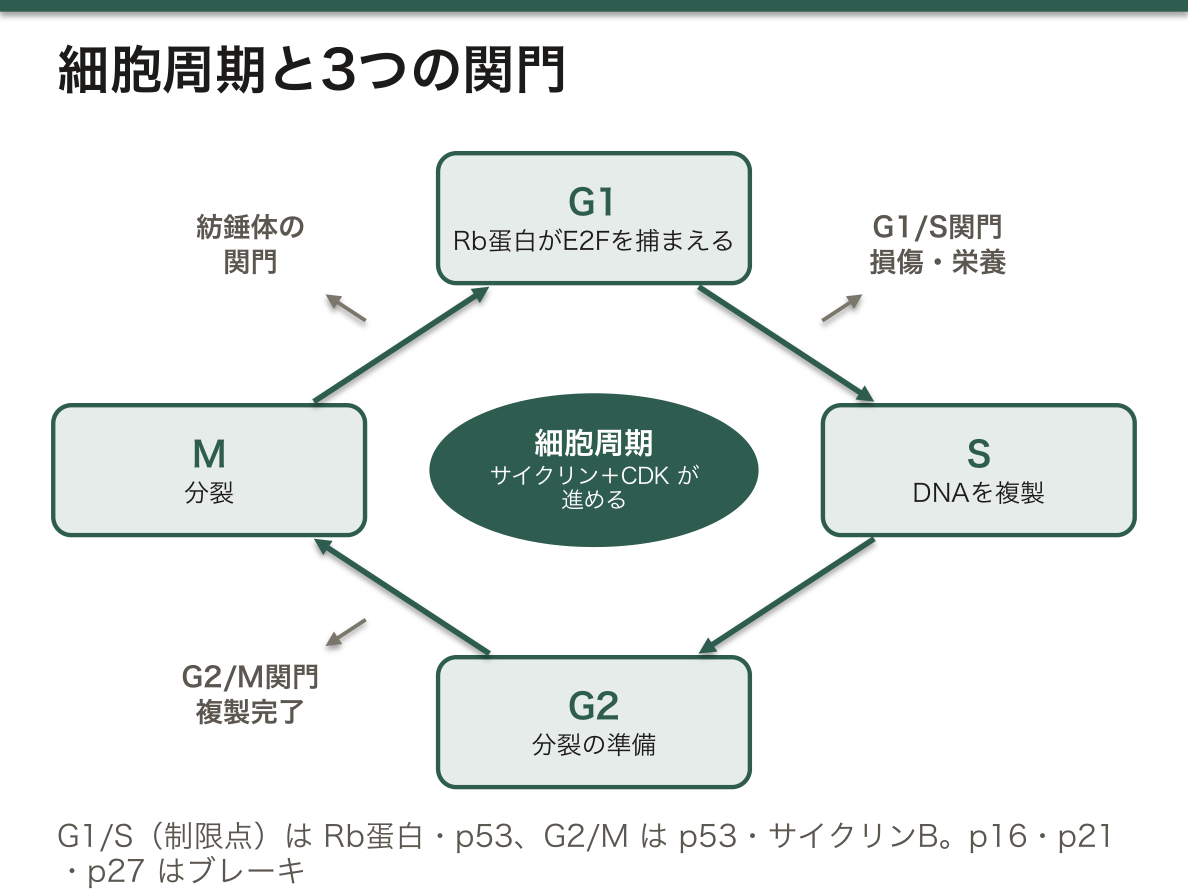
周期はG1 → S → G2 → M。進めるのはサイクリンとサイクリン依存性キナーゼの複合体である。
| 関門 | 何を確かめるか | 中心分子 |
|---|---|---|
| G1/S(制限点) | DNAに損傷が無いか、栄養は足りるか | Rb蛋白・p53 |
| G2/M | 複製が完了したか | p53・サイクリンB |
| 紡錘体 | 染色体が正しく付いたか | — |
- Rb蛋白は転写因子E2Fを捕まえて、周期を止めている。リン酸化されると離し、S期へ進む
- p16・p21・p27はサイクリン依存性キナーゼを阻害する(ブレーキ)
- 癌遺伝子はアクセルの故障(片方の変異で発症)、癌抑制遺伝子はブレーキの故障(両方壊れて発症)
Knudsonの二段階仮説が、遺伝性腫瘍の見え方を決めている。癌抑制遺伝子は2つある対立遺伝子の両方が壊れて初めて機能を失う。
- 遺伝性(家族性)——生まれつき片方が壊れている。もう1回で発症するので、若年・両側性・多発性になる
- 散発性——2回とも後天的に起きる必要があるので、高齢・片側・単発
網膜芽細胞腫で両眼性なら遺伝性、という判断はここから出る。家族歴が無くても、両側性なら生殖細胞系列の変異を疑う——新生変異があるからである。
p53が「ゲノムの守護者」と呼ばれる理由。DNA損傷を検知すると、
- p21を誘導して細胞周期を止める(修復の時間を稼ぐ)
- 修復させる
- 直らなければアポトーシスへ送る
Li-Fraumeni症候群は生殖細胞系列のp53変異で、若年から多臓器に多様な癌が出る。放射線診断を安易に繰り返さないという配慮が要る。
サイクリン依存性キナーゼ4/6阻害薬(パルボシクリブなど)は、Rb蛋白のリン酸化を止めてG1で足止めする薬で、ホルモン受容体陽性乳癌に用いられる。Rbが壊れている腫瘍には効かない——薬の作用点の下流が生きていることが条件だからである。
English version
Core
The cycle is G1 → S → G2 → M. What drives it is the complex of a cyclin and a cyclin-dependent kinase.
| Gate | What it checks | Central molecules |
|---|---|---|
| G1/S (the restriction point) | Is the DNA undamaged, are nutrients sufficient | Rb protein, p53 |
| G2/M | Is replication complete | p53, cyclin B |
| Spindle | Are the chromosomes correctly attached | — |
- The Rb protein holds the transcription factor E2F and stops the cycle. Phosphorylated, it lets go and the cell proceeds to S phase.
- p16, p21 and p27 inhibit the cyclin-dependent kinases (the brakes).
- An oncogene is a fault in the accelerator (one mutation suffices); a tumour suppressor is a fault in the brake (both copies must break).
Going further
Knudson’s two-hit hypothesis decides how hereditary tumours appear. A tumour suppressor loses its function only when both alleles are broken.
- Hereditary (familial) — one copy is broken from birth. One more hit causes disease, so it is young, bilateral and multiple.
- Sporadic — both hits must be acquired, so it is older, unilateral and single.
Bilateral retinoblastoma means hereditary — the judgement comes from here. Even without a family history, bilaterality raises a germline mutation — because there are new mutations.
Why p53 is called "the guardian of the genome". On detecting DNA damage it
- induces p21 and stops the cell cycle (buying time for repair)
- has the damage repaired
- sends the cell to apoptosis if it cannot be repaired.
Li–Fraumeni syndrome is a germline p53 mutation, with diverse cancers in many organs from a young age. The care of not lightly repeating radiological investigations is required.
CDK4/6 inhibitors (palbociclib and others) are drugs that stop the phosphorylation of the Rb protein and hold the cell in G1, used in hormone receptor-positive breast cancer. They do not work in a tumour whose Rb is broken — because what lies downstream of the drug’s point of action must be intact.
アポトーシスとネクローシス — 静かに死ぬか、周りを巻き込むか
| アポトーシス | ネクローシス | |
|---|---|---|
| 引き金 | 計画された・生理的 | 外傷・虚血・毒 |
| 細胞の形 | 縮む・膜は保たれる | 膨れて破れる |
| 核 | 断片化(ラダー状のDNA切断) | 不規則に融解 |
| 炎症 | 起こさない | 起こす |
| ATP | 必要 | 不要 |
アポトーシスの2つの入口。
- 内因系(ミトコンドリア経路)——Bcl-2ファミリーが決める。Bax・BakがミトコンドリアからシトクロムCを出し、カスパーゼ9を活性化。Bcl-2は抑える側
- 外因系(death receptor経路)——Fas・腫瘍壊死因子受容体にリガンドが結合 → カスパーゼ8
どちらも実行カスパーゼ(3・6・7)に集約する。
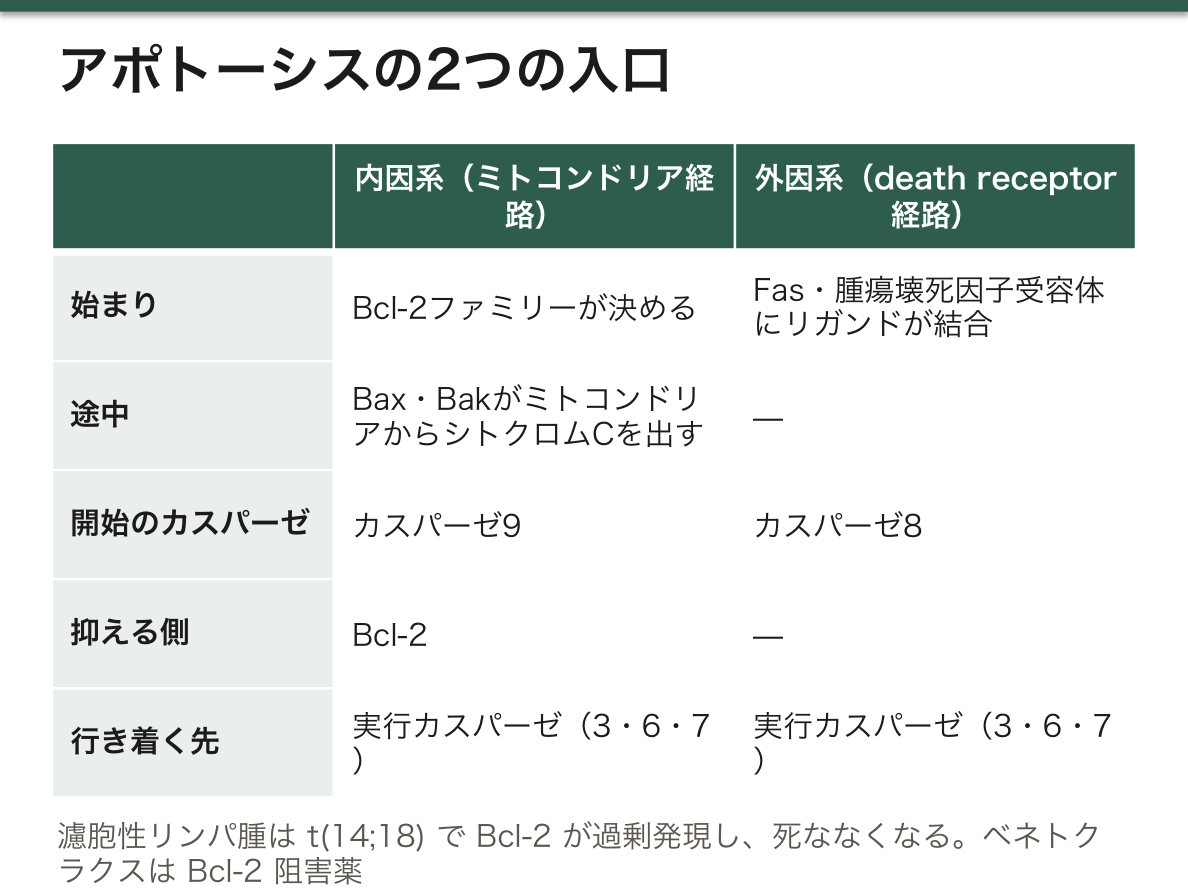
Bcl-2の名前は疾患から付いた。濾胞性リンパ腫のt(14;18)転座により、Bcl-2遺伝子が免疫グロブリン重鎖の強力な制御領域の下に置かれ、過剰発現する。するとアポトーシスが起きなくなり、B細胞が死なずに溜まる。
「増えるのが速いのではなく、死ななくなった腫瘍」という概念がここで生まれた。だから増殖を止める従来の抗癌薬が効きにくく、経過が緩慢なのに治りにくい——濾胞性リンパ腫の臨床像がそのまま説明される。
ベネトクラクス(Bcl-2阻害薬)は、この抑えを外してアポトーシスを再開させる薬である。効きすぎて腫瘍崩壊症候群を起こすため、少量から漸増する——機序が副作用の管理法まで決めている。
Fas経路は免疫の恒常性を担う。細胞傷害性T細胞が標的を殺す手段であり、同時に役目を終えた活性化リンパ球を除去する仕組みでもある。Fasの変異では自己免疫性リンパ増殖症候群——リンパ節腫脹と自己免疫性血球減少——が起きる。
ネクローシスにも制御された型があることが分かってきた。ネクロプトーシスやパイロトーシス(インフラマソームによる、インターロイキン1βの放出を伴う細胞死)で、「炎症を伴う細胞死」も遺伝的にプログラムされている。敗血症や自己炎症性疾患の理解が、この視点で書き換えられつつある。
English version
Core
| Apoptosis | Necrosis | |
|---|---|---|
| Trigger | Programmed, physiological | Trauma, ischaemia, poison |
| Shape of the cell | Shrinks, the membrane is preserved | Swells and bursts |
| Nucleus | Fragmentation (a ladder of DNA cuts) | Irregular lysis |
| Inflammation | None | Yes |
| ATP | Required | Not required |
The two entrances to apoptosis.
- Intrinsic (the mitochondrial pathway) — the Bcl-2 family decides. Bax and Bak release cytochrome C from the mitochondrion and activate caspase 9. Bcl-2 is on the suppressing side.
- Extrinsic (the death receptor pathway) — a ligand binds Fas or a TNF receptor → caspase 8.
Both converge on the executioner caspases (3, 6, 7).
Going further
Bcl-2 was named from a disease. The t(14;18) translocation of follicular lymphoma places the Bcl-2 gene under the powerful regulatory region of the immunoglobulin heavy chain and it is overexpressed. Then apoptosis no longer occurs and B cells accumulate without dying.
The concept "a tumour that does not proliferate fast but has stopped dying" was born here. Hence conventional antitumour drugs that stop proliferation work poorly, and the course is indolent and hard to cure — the clinical picture of follicular lymphoma explained directly.
Venetoclax (a Bcl-2 inhibitor) is a drug that lifts this suppression and restarts apoptosis. It works so well that it causes tumour lysis syndrome, so it is started at a small dose and increased gradually — the mechanism deciding even how the adverse effect is managed.
The Fas pathway maintains the homeostasis of immunity. It is the means by which a cytotoxic T cell kills its target and at the same time the mechanism removing activated lymphocytes whose work is done. A mutation of Fas gives autoimmune lymphoproliferative syndrome — lymphadenopathy and autoimmune cytopenias.
It has emerged that necrosis too has regulated forms. Necroptosis and pyroptosis (cell death through the inflammasome, accompanied by release of interleukin 1β), so that "cell death with inflammation" is also genetically programmed. The understanding of sepsis and of the autoinflammatory diseases is being rewritten from this point of view.
p53 — ゲノムの守護者が下す、3つの結末
DNA 損傷・低酸素・癌遺伝子の活性化などを感知して安定化し、転写因子として働く。
下す判断は3つになる。
| 結末 | 働く分子 | 意味 |
|---|---|---|
| ①細胞周期を止める | p21 が CDK を阻害 → G1/S 関門で停止 | 直す時間を作る |
| ②修復する | GADD45 など | 直す |
| ③死ぬ・老化する | BAX・PUMA・NOXA | 直らないなら残さない |
平時は MDM2 によって分解され続けている——ストレスでリン酸化されると MDM2 から外れて蓄積する。
ヒトの悪性腫瘍の約半数で TP53 に変異がある。生殖細胞系列の変異は Li-Fraumeni 症候群になる。
「壊れているのは、増やす仕組みではなく、止める仕組みである」というのが癌抑制遺伝子の考え方になる。アクセルを踏むのではなく、ブレーキが効かない(発癌の分子機構の章)——「だから両方の対立遺伝子が失われて初めて効く(two-hit)」。
p53 が失われることは、治療への抵抗にも直結する。放射線も多くの抗腫瘍薬も、DNA を傷つけてアポトーシスを起こさせる薬になる(放射線生物学の章)——「傷を感知して死ぬ仕組みが無ければ、傷つけても死なない」。
ヒトパピローマウイルスの E6 蛋白は、p53 を分解へ導く(ウイルスと発癌の章)——「E7 は Rb を不活化するので、2つのブレーキが同時に外れる」。
Li-Fraumeni 症候群では、若年で多臓器に腫瘍が出る(遺伝性腫瘍の章)——「サーベイランスに放射線を伴う検査を避け、MRI を使う」。
細胞老化も、p53 が選ぶ結末の1つになる(細胞老化の章)——「癌を防ぐ仕組みが、老化を進める仕組みでもある」。
English version
Core
It is stabilised on sensing DNA damage, hypoxia or the activation of an oncogene, and acts as a transcription factor.
It hands down three verdicts.
| Outcome | Molecules | Meaning |
|---|---|---|
| ① Stop the cell cycle | p21 inhibits CDK → arrest at the G1/S gate | Make time to repair |
| ② Repair | GADD45 and others | Repair it |
| ③ Die or senesce | BAX, PUMA, NOXA | If it cannot be repaired, do not leave it |
In peacetime it is continually degraded by MDM2 — phosphorylated under stress, it leaves MDM2 and accumulates.
About half of human malignancies have a mutation of TP53. A germline mutation gives Li–Fraumeni syndrome.
Going further
- The idea of a tumour suppressor is that what is broken is not the machinery that multiplies but the machinery that stops. Not the accelerator pressed but the brake not working (the chapter on the molecular mechanisms of carcinogenesis) — hence it tells only when both alleles are lost (two hits).
- Losing p53 bears directly on resistance to treatment. Radiation and most antitumour drugs are agents that damage DNA and cause apoptosis (the chapter on radiation biology) — with no mechanism to sense damage and die, damage does not kill.
- The E6 protein of human papillomavirus sends p53 to degradation (the chapter on viruses and carcinogenesis) — E7 inactivates Rb, so two brakes come off at once.
- In Li–Fraumeni syndrome tumours arise young in many organs (the chapter on hereditary tumours) — avoid investigations involving radiation in surveillance and use MRI.
- Cellular senescence is also one of the outcomes p53 chooses (the chapter on cellular senescence) — the mechanism that prevents cancer being also the mechanism that advances ageing.
増殖の速さを測る — Ki-67 が見ているのは、細胞周期のどこか
Ki-67 は、G1・S・G2・M 期に発現し、G0 期には発現しない核蛋白になる——つまり「休んでいない細胞」を染める。
陽性細胞の割合(標識率)が、腫瘍の増殖能の指標になる。
| 腫瘍 | 使われ方 |
|---|---|
| 乳癌 | Luminal A と B の区別、化学療法の適応 |
| 神経内分泌腫瘍 | 核分裂像数と合わせて G1/G2/G3 に分ける |
| リンパ腫 | Burkitt リンパ腫ではほぼ 100% |
細胞周期の関門は2つが主になる——G1/S(Rb と E2F、p53-p21)と G2/M(DNA 損傷のチェック)。
細胞周期に入っていない G0 の細胞は、多くの抗腫瘍薬が効かない。
「増殖が速い腫瘍ほど、薬がよく効く」という原則と、その裏返しがここにある。Burkitt リンパ腫は化学療法によく反応し、腫瘍崩壊症候群を起こしやすい(腫瘍崩壊症候群の項)——「効きすぎることが、危険になる」。
逆に、休んでいる細胞が残ることが再発の源になる(腫瘍総論の章)——「治療が終わった後に、G0 から戻ってくる細胞がいる」。
だから細胞周期に依存しない薬や、分割照射という工夫が要る(放射線治療の章)——「時間をかけて当てることで、周期に入ってきた細胞を捕まえている」。
CDK4/6 阻害薬は、G1/S の関門を直接止める薬になる(分子標的薬の章)——「ホルモン受容体陽性の乳癌で、内分泌療法と併用される」。
正常組織でも、増殖の速い場所が副作用の場所になる(消化管上皮の章)——「骨髄・消化管粘膜・毛根・生殖細胞が、その順に並ぶ」。
English version
Core
Ki-67 is a nuclear protein expressed in G1, S, G2 and M and not in G0 — that is, it stains "cells that are not resting".
The proportion of positive cells (the labelling index) is an index of the proliferative capacity of a tumour.
| Tumour | How it is used |
|---|---|
| Breast cancer | Distinguishing luminal A from B, the indication for chemotherapy |
| Neuroendocrine tumour | With the mitotic count, dividing into G1/G2/G3 |
| Lymphoma | Nearly 100 per cent in Burkitt lymphoma |
There are two chief gates in the cycle — G1/S (Rb and E2F, p53-p21) and G2/M (the check on DNA damage).
Cells not in the cycle, in G0, are unaffected by many antitumour drugs.
Going further
- Here is the principle "the faster a tumour proliferates the better the drugs work" and its reverse. Burkitt lymphoma responds well to chemotherapy and readily causes tumour lysis syndrome (the section on tumour lysis syndrome) — working too well becoming the danger.
- Conversely, resting cells that remain are the source of relapse (the chapter on general tumour pathology) — after treatment ends, there are cells that come back from G0.
- Hence the need for drugs independent of the cycle, and for the device of fractionated radiotherapy (the chapter on radiotherapy) — irradiating over time catches the cells as they enter the cycle.
- CDK4/6 inhibitors are drugs that stop the G1/S gate directly (the chapter on molecularly targeted drugs) — combined with endocrine therapy in hormone receptor-positive breast cancer.
- In normal tissue too, the places that proliferate fast are the places of the adverse effects (the chapter on the gastrointestinal epithelium) — marrow, gut mucosa, hair follicle and germ cells, in that order.
細胞周期のどこにいるかで、薬と放射線の効き方が変わる
抗癌剤は「分裂の速い細胞に効く」と言われるが、薬ごとに、細胞周期のどの時期を狙っているかが違う。
| S 期特異的 | 代謝拮抗薬(メトトレキサート・5-FU・シタラビン) | DNA を合成している細胞だけに効く。だから短時間の高濃度より、長時間の曝露が有利になる |
| M 期特異的 | タキサン・ビンカアルカロイド | 紡錘体を壊す/固める。分裂しようとした細胞が死ぬ |
| 周期非特異的 | アルキル化剤・白金製剤 | 休止期(G0)の細胞にも効く。用量に比例して効果が上がる |
G0 にいる細胞が、再発の源になる。分裂していない癌幹細胞は S 期にも M 期にもいないので、周期特異的な薬をすり抜ける。治療後に長い時間をおいて再発する現象は、これで説明される。
放射線でも同じ理屈が働く。感受性は時期で違う。
- M 期と G2 後期が最も感受性が高い——染色体が凝縮していて修復できない
- S 期後期が最も抵抗性——姉妹染色分体を鋳型に相同組換えで直せる
分割照射が行われる理由の一部がここにある。1 回で当てると抵抗性の時期にいた細胞が生き残るが、時間をおくと細胞周期が回って(再分布)、次の照射で感受性の時期に入る。同時に正常組織は回復し、腫瘍の低酸素部分は再酸素化する。
だから「1 回で強く」より「分けて繰り返す」ほうが、腫瘍と正常組織の差を大きくできる。
併用療法の設計にも同じ考え方が使われる。
- 作用点の違う薬を組み合わせる——耐性が出にくい
- 副作用の重ならない薬を選ぶ——それぞれを十分量使える
- 順序が効果を変える——細胞周期を止める薬の後に S 期特異的な薬を使うと、かえって効かなくなることがある
CDK4/6 阻害薬は逆向きの発想で、癌細胞を G1 で止めてしまう薬である。殺すのではなく増えなくするので、内分泌療法と併用して長く効かせる使い方をする。
化学療法の「回数」と「間隔」は経験則ではない。正常組織の回復と、癌細胞の周期から決められている。
English version
Core
Antitumour drugs are said to "work on rapidly dividing cells", but which phase of the cycle each drug aims at differs.
| S-phase specific | Antimetabolites (methotrexate, 5-FU, cytarabine) | They act only on cells synthesising DNA. Hence long exposure is better than a high concentration for a short time |
| M-phase specific | Taxanes, vinca alkaloids | They break or fix the spindle. A cell that tries to divide dies |
| Cycle-nonspecific | Alkylating agents, platinum compounds | They act on resting (G0) cells too. The effect rises in proportion to the dose |
Cells in G0 are the source of relapse. A non-dividing cancer stem cell is in neither S nor M phase, so it slips past the cycle-specific drugs. The phenomenon of relapse long after treatment is explained this way.
Going further
The same reasoning works for radiation. The sensitivity differs with the phase.
- M phase and late G2 are the most sensitive — the chromosomes are condensed and cannot be repaired.
- Late S is the most resistant — it can repair by homologous recombination using the sister chromatid as template.
Part of the reason for fractionated irradiation lies here. Given in one dose, the cells that were in a resistant phase survive; leave an interval and the cycle turns (redistribution), so the next fraction catches them in a sensitive phase. At the same time normal tissue recovers and the hypoxic part of the tumour is reoxygenated.
So "divided and repeated" widens the gap between tumour and normal tissue more than "strong at once".
The same thinking is used in designing combinations.
- Combine drugs with different points of action — resistance emerges less readily.
- Choose drugs whose adverse effects do not overlap — each can be used at a full dose.
- The order changes the effect — using an S-phase-specific drug after a drug that arrests the cycle can make it work less well.
CDK4/6 inhibitors work in the opposite direction, holding the cancer cell in G1. Rather than killing, they stop it multiplying, so they are used with endocrine therapy for a long-lasting effect.
In the clinic
The "number" and the "interval" of chemotherapy cycles are not rules of thumb. They are set by the recovery of normal tissue and the cycle of the cancer cells.
癌になる遺伝子と、癌を防ぐ遺伝子は、壊れ方が対称ではない
癌に関わる遺伝子は 2 種類あり、必要な変異の数が違う。この非対称が、遺伝性腫瘍の姿を決めている。
| 癌原遺伝子(アクセル) | 癌抑制遺伝子(ブレーキ) | |
| 変異の性質 | 機能獲得 | 機能喪失 |
| 必要な変異 | 片方で足りる(顕性) | 両方壊れる必要がある(潜性) |
| 例 | RAS・MYC・EGFR・BCR-ABL・HER2 | RB1・TP53・APC・BRCA1/2・VHL |
| 薬 | 阻害薬が作れる(分子標的薬) | 無いものは阻害できない——別の道を狙う |
だから分子標的薬はアクセル側に偏っている。「働きすぎているものを止める」ことはできても、「壊れて無くなったものを戻す」ことは難しい。
遺伝性腫瘍症候群の大半が癌抑制遺伝子であるのは、この非対称の帰結である。
Knudson の二段階仮説——生まれつき片方が壊れている人は、残りの1つが壊れるだけで発症する。だから
- 若く発症する(1 個の変異を待つだけでよい)
- 両側性・多発性になる(体中の細胞が既に片方壊れている)
- 家系内では顕性に見える——細胞のレベルでは潜性なのに、個体のレベルでは顕性遺伝に見える。ここが最も混乱しやすい点である
網膜芽細胞腫が典型例で、遺伝性は両眼性・多発性・早期発症、非遺伝性は片眼性・単発・やや遅いという違いになる。
⚠️ 例外を知っておくと、理解が確かになる。
- RET は癌原遺伝子でありながら、多発性内分泌腫瘍症 2 型として遺伝する——数少ない「顕性に遺伝する癌原遺伝子」である
- ハプロ不全——片方が壊れただけで表現型が出る癌抑制遺伝子もある
- 2 つ目の不活化は、変異とは限らない——メチル化による発現の抑制でも起こる(エピジェネティックな第二段階)
若年発症・両側性・多発性の腫瘍を見たら、遺伝性を疑う。この3つが揃うことには、理論的な裏づけがある。
English version
Core
There are two kinds of gene involved in cancer, and the number of mutations required differs. This asymmetry decides the appearance of hereditary tumours.
| Proto-oncogene (the accelerator) | Tumour suppressor (the brake) | |
|---|---|---|
| Nature of the mutation | Gain of function | Loss of function |
| Mutations required | One copy suffices (dominant) | Both must break (recessive) |
| Examples | RAS, MYC, EGFR, BCR-ABL, HER2 | RB1, TP53, APC, BRCA1/2, VHL |
| Drugs | Inhibitors can be made (molecularly targeted drugs) | What is not there cannot be inhibited — aim at another route |
Hence molecularly targeted drugs are weighted to the accelerator side. "Stopping something that is working too hard" is possible; "restoring something that has broken and gone" is difficult.
Going further
That most hereditary tumour syndromes involve tumour suppressors is a consequence of this asymmetry.
- Knudson’s two-hit hypothesis — a person with one copy broken from birth develops disease when the remaining one breaks. So it
- presents young (only one mutation need be waited for)
- is bilateral and multiple (every cell in the body already has one copy broken)
- looks dominant within a family — recessive at the level of the cell and dominant at the level of the person. This is the most confusing point.
Retinoblastoma is the type case: the hereditary form is bilateral, multiple and early, the non-hereditary unilateral, single and somewhat later.
⚠️ Knowing the exceptions makes the understanding firm.
- RET is a proto-oncogene and yet is inherited as multiple endocrine neoplasia type 2 — one of the few "dominantly inherited proto-oncogenes".
- Haploinsufficiency — there are tumour suppressors whose phenotype appears with one copy broken.
- The second inactivation is not necessarily a mutation — silencing of expression by methylation does it too (an epigenetic second hit).
In the clinic
Seeing a tumour that is early, bilateral and multiple, suspect a hereditary form. That these three come together has a theoretical basis.
まとめ
| 細胞周期の関門 — サイクリンと、癌抑制遺伝子 | 周期はG1 → S → G2 → M。進めるのはサイクリンとサイクリン依存性キナーゼの複合体である。 |
|---|---|
| アポトーシスとネクローシス — 静かに死ぬか、周りを巻き込むか | アポトーシスネクローシス引き金計画された・生理的外傷・虚血・毒細胞の形縮む・膜は保たれる膨れて破れる核断片化(ラダー状のDNA切断)不規則に融解炎症起こさない起こすATP必要不要ア… |
| p53 — ゲノムの守護者が下す、3つの結末 | DNA 損傷・低酸素・癌遺伝子の活性化などを感知して安定化し、転写因子として働く。 |
| 増殖の速さを測る — Ki-67 が見ているのは、細胞周期のどこか | Ki-67 は、G1・S・G2・M 期に発現し、G0 期には発現しない核蛋白になる——つまり「休んでいない細胞」を染める。 |
| 細胞周期のどこにいるかで、薬と放射線の効き方が変わる | 抗癌剤は「分裂の速い細胞に効く」と言われるが、薬ごとに、細胞周期のどの時期を狙っているかが違う。 |
| 癌になる遺伝子と、癌を防ぐ遺伝子は、壊れ方が対称ではない | 癌に関わる遺伝子は 2 種類あり、必要な変異の数が違う。 |
このノートは医学生が授業の内容を自分の言葉でまとめたもので、診療の判断に使うものではありません。誤りに気づいたらお知らせください。