栄養素はそのままでは吸収できない。単糖・アミノ酸/小ペプチド・脂肪酸とモノアシルグリセロールまで分解して、はじめて運べる。
吸収には場所の分業があり、どこが失われると何が不足するかが決まっている。切除後や吸収不良の患者を診るときに、この地図が要る。
- 分解する酵素と、活性化の順序
- 消化液の一覧 — pH・作る細胞・呼び出すホルモン
- ペプチダーゼの切断規則 — 誰が、どの結合を切るか
- ペプチドを手で消化する — 側鎖を5群に分けて、消化管の順に切る
- アミノ酸とジペプチド・トリペプチドの吸収 — Na⁺ で入るものと、H⁺ で入るもの
- 吸収の地図 — どこで何が入るか
- 二糖類分解酵素 — 一番端の一歩が、症状を決める
- アミロペクチンが単糖になるまで — 口・胃・十二指腸・刷子縁の4段階
- 糖の消化が止まるとき — スクラーゼ-イソマルターゼ欠損症と α-グルコシダーゼ阻害薬
- 脂質の消化酵素 — 3つのリパーゼと、コリパーゼ・PLA₂・CEL
- 胆汁酸と胆汁酸塩・乳化とミセル — 「酸」と「塩」は pKa の話である
- 上皮細胞の中で起きること — 長鎖はカイロミクロンでリンパへ、短鎖・中鎖は門脈へ
- 脂肪の消化が止まる場所 — オルリスタット・膵外分泌不全・胆汁うっ滞・胆石
- 核酸の消化 — ヌクレアーゼ・ヌクレオチダーゼ・ヌクレオシダーゼの3段階
- 胃酸と内因子 — 1つの細胞が、2つの別々の仕事をしている
- ミネラルの吸収は、化学の条件で決まる — 酸・還元・競合
- 胃酸を止めるということ — 便利さと引き換えに何が起きるか
- 分解する酵素と、活性化の順序
- 消化液の一覧 — pH・作る細胞・呼び出すホルモン
- ペプチダーゼの切断規則 — 誰が、どの結合を切るか
- ペプチドを手で消化する — 側鎖を5群に分けて、消化管の順に切る
- アミノ酸とジペプチド・トリペプチドの吸収 — Na⁺ で入るものと、H⁺ で入るもの
- 吸収の地図 — どこで何が入るか
- 二糖類分解酵素 — 一番端の一歩が、症状を決める
- アミロペクチンが単糖になるまで — 口・胃・十二指腸・刷子縁の4段階
- 糖の消化が止まるとき — スクラーゼ-イソマルターゼ欠損症と α-グルコシダーゼ阻害薬
- 脂質の消化酵素 — 3つのリパーゼと、コリパーゼ・PLA₂・CEL
- 胆汁酸と胆汁酸塩・乳化とミセル — 「酸」と「塩」は pKa の話である
- 上皮細胞の中で起きること — 長鎖はカイロミクロンでリンパへ、短鎖・中鎖は門脈へ
- 脂肪の消化が止まる場所 — オルリスタット・膵外分泌不全・胆汁うっ滞・胆石
- 核酸の消化 — ヌクレアーゼ・ヌクレオチダーゼ・ヌクレオシダーゼの3段階
- 胃酸と内因子 — 1つの細胞が、2つの別々の仕事をしている
- ミネラルの吸収は、化学の条件で決まる — 酸・還元・競合
- 胃酸を止めるということ — 便利さと引き換えに何が起きるか
- まとめ
分解する酵素と、活性化の順序
| 栄養素 | 酵素 | 最終形 |
|---|---|---|
| デンプン | 唾液・膵アミラーゼ → 刷子縁の二糖類分解酵素 | 単糖 |
| 蛋白 | ペプシン → トリプシン・キモトリプシン → 刷子縁のペプチダーゼ | アミノ酸・ジペプチド/トリペプチド |
| 脂肪 | 胆汁酸で乳化 → 膵リパーゼ | 脂肪酸・モノアシルグリセロール |
膵酵素の活性化の順序が決定的である。
- 膵はすべて前駆体として分泌する
- 十二指腸の刷子縁にあるエンテロキナーゼがトリプシノーゲンをトリプシンに変える
- トリプシンが他のすべてを活性化する(自己触媒も含む)
- 膵内でトリプシンが活性化されないよう、膵分泌性トリプシンインヒビターが備わっている
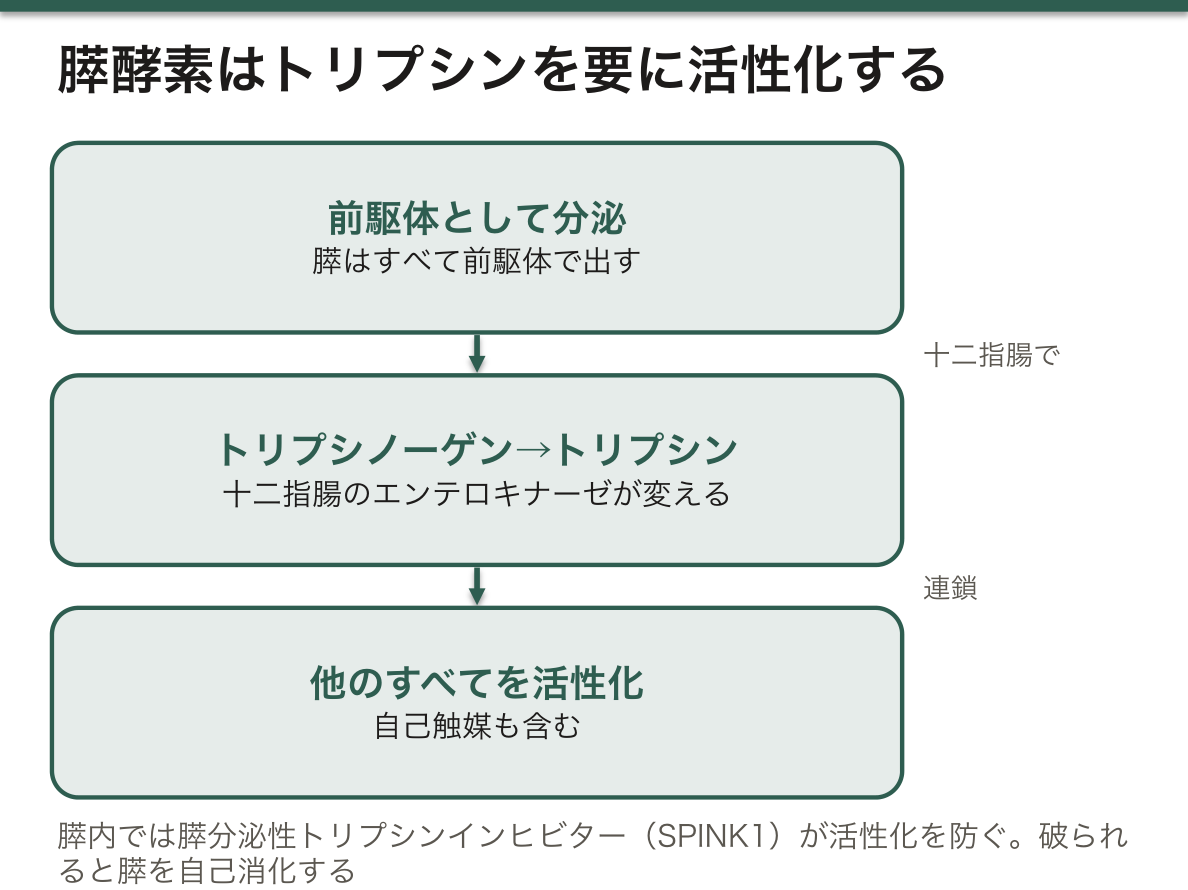
「トリプシンが要になっている」設計が、膵炎の理解の中心である。トリプシンさえ膵内で活性化されなければ他も動かない——逆に言えば、そこが破られると連鎖的にすべてが活性化して膵を自己消化する。
- 遺伝性膵炎——カチオニックトリプシノーゲン(PRSS1)の変異で、いったん活性化したトリプシンが分解されにくくなる
- 膵分泌性トリプシンインヒビター(SPINK1)の変異も慢性膵炎の素因になる
- アルコールと胆石が最多の原因——胆石は共通管を塞いで胆汁が膵管へ逆流する
乳糖不耐症は「病気」というより「多数派」である。ラクターゼは離乳後に活性が落ちるのが哺乳類の標準で、成人でも保たれる形質のほうが後から生じた変異である。北欧系では大半が保たれ、東アジア・アフリカでは大半が低下する。
- 吸収されない乳糖が浸透圧性下痢を起こし、腸内細菌が発酵してガスと腹部膨満
- ヨーグルトやチーズは乳糖が減っているので食べられることが多い
- 二次性乳糖不耐症——ウイルス性腸炎の後に刷子縁が傷んで一過性に起こる。小児で頻度が高い
アミラーゼが上がる原因は膵だけではない——唾液腺(流行性耳下腺炎)・卵管(子宮外妊娠)・マクロアミラーゼ。膵炎の診断にはリパーゼのほうが特異的で、上昇も長く続く。
English version
Core
| Nutrient | Enzymes | Final form |
|---|---|---|
| Starch | Salivary and pancreatic amylase → the brush border disaccharidases | Monosaccharides |
| Protein | Pepsin → trypsin and chymotrypsin → brush border peptidases | Amino acids, di- and tripeptides |
| Fat | Emulsified by bile acids → pancreatic lipase | Fatty acids and monoacylglycerol |
The order of activation of the pancreatic enzymes is decisive.
- The pancreas secretes them all as precursors.
- Enterokinase on the duodenal brush border converts trypsinogen to trypsin.
- Trypsin then activates all the rest (including itself, autocatalytically).
- Pancreatic secretory trypsin inhibitor is provided so that trypsin is not activated within the pancreas.
Going further
The design in which trypsin is the crux is the centre of understanding pancreatitis. If trypsin is not activated within the pancreas the others cannot move — and conversely, once that is breached, everything is activated in a chain and the pancreas digests itself.
- Hereditary pancreatitis — a mutation of cationic trypsinogen (PRSS1) makes activated trypsin harder to degrade.
- Mutations of the trypsin inhibitor (SPINK1) also predispose to chronic pancreatitis.
- Alcohol and gallstones are the commonest causes — a stone blocks the common channel and bile refluxes into the pancreatic duct.
Lactose intolerance is less a disease than the majority state. Lactase activity falling after weaning is the mammalian norm, and retaining it into adult life is the later mutation. It is retained in most people of northern European descent and lost in most of East Asia and Africa.
- The unabsorbed lactose causes an osmotic diarrhoea, and the gut flora ferment it to gas and distension.
- Yoghurt and cheese contain less lactose and can often be eaten.
- Secondary lactose intolerance — transient after viral enteritis has damaged the brush border. Common in children.
Amylase rises from more than the pancreas — salivary glands (mumps), fallopian tube (ectopic pregnancy), macroamylase. Lipase is more specific for pancreatitis and stays raised longer.
消化液の一覧 — pH・作る細胞・呼び出すホルモン
消化液は4つ(唾液・胃液・膵液・腸液)に胆汁を加えた5つで考える。それぞれの pH は、そこで働く酵素の至適 pH とほぼ一致している。酵素を覚えるときは、液の pH と一緒に覚えると取り違えない。
| 消化液 | pH | pH を決めるもの | 主な酵素・成分 |
|---|---|---|---|
| 唾液 | 6.8〜7.2(刺激時は〜8) | HCO₃⁻・リン酸・蛋白の緩衝 | 唾液 α-アミラーゼ(Cl⁻ で活性化)・舌リパーゼ |
| 胃液 | 1〜2 | 壁細胞の H⁺/K⁺-ATPase が出す HCl | ペプシノゲン(主細胞)・胃リパーゼ・内因子・粘液 |
| 膵液 | 7.6〜8.3 | 導管細胞が出す HCO₃⁻ | 膵アミラーゼ・トリプシノーゲンなどの前駆体・膵リパーゼ・コリパーゼ・ヌクレアーゼ |
| 腸液(小腸の内容) | 7.1〜7.6(十二指腸の入口は6前後) | 膵液と胆汁の HCO₃⁻ が胃酸を中和 | 刷子縁の膜酵素(二糖類分解酵素・アミノペプチダーゼ・ジペプチダーゼ・ヌクレオチダーゼ) |
| 胆汁 | 肝胆汁で7〜8 | HCO₃⁻ | 酵素は含まない。胆汁酸塩・リン脂質・コレステロール・ビリルビン |
膵液と胆汁を呼び出すのは、十二指腸から出る2つのホルモンである。酸が来たらセクレチン、脂肪と蛋白が来たら CCK、と「何が来たか」で分担している。
| ホルモン | 出す細胞 | 刺激 | 主な作用 |
|---|---|---|---|
| ガストリン | 胃前庭部・十二指腸の G 細胞 | 胃の伸展・ペプチドとアミノ酸・迷走神経 | 胃酸分泌↑・胃の運動↑ |
| セクレチン(secretin) | 十二指腸の S 細胞 | 酸性の糜粥(pH が下がる) | 膵と胆管から HCO₃⁻ ↑・胃酸↓・胃排出↓ |
| コレシストキニン(CCK) | 十二指腸・空腸の I 細胞 | 脂肪酸・ペプチド・アミノ酸 | 膵の酵素分泌↑・胆嚢収縮と Oddi 括約筋の弛緩・胃排出↓・満腹感 |
| GIP・GLP-1 | K 細胞・L 細胞 | 糖・脂肪 | インスリン分泌↑(インクレチン)・胃排出↓ |
なぜ胃だけが極端な酸性なのか。理由は3つあり、どれも「消化の前段階」である。①口から入った微生物の大半を殺す。②食物の蛋白を変性させ、ほどけた鎖をペプシンが切りやすくする。③ペプシノゲンが活性化し、ペプシンが働く(pH 5 以上でほぼ失活する)。逆に言えば、胃の中では唾液アミラーゼも膵の酵素も働けない。食塊の内側がまだ酸に浸っていない間だけ、唾液アミラーゼは胃の中でもしばらく働き続ける。
セクレチンと CCK の組み合わせは「中和してから消化する」順序を作っている。酸が十二指腸に入るとまずセクレチンで HCO₃⁻ が出て pH が上がり、それから CCK で呼ばれた酵素と胆汁が働く。膵酵素は中性付近でしか働かず、胆汁酸も酸性では沈殿してしまうので、この順序が崩れると脂肪の消化が真っ先に止まる。
腸液の酵素の多くは「液の中を漂う」のではなく、上皮細胞の刷子縁の膜に埋まったまま、外向きに活性部位を出している。だから「腸液の酵素」と呼ばれていても、実際に働くのは細胞の表面であり、上皮が傷むと酵素ごと失われる。
脂肪の多い食事のあとに右季肋部が痛む(胆石発作)のは、CCK が胆嚢を収縮させ、胆嚢管に石が押し付けられるためである。GLP-1 は糖尿病と肥満の治療薬(GLP-1 受容体作動薬)の標的になっており、胃排出を遅らせる作用が、吐き気という副作用と満腹感の両方の理由になる。
English version
Core
Think of five digestive fluids: saliva, gastric juice, pancreatic juice, intestinal juice and bile. The pH of each fluid roughly matches the pH optimum of the enzymes that work in it, so learn the enzymes together with the pH.
| Fluid | pH | What sets the pH | Main enzymes / contents |
|---|---|---|---|
| Saliva | 6.8–7.2 (up to 8 when stimulated) | HCO₃⁻, phosphate, proteins | Salivary α-amylase (activated by Cl⁻), lingual lipase |
| Gastric juice | 1–2 | HCl from the H⁺/K⁺-ATPase of parietal cells | Pepsinogen (chief cells), gastric lipase, intrinsic factor, mucus |
| Pancreatic juice | 7.6–8.3 | HCO₃⁻ from duct cells | Pancreatic amylase, protease precursors, pancreatic lipase, colipase, nucleases |
| Intestinal contents | 7.1–7.6 (about 6 at the start of the duodenum) | HCO₃⁻ of pancreatic juice and bile neutralise the acid | Brush-border enzymes: disaccharidases, aminopeptidase, dipeptidase, nucleotidase |
| Bile | 7–8 (hepatic bile) | HCO₃⁻ | No enzymes; bile salts, phospholipids, cholesterol, bilirubin |
Two duodenal hormones call pancreatic juice and bile. Acid arriving calls secretin; fat and protein arriving call CCK.
| Hormone | Cell | Stimulus | Main actions |
|---|---|---|---|
| Gastrin | G cells, antrum and duodenum | Stretch, peptides and amino acids, vagus | ↑ acid, ↑ gastric motility |
| Secretin | S cells, duodenum | Acid chyme | ↑ HCO₃⁻ from pancreas and bile ducts, ↓ acid, ↓ gastric emptying |
| Cholecystokinin (CCK) | I cells, duodenum and jejunum | Fatty acids, peptides, amino acids | ↑ pancreatic enzymes, gallbladder contraction, relaxation of the sphincter of Oddi, ↓ gastric emptying, satiety |
| GIP, GLP-1 | K cells, L cells | Sugar, fat | ↑ insulin (incretins), ↓ gastric emptying |
Going further
Why is only the stomach so acidic? Three reasons, all preparing for digestion: it kills most swallowed microbes; it denatures food proteins so that pepsin can cut the unfolded chains; and it activates pepsinogen (pepsin is almost inactive above pH 5). Salivary amylase and pancreatic enzymes cannot work in acid; salivary amylase keeps working only inside the food bolus until acid reaches it.
Secretin and CCK create the order ‘neutralise first, then digest’. Secretin raises the pH with HCO₃⁻; then the enzymes and bile called by CCK can work. Pancreatic enzymes need a near-neutral pH and bile acids precipitate in acid, so fat digestion is the first thing to fail when this order breaks.
Most ‘intestinal juice’ enzymes do not float in the fluid. They sit in the brush-border membrane with the active site facing the lumen, so damage to the epithelium removes the enzymes too.
In the clinic
Pain under the right ribs after a fatty meal (biliary colic) happens because CCK contracts the gallbladder and presses a stone into the cystic duct. GLP-1 is the target of GLP-1 receptor agonists for diabetes and obesity; slower gastric emptying explains both the nausea and the feeling of fullness.
ペプチダーゼの切断規則 — 誰が、どの結合を切るか
蛋白の消化に関わるペプチダーゼは8つで、「鎖の内側を切る(エンド型)か、端から1つずつ外す(エキソ型)か」と「どのアミノ酸を見分けるか」の2つで整理できる。
| 分泌される場所 | 酵素(前駆体) | 型 | 見分けるもの・切る場所 |
|---|---|---|---|
| 胃(主細胞) | ペプシン(ペプシノゲン) | エンド | 芳香族アミノ酸(Phe・Tyr・Trp)の後ろ(C 末端側)の結合 |
| 膵 → 十二指腸 | トリプシン(トリプシノーゲン) | エンド | 塩基性アミノ酸(Lys・Arg)の後ろ。His は含まない |
| キモトリプシン(キモトリプシノーゲン) | エンド | 芳香族アミノ酸の後ろ | |
| エラスターゼ(プロエラスターゼ) | エンド | 側鎖の小さいアミノ酸(Gly・Ala・Ser・Thr・Cys)の後ろ | |
| カルボキシペプチダーゼ A(前駆体) | エキソ | C 末端の芳香族アミノ酸を1つ外す | |
| カルボキシペプチダーゼ B(前駆体) | エキソ | C 末端の塩基性アミノ酸(Lys・Arg)を1つ外す | |
| 小腸の刷子縁 | アミノペプチダーゼ(Zn²⁺) | エキソ | N 末端から、種類を問わず1つずつ外す |
| ジペプチダーゼ(Zn²⁺) | エキソ | ジペプチドを2つのアミノ酸にする |
規則を使うときに効く約束が3つある。①エンド型は鎖の内側の結合しか切れない。端のアミノ酸を1つだけ外すような結合(最初と最後の結合)は切らないので、エンド型の産物は最小でもジペプチドになる。②カルボキシペプチダーゼとアミノペプチダーゼはトリペプチド以上にしか働かない。最後に残ったジペプチドはジペプチダーゼの仕事である。③膵のペプチダーゼはすべて、トリプシンが前駆体を切って活性化する。
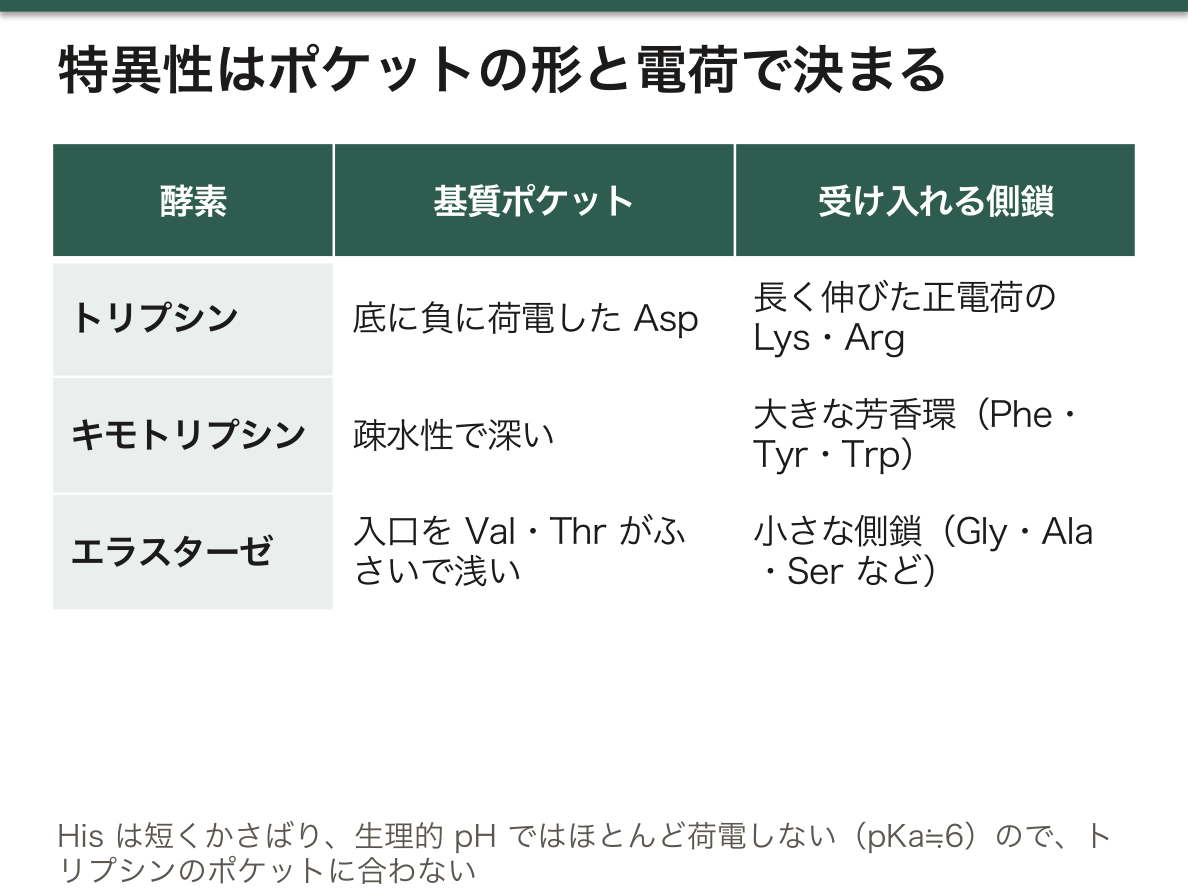
なぜ His は「塩基性」なのにトリプシンに切られないのか。トリプシンの基質ポケットの底には負に荷電した Asp があり、長く伸びた Lys・Arg の正電荷の側鎖を奥まで受け入れる。His の側鎖はイミダゾール環で短くかさばり、しかも生理的 pH ではほとんど荷電していない(pKa≒6)。だからポケットに合わない。キモトリプシンのポケットは疎水性で深く、大きな芳香環を受け入れる。エラスターゼのポケットは入口を大きな残基(Val・Thr)がふさいでいて浅く、小さな側鎖しか入れない。特異性は「ポケットの形と電荷」で決まっているので、理由ごと覚えると表を丸暗記しなくて済む。
ここで使った規則は、ヨーロッパの医学部の生化学でよく使われる単純化である。生化学の教科書ではもう少し細かく、トリプシンとキモトリプシンは直後が Pro だと切らない、ペプシンは Leu の前後も好む、キモトリプシンは Leu や Met もゆっくり切る、と書かれている。手で切断を追うときは表の規則で十分で、細部は「例外がある」と知っておけばよい。日本の教科書では、トリプシン=塩基性、キモトリプシン=芳香族、エラスターゼ=小さい中性、の3つを押さえる形が多い。
トリプシンが「他の前駆体をすべて活性化する」設計が、急性膵炎で酵素が連鎖的に暴走する理由になる。逆に、エンテロペプチダーゼ(エンテロキナーゼ)が先天的に欠けると、トリプシンが活性化されず、蛋白が消化できずに乳児期から下痢・発育不良・低蛋白による浮腫が出る。膵酵素の補充で改善する。
English version
Core
Eight peptidases digest protein. Sort them by two questions: do they cut inside the chain (endo) or remove one residue from an end (exo)? Which amino acid do they recognise?
| Where secreted | Enzyme (precursor) | Type | Recognises / cuts |
|---|---|---|---|
| Stomach (chief cells) | Pepsin (pepsinogen) | Endo | Bond after an aromatic amino acid (Phe, Tyr, Trp) |
| Pancreas → duodenum | Trypsin (trypsinogen) | Endo | Bond after a basic amino acid (Lys, Arg; not His) |
| Chymotrypsin (chymotrypsinogen) | Endo | Bond after an aromatic amino acid | |
| Elastase (proelastase) | Endo | Bond after a small amino acid (Gly, Ala, Ser, Thr, Cys) | |
| Carboxypeptidase A (precursor) | Exo | Removes a C-terminal aromatic amino acid | |
| Carboxypeptidase B (precursor) | Exo | Removes a C-terminal basic amino acid | |
| Brush border | Aminopeptidase (Zn²⁺) | Exo | Removes any amino acid from the N-terminus, one at a time |
| Dipeptidase (Zn²⁺) | Exo | Splits a dipeptide into two amino acids |
Three rules matter. (1) Endopeptidases cut only internal bonds; they do not cut the first or last bond, so their smallest product is a dipeptide. (2) Carboxypeptidases and aminopeptidase need at least a tripeptide; the last dipeptides are the job of dipeptidase. (3) Trypsin activates all the pancreatic precursors.
Going further
Why is His not cut by trypsin although it is ‘basic’? The trypsin pocket has a negative Asp at the bottom that holds the long, positive side chains of Lys and Arg. The His side chain is a short, bulky ring and is hardly charged at body pH (pKa about 6), so it does not fit. The chymotrypsin pocket is deep and hydrophobic for big aromatic rings; the elastase pocket is blocked by large residues and only takes small side chains. Specificity comes from the shape and charge of the pocket.
These rules are a simplification often used in European medical biochemistry. Textbooks add details: trypsin and chymotrypsin do not cut before Pro, pepsin also likes Leu, and chymotrypsin slowly cuts after Leu or Met. For working a peptide by hand the table is enough. Japanese textbooks usually teach trypsin = basic, chymotrypsin = aromatic, elastase = small neutral.
In the clinic
Because trypsin activates every other precursor, enzymes run away in a chain in acute pancreatitis. In congenital enteropeptidase (enterokinase) deficiency trypsin is never activated; infants have diarrhoea, poor growth and oedema from low protein, and improve with pancreatic enzyme replacement.
ペプチドを手で消化する — 側鎖を5群に分けて、消化管の順に切る
ペプチドの配列が与えられたら、次の4手順で最後のアミノ酸まで切っていける。
①両端を決める——遊離の –NH₃⁺ がある側が N 末端、–COO⁻ がある側が C 末端。配列は N→C の向きに書く約束である。②ペプチド結合を数える——n 個のアミノ酸なら結合は n−1 本。③側鎖を5群に分ける(下の表)。④消化管の順に酵素を当てる——胃(ペプシン)→ 膵(トリプシン・キモトリプシン・エラスターゼ、続いてカルボキシペプチダーゼ A・B)→ 刷子縁(アミノペプチダーゼ、最後にジペプチダーゼ)。1本切れたら、その後は2本の別々の鎖として「どれが端か」を数え直す。
| 記号 | 群 | アミノ酸 | 効く酵素 |
|---|---|---|---|
| A | 芳香族 | Phe・Tyr・Trp | ペプシン・キモトリプシン・CPA |
| B | 塩基性 | Lys・Arg(His は入れない) | トリプシン・CPB |
| S | 小さい(側鎖の炭素2つ以下で無電荷) | Gly・Ala・Ser・Thr・Cys | エラスターゼ |
| OP | その他・極性 | Asn・Gln・Asp・Glu・His | (特異的な酵素なし) |
| ONP | その他・非極性 | Val・Leu・Ile・Met・Pro | (特異的な酵素なし) |
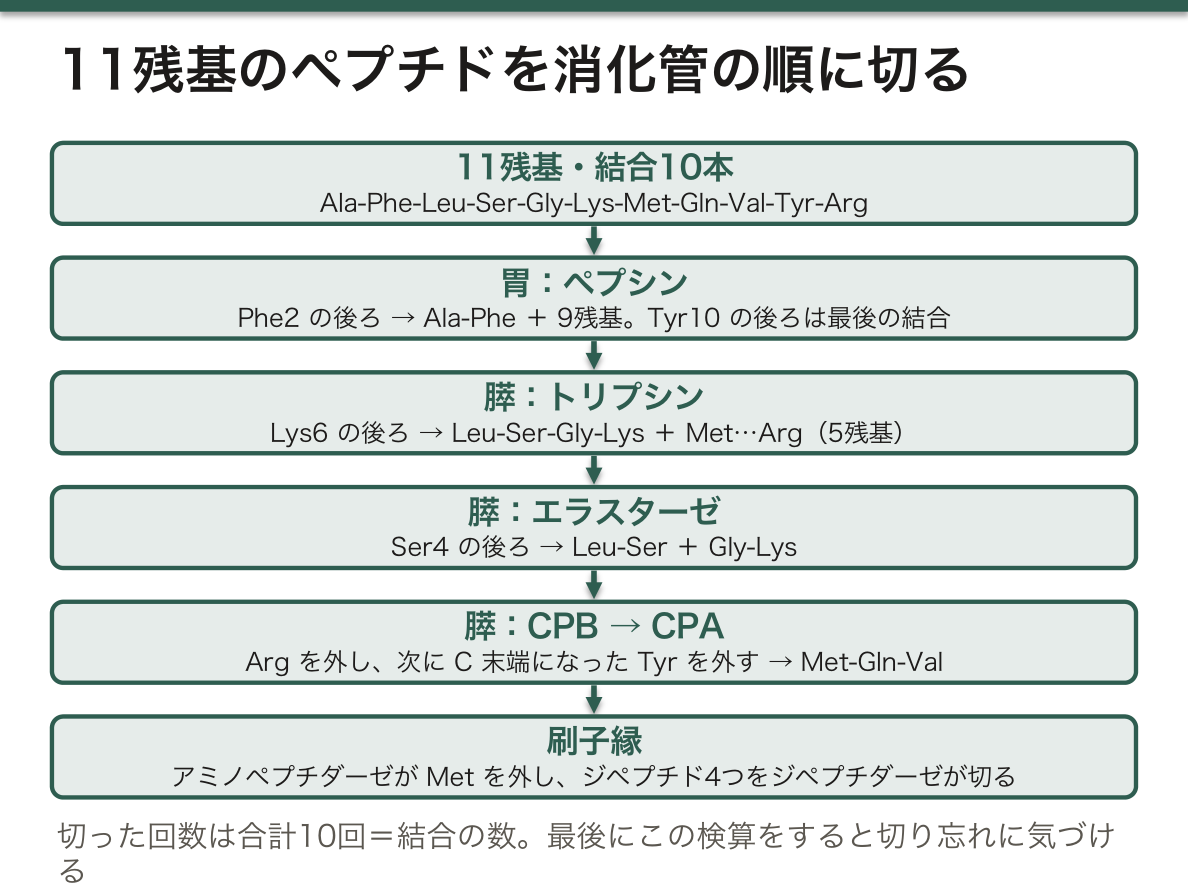
例として 11 残基の Ala-Phe-Leu-Ser-Gly-Lys-Met-Gln-Val-Tyr-Arg を切ってみる。群は S-A-ONP-S-S-B-ONP-OP-ONP-A-B、結合は10本である。
胃:ペプシンは芳香族の後ろを切る。Phe2 の後ろ(2–3)は内側なので切れる。Tyr10 の後ろ(10–11)は最後の結合なので切れない。→ Ala-Phe + Leu…Arg(9残基)。
膵:トリプシンは Lys6 の後ろ(6–7)を切る。Arg11 は C 末端で後ろが無い。→ Leu-Ser-Gly-Lys + Met-Gln-Val-Tyr-Arg。キモトリプシンが狙える Tyr10 の後ろは、まだ最後の結合なので切れない。エラスターゼは Ser4 の後ろ(4–5)を切る(Gly5 の後ろは最後の結合)。→ Leu-Ser + Gly-Lys。続いてエキソ型:CPB が Met-Gln-Val-Tyr-Arg から Arg を、新しく C 末端になった Tyr を CPA が外す。→ Met-Gln-Val。ジペプチド(Ala-Phe・Gly-Lys など)には CPA・CPB は働かない。
刷子縁:アミノペプチダーゼが Met-Gln-Val から Met を外し、残った Gln-Val・Ala-Phe・Leu-Ser・Gly-Lys の4つをジペプチダーゼが切る。切った回数は合計10回で、結合の数と一致する——最後にこの検算をすると切り忘れに気づける。
酵素を当てる順番は、膵の中では入れ替わってもよい(同じ十二指腸で同時に働くため)。動かせないのは「胃 → 膵 → 刷子縁」の順と、トリプシンが他を活性化するという関係だけである。
実際の消化では、産物の多くはアミノ酸ではなくジペプチド・トリペプチドのまま吸収される(次の項)。この手順は「どの酵素が欠けると、どこで消化が止まるか」を考える練習でもある。たとえば膵外分泌不全では膵の5つがまとめて失われ、胃と刷子縁だけでは大きな断片が残るので、便に出る窒素が増える(脂肪便ほど目立たないが、同じ消化不良の表れである)。
English version
Core
Given a peptide sequence, four steps take you down to free amino acids.
(1) Find the ends: the free –NH₃⁺ is the N-terminus, the free –COO⁻ is the C-terminus; sequences are written N→C. (2) Count the peptide bonds: n residues have n−1 bonds. (3) Put each side chain in one of five groups (table). (4) Apply the enzymes in the order of the gut: stomach (pepsin) → pancreas (trypsin, chymotrypsin, elastase, then carboxypeptidases A and B) → brush border (aminopeptidase, finally dipeptidase). After each cut, treat the pieces as separate chains and decide again which bonds are terminal.
| Code | Group | Amino acids | Enzymes that recognise it |
|---|---|---|---|
| A | Aromatic | Phe, Tyr, Trp | Pepsin, chymotrypsin, CPA |
| B | Basic | Lys, Arg (not His) | Trypsin, CPB |
| S | Small (≤2 side-chain carbons, uncharged) | Gly, Ala, Ser, Thr, Cys | Elastase |
| OP | Other polar | Asn, Gln, Asp, Glu, His | (no specific enzyme) |
| ONP | Other non-polar | Val, Leu, Ile, Met, Pro | (no specific enzyme) |
Going further
Example: the 11-residue Ala-Phe-Leu-Ser-Gly-Lys-Met-Gln-Val-Tyr-Arg. Groups S-A-ONP-S-S-B-ONP-OP-ONP-A-B; 10 bonds.
Stomach: pepsin cuts after Phe2 (bond 2–3 is internal). The bond after Tyr10 (10–11) is the last bond, so it is not cut. → Ala-Phe + a 9-residue chain.
Pancreas: trypsin cuts after Lys6 → Leu-Ser-Gly-Lys + Met-Gln-Val-Tyr-Arg. Chymotrypsin cannot cut after Tyr10 because it is still the last bond. Elastase cuts after Ser4 (the bond after Gly5 is the last bond) → Leu-Ser + Gly-Lys. Then the exopeptidases: CPB removes Arg, then CPA removes the new C-terminal Tyr → Met-Gln-Val. CPA and CPB do not act on dipeptides.
Brush border: aminopeptidase removes Met from Met-Gln-Val; dipeptidase splits Gln-Val, Ala-Phe, Leu-Ser and Gly-Lys. Ten cuts in total, equal to the number of bonds — a useful final check.
Inside the pancreas the order of enzymes may change, because they work together in the duodenum. What cannot change is stomach → pancreas → brush border, and that trypsin activates the others.
In the clinic
In real digestion much of the product is absorbed as di- and tripeptides (next item). The method also trains you to ask where digestion stops when an enzyme is missing. In pancreatic insufficiency all five pancreatic enzymes are lost together; large fragments remain and nitrogen appears in the stool.
アミノ酸とジペプチド・トリペプチドの吸収 — Na⁺ で入るものと、H⁺ で入るもの
蛋白の消化産物は、遊離アミノ酸とジペプチド・トリペプチドの2つの形で上皮細胞に入る。
遊離アミノ酸——管腔側の膜に、中性・酸性・塩基性・イミノ酸(Pro)に分かれた複数の輸送体がある。多くは Na⁺ と共輸送し、Na⁺/K⁺-ATPase が作った Na⁺ の濃度差を使う(二次性能動輸送)。基底側からは促進拡散で血液へ出る。
ジペプチド・トリペプチド——別の輸送体 PepT1 が H⁺ と一緒に取り込む。H⁺ の濃度差は、刷子縁の Na⁺/H⁺ 交換体が H⁺ を外へ汲み出すことで作られ、その交換体は Na⁺ の勾配で、Na⁺ の勾配は ATP で作られている。PepT1 は 400 種のジペプチドと 8000 種のトリペプチドを1つの輸送体で運べる。
細胞に入ったジ・トリペプチドの大部分は細胞質のペプチダーゼでアミノ酸に分解されてから門脈へ出る。門脈に入ったアミノ酸は、まず肝に届く。
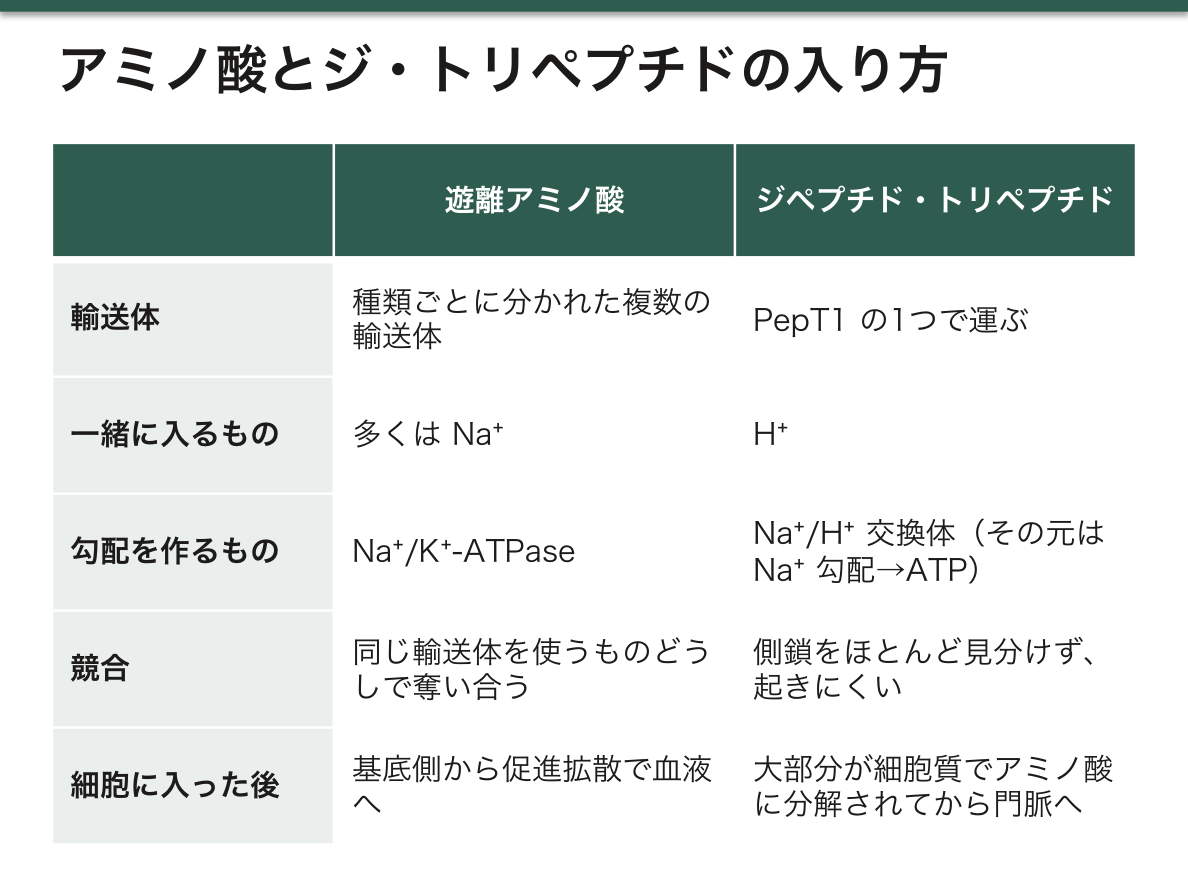
なぜ遊離アミノ酸より、ジ・トリペプチドのほうが速く吸収されるのか。遊離アミノ酸の輸送体は種類ごとに分かれていて、同じ輸送体を使うアミノ酸どうしが奪い合う。PepT1 は側鎖をほとんど見分けないので、競合が起きにくく、1回の輸送で2〜3個ぶんのアミノ酸が入る。だから経腸栄養剤には、アミノ酸だけでなく小さなペプチドで窒素を入れる製品がある。
輸送体の欠損は、ペプチドの経路があるおかげで栄養失調になりにくい。Hartnup 病(中性アミノ酸の輸送体の異常)とシスチン尿症(シスチンと塩基性アミノ酸の輸送体の異常。この輸送体は Na⁺ 非依存の交換輸送体)では、同じ輸送体を持つ腎の尿細管でも再吸収できず、尿にアミノ酸が出る。それでも腸からはペプチドの形で入れるので、欠乏は軽く済むことが多い。Hartnup 病でペラグラ様の皮疹が出るのは、トリプトファンが不足してナイアシンが作れないためである。
PepT1 は薬も運ぶ。セファレキシンなどの β-ラクタム系経口薬や、バラシクロビル(アシクロビルにバリンを付けたプロドラッグ)は、ペプチドに似た形をしているので PepT1 に乗って吸収される。アシクロビルにアミノ酸を1つ付けるだけで経口での吸収が数倍になるのは、この輸送体を利用した設計による。
English version
Core
Protein digestion products enter the epithelial cell in two forms: free amino acids and di-/tripeptides.
Free amino acids: several apical transporters for neutral, acidic, basic and imino (Pro) amino acids. Most use Na⁺ cotransport, driven by the Na⁺ gradient made by the Na⁺/K⁺-ATPase (secondary active transport). They leave the basal side by facilitated diffusion.
Di- and tripeptides: another transporter, PepT1, takes them in with H⁺. The H⁺ gradient is made by the apical Na⁺/H⁺ exchanger, which runs on the Na⁺ gradient, which runs on ATP. One transporter carries about 400 dipeptides and 8000 tripeptides.
Inside the cell most di- and tripeptides are split by cytosolic peptidases, and amino acids go into the portal vein to the liver first.
Going further
Why are di-/tripeptides absorbed faster than free amino acids? Amino acid transporters are separate by type, and amino acids sharing one transporter compete. PepT1 hardly looks at the side chain, so there is little competition and each transport brings in two or three amino acids. Some enteral formulas therefore give nitrogen as small peptides.
Because of the peptide route, transporter defects rarely cause malnutrition. In Hartnup disease (neutral amino acid transporter) and cystinuria (transporter for cystine and basic amino acids; this one is a Na⁺-independent exchanger) the same transporter is missing in the renal tubule, so amino acids appear in the urine. The gut can still take them in as peptides. The pellagra-like rash in Hartnup disease comes from too little tryptophan to make niacin.
In the clinic
PepT1 also carries drugs. Oral β-lactams such as cephalexin and valacyclovir (aciclovir with a valine attached) look like peptides and ride on PepT1. Adding one amino acid to aciclovir raises oral absorption several-fold by using this transporter.
吸収の地図 — どこで何が入るか
| 部位 | 吸収されるもの |
|---|---|
| 十二指腸・空腸上部 | 鉄・カルシウム・葉酸・糖・アミノ酸 |
| 空腸 | 大部分の栄養素・脂溶性ビタミン |
| 回腸末端 | ビタミンB12(内因子と共に)・胆汁酸 |
| 大腸 | 水・電解質・短鎖脂肪酸・ビタミンK(腸内細菌) |
ビタミンB12の吸収は多段階で、どこが壊れても欠乏する。
- 唾液のハプトコリンが結合(胃酸から守る)
- 膵酵素がハプトコリンを外す
- 胃壁細胞の内因子が結合
- 回腸末端の受容体(キュビリン)で取り込む
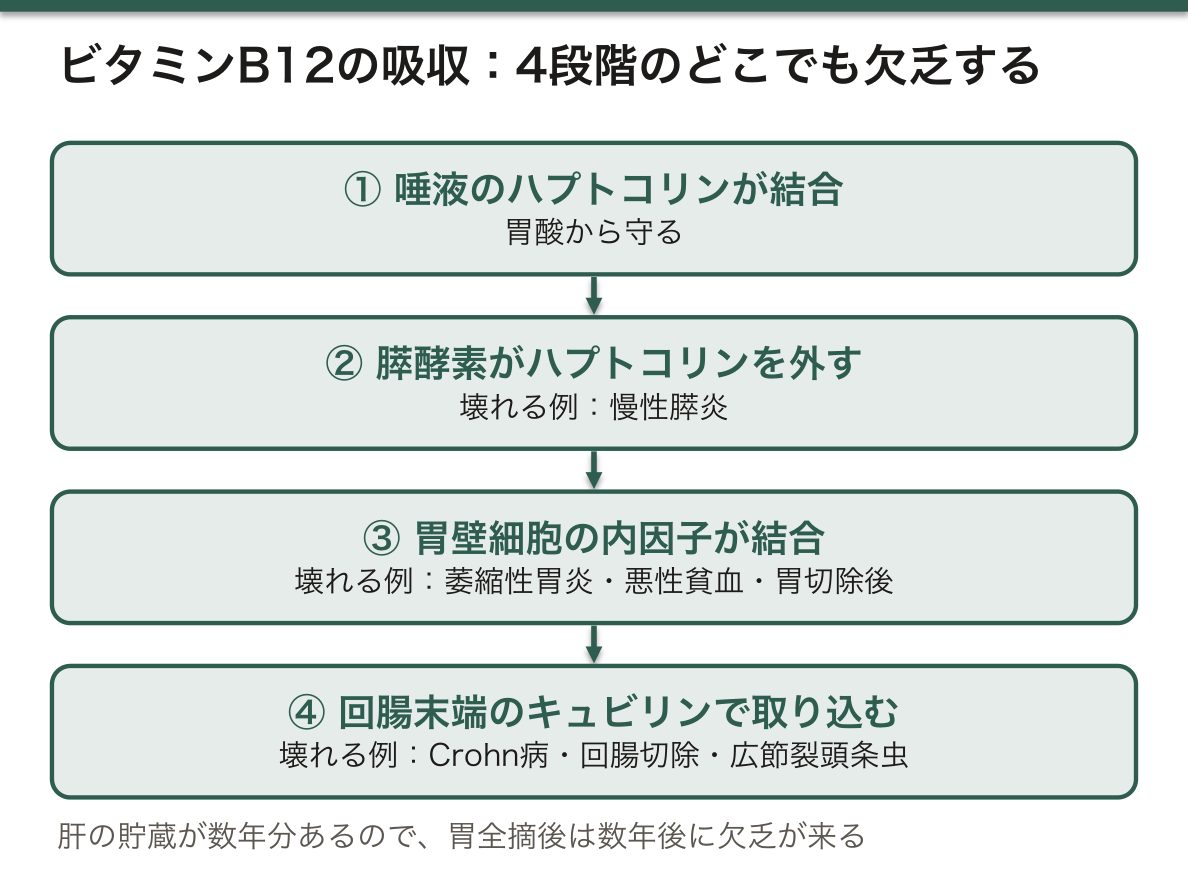
ビタミンB12欠乏の原因を、この4段階に当てはめると全部言える。
- 1と3が壊れる——萎縮性胃炎・悪性貧血(内因子に対する自己抗体)・胃切除後
- 2が壊れる——慢性膵炎
- 4が壊れる——Crohn病・回腸切除・広節裂頭条虫
- 供給不足——完全菜食。ただし肝の貯蔵が数年分あるので、発症までに時間がかかる
胃全摘後は必ず、数年後にビタミンB12欠乏が来る——貯蔵が尽きる時期に合わせて補充を始める。経口では吸収経路そのものが無いので、筋注か、大量経口(受動拡散で1%程度が入る)による。
鉄とカルシウムが上部で吸収されることも、実務に効く。胃切除後(特にBillroth II法やルーワイ法)では十二指腸を通らないので、鉄とカルシウムが不足する。肥満手術後の栄養管理も同じ理由で必要になる。
短鎖脂肪酸は大腸の生化学の中心である。食物繊維を腸内細菌が発酵して酢酸・プロピオン酸・酪酸を作る。
- 酪酸は大腸上皮細胞の主要なエネルギー源——血流からではなく、内腔側から栄養をもらっている
- プロピオン酸は肝で糖新生に使われる
- ヒトは食物繊維を消化できないが、細菌を介してエネルギーの数%を得ている
だから絶食が続くと大腸粘膜が萎縮する——経腸栄養が可能なら経腸を選ぶという原則の生化学的な根拠になっている。
English version
Core
| Site | What is absorbed |
|---|---|
| Duodenum and upper jejunum | Iron, calcium, folate, sugars, amino acids |
| Jejunum | Most nutrients, the fat-soluble vitamins |
| Terminal ileum | Vitamin B12 (with intrinsic factor), bile acids |
| Colon | Water, electrolytes, short-chain fatty acids, vitamin K (from the flora) |
The absorption of B12 has several stages, and a break at any of them causes deficiency.
- Salivary haptocorrin binds it (protecting it from gastric acid).
- Pancreatic enzymes remove the haptocorrin.
- Intrinsic factor from the gastric parietal cell binds it.
- It is taken up by the receptor (cubilin) in the terminal ileum.
Going further
Fit the causes of B12 deficiency to those four stages and they can all be named.
- 1 and 3 broken — atrophic gastritis, pernicious anaemia (autoantibody to intrinsic factor), after gastrectomy.
- 2 broken — chronic pancreatitis.
- 4 broken — Crohn’s disease, ileal resection, Diphyllobothrium.
- Inadequate supply — a strict vegan diet. But the liver holds years’ worth, so it takes time to appear.
After total gastrectomy B12 deficiency is certain, years later — begin replacement to coincide with the exhaustion of the store. There is no absorptive route left, so it is given by injection, or by a large oral dose (about 1 per cent enters by passive diffusion).
That iron and calcium are absorbed high up also tells in practice. After gastrectomy (especially Billroth II or Roux-en-Y) the duodenum is bypassed and iron and calcium run short. Nutritional care after bariatric surgery is needed for the same reason.
Short-chain fatty acids are the centre of the biochemistry of the colon. The flora ferment dietary fibre to acetate, propionate and butyrate.
- Butyrate is the principal fuel of the colonic epithelium — nourished from the lumen rather than from the blood.
- Propionate is used for gluconeogenesis in the liver.
- Humans cannot digest fibre but obtain a few per cent of their energy through the bacteria.
So the colonic mucosa atrophies during prolonged fasting — the biochemical basis of the rule that enteral feeding is chosen where it is possible.
二糖類分解酵素 — 一番端の一歩が、症状を決める
糖の消化は、腸上皮の刷子縁で最後の一歩を踏む。
| 酵素 | 基質 | できるもの |
|---|---|---|
| ラクターゼ | 乳糖 | グルコース+ガラクトース |
| スクラーゼ・イソマルターゼ | ショ糖・α-1,6結合 | グルコース+フルクトース |
| マルターゼ・グルコアミラーゼ | 麦芽糖 | グルコース |
単糖の取り込み——グルコースとガラクトースは SGLT1(Na⁺ と共輸送)、フルクトースは GLUT5(促進拡散)。基底側からは GLUT2 で出る。
ラクターゼは刷子縁の先端にあり、最も失われやすい。
分解されない糖は大腸へ届き、浸透圧性の下痢と、細菌による発酵(ガス・腹部膨満)を起こす。
「一番外側にある酵素が、一番先に失われる」という位置の話が、臨床の頻度を作っている。だから腸炎の後に一過性の乳糖不耐が出る(二次性)(小児の急性疾患の章)——「下痢が治った後も、しばらく牛乳で下痢をする」。
成人型の乳糖不耐は、病気ではなく多数派になる。離乳後にラクターゼが減るのが哺乳類の既定で、成人まで保つ形質のほうが後から広がった——「日本人を含む多くの集団で、成人の低ラクターゼは正常になる」。
SGLT1 が Na⁺ と一緒に糖を運ぶことが、経口補水液の設計そのものになっている。糖と塩を同時に入れると、水の吸収が桁違いに速くなる(脱水の章)——「輸液せずに助けられる子どもの数を、この輸送体が決めている」。
同じ輸送体を腎で止めるのが SGLT2 阻害薬になる(糖尿病の各論の章)——「腸の SGLT1 と腎の SGLT2 は別なので、消化管の吸収はほぼ妨げない」。
診断は呼気水素試験で行う。吸収されなかった糖を大腸の細菌が発酵し、水素が呼気に出る(腸内細菌の章)——「人が作らない気体を測ることで、菌が食べた証拠を取る」。
English version
Core
The digestion of sugar takes its last step at the brush border of the intestinal epithelium.
| Enzyme | Substrate | Products |
|---|---|---|
| Lactase | Lactose | Glucose + galactose |
| Sucrase-isomaltase | Sucrose, α-1,6 bonds | Glucose + fructose |
| Maltase-glucoamylase | Maltose | Glucose |
Uptake of the monosaccharides — glucose and galactose by SGLT1 (cotransport with Na⁺), fructose by GLUT5 (facilitated diffusion); they leave the basal side by GLUT2.
Lactase sits at the tip of the brush border and is the most readily lost. Undigested sugar reaches the colon and causes an osmotic diarrhoea and bacterial fermentation (gas and distension).
Going further
The positional fact that the outermost enzyme is the first to be lost creates the clinical frequency. Hence transient lactose intolerance after enteritis (secondary) — the child goes on having diarrhoea with milk after the gastroenteritis has settled.
Adult-type lactose intolerance is the majority state, not a disease. Falling lactase after weaning is the mammalian default and retention into adult life spread later — in many populations including the Japanese, low adult lactase is normal.
That SGLT1 carries sugar together with Na⁺ is itself the design of oral rehydration solution. Put sugar and salt in together and the absorption of water is orders of magnitude faster — this transporter decides how many children can be saved without an intravenous line.
Blocking the same family of transporter in the kidney gives the SGLT2 inhibitors — intestinal SGLT1 and renal SGLT2 are different, so intestinal absorption is scarcely affected.
The diagnosis is by hydrogen breath test. The colonic flora ferment the unabsorbed sugar and hydrogen appears in the breath — taking the evidence that bacteria have eaten it by measuring a gas humans do not make.
アミロペクチンが単糖になるまで — 口・胃・十二指腸・刷子縁の4段階
デンプンの7〜8割を占めるアミロペクチンは、α1→4 結合の鎖に α1→6 結合の枝が付いた分子である。どの酵素がどの結合を切れないかを追うと、途中の産物が自然に決まる。
| 場所 | 酵素 | 切る結合 | 残るもの |
|---|---|---|---|
| 口 | 唾液 α-アミラーゼ(エンド型) | 鎖の内側の α1→4 | デキストリン(短くなった枝つきの断片)・少量のマルトース |
| 胃 | (酸で唾液アミラーゼが失活) | — | 食塊の内側が酸性になるまでだけ、口の反応が続く |
| 十二指腸 | 膵 α-アミラーゼ(エンド型) | 内側の α1→4 | マルトース・マルトトリオース・α-限界デキストリン(α1→6 の分岐を含む数個の断片) |
| 小腸の刷子縁 | グルコアミラーゼ(マルターゼ-グルコアミラーゼ、エキソ型) | 非還元末端から α1→4 を1つずつ | グルコース |
| スクラーゼ-イソマルターゼ(エキソ型) | α1→6(分岐点)と α1→4 | グルコース |
アミラーゼだけではグルコースはほとんどできない。エンド型は鎖の端の結合も α1→6 結合も切れないので、産物は最小でもマルトース(2糖)である。分岐点を外して最後のグルコースにするのは、刷子縁のエキソ型の仕事になる。
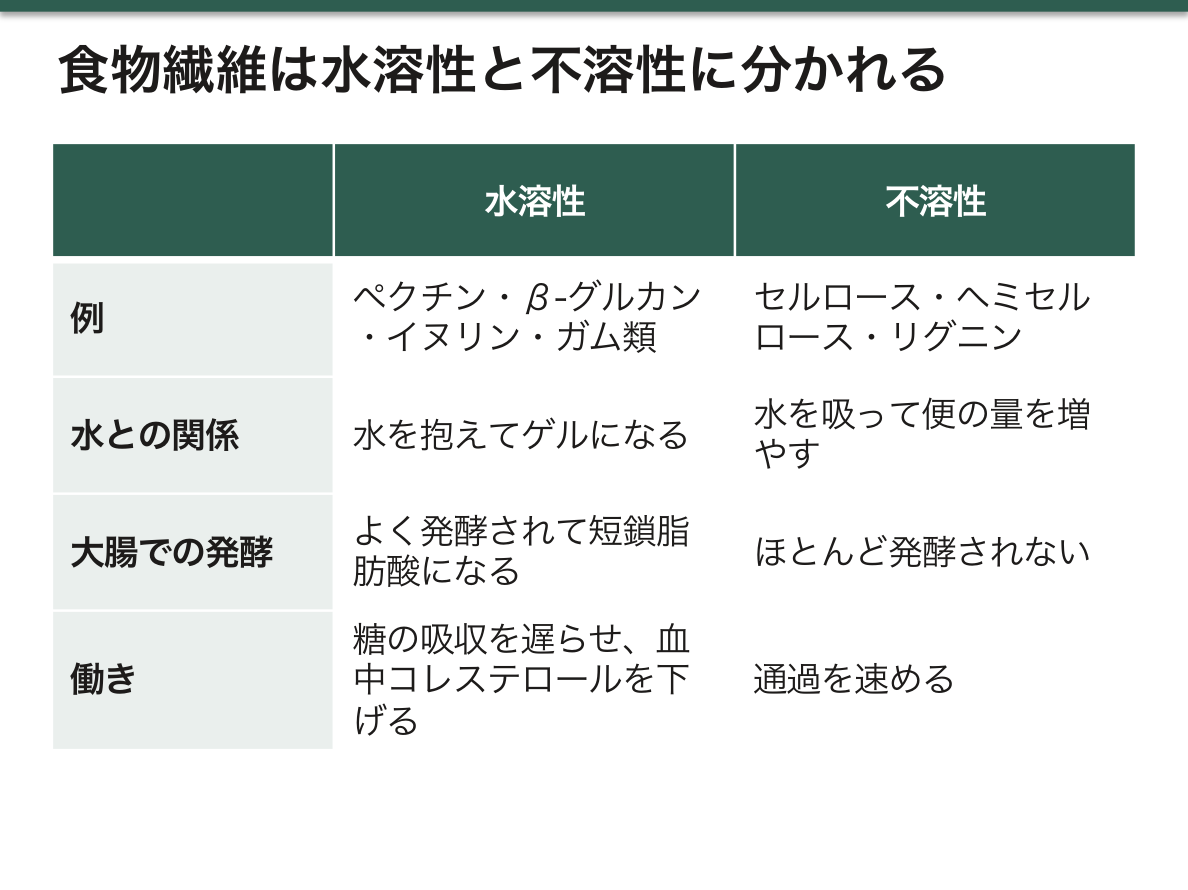
ヒトの酵素では切れない糖も同じ考え方で分かる。β1→4 結合のセルロース、フルクトースの重合体であるイヌリン、そして豆類のラフィノース族オリゴ糖(ショ糖のグルコースに α1→6 でガラクトースが1〜3個付いたもの:ラフィノース・スタキオース・ベルバスコース)である。ヒトの小腸にはこの α1→6 のガラクトースを外す α-ガラクトシダーゼが無いので、そのまま大腸へ届く。大腸の細菌が発酵して H₂・CO₂・メタンと短鎖脂肪酸を作るので、腹部膨満と放屁が起きる。付いているガラクトースが多いほど、また含量が多い豆ほど症状は強くなる。
消化できない多糖は食物繊維として扱われ、2つに分かれる。水溶性(ペクチン・β-グルカン・イヌリン・ガム類)は水を抱えてゲルになり、大腸でよく発酵されて短鎖脂肪酸になる。糖の吸収を遅らせ、胆汁酸を便へ逃がすことで血中コレステロールを下げる。不溶性(セルロース・ヘミセルロース・リグニン)はほとんど発酵されず、水を吸って便の量を増やし、通過を速める。
α-ガラクトシダーゼの錠剤(豆料理の前に飲む市販品)は、ヒトに無い酵素を外から補ってラフィノース族を小腸で分解させるものである。水溶性食物繊維がコレステロールを下げる仕組みは、胆汁酸吸着薬(コレスチラミン)と同じ「胆汁酸を回収させない → 肝がコレステロールから胆汁酸を作り直す」という流れになる。
English version
Core
Amylopectin, 70–80% of starch, is an α1→4 chain with α1→6 branches. Follow which bond each enzyme cannot cut, and the intermediate products follow.
| Site | Enzyme | Bond cut | What remains |
|---|---|---|---|
| Mouth | Salivary α-amylase (endo) | Internal α1→4 | Dextrins (shorter branched pieces), a little maltose |
| Stomach | (acid inactivates salivary amylase) | — | The mouth reaction continues only inside the bolus until it is acidified |
| Duodenum | Pancreatic α-amylase (endo) | Internal α1→4 | Maltose, maltotriose, α-limit dextrins (small pieces with an α1→6 branch) |
| Brush border | Glucoamylase (maltase-glucoamylase, exo) | α1→4 from the non-reducing end, one by one | Glucose |
| Sucrase-isomaltase (exo) | α1→6 (branch point) and α1→4 | Glucose |
Amylase alone makes almost no glucose. An endo-enzyme cannot cut end bonds or α1→6 bonds, so its smallest product is maltose. Removing branch points and freeing the last glucose is the job of the brush-border exo-enzymes.
Going further
Sugars human enzymes cannot cut follow the same logic: cellulose (β1→4), inulin (a fructose polymer), and the raffinose-family oligosaccharides of beans (sucrose with 1–3 galactoses attached by α1→6: raffinose, stachyose, verbascose). The human small intestine has no α-galactosidase for this bond, so they reach the colon. Bacteria ferment them to H₂, CO₂, methane and short-chain fatty acids, giving bloating and flatus. More galactose units, and a higher content in the bean, mean stronger symptoms.
Undigestible polysaccharides are dietary fibre, of two kinds. Soluble fibre (pectin, β-glucan, inulin, gums) forms a gel, is well fermented to short-chain fatty acids, slows sugar absorption and lowers blood cholesterol by carrying bile acids into the stool. Insoluble fibre (cellulose, hemicellulose, lignin) is hardly fermented; it holds water, increases stool bulk and speeds transit.
In the clinic
α-Galactosidase tablets taken before a bean meal supply the enzyme humans lack. Soluble fibre lowers cholesterol in the same way as bile acid sequestrants (cholestyramine): bile acids are not recovered, so the liver makes new ones from cholesterol.
糖の消化が止まるとき — スクラーゼ-イソマルターゼ欠損症と α-グルコシダーゼ阻害薬
先天性スクラーゼ-イソマルターゼ欠損症(常染色体潜性)では、刷子縁でショ糖と α1→6 結合(イソマルトース・α-限界デキストリン)が切れない。乳糖を分解するラクターゼは正常なので、糖が乳糖だけの母乳や粉ミルクを飲んでいる間は症状が出ない。果汁・果物・ショ糖入りの食品やデンプンを食べ始めた時期から、浸透圧性の下痢・腹部膨満・ガス・不機嫌が始まるのが特徴である。
便は酸性になる(大腸の細菌が残った糖を発酵して乳酸と短鎖脂肪酸を作るため。pH 5〜6 以下)。便の還元糖の検査は、ショ糖が非還元糖なのでそのままでは陰性になりやすく、酸で加水分解してから調べると陽性になる。乳糖不耐症と違って、牛乳を除いても良くならない。
同じ酵素を薬で止めるのがα-グルコシダーゼ阻害薬(アカルボース・ボグリボース・ミグリトール)である。刷子縁の二糖類分解酵素を競合的に阻害して、食後の血糖の立ち上がりを遅らせる。
症状が出る時期が、欠けている酵素を教えてくれる。乳糖を分解できない先天性ラクターゼ欠損症なら授乳の最初から症状が出る。ショ糖とデンプンを分解できない場合は、離乳食や果汁が始まってからになる。果汁にはフルクトースとグルコースのほかにショ糖も多く含まれるので、「果汁で悪化する」はショ糖の消化の問題を示す。なお果糖そのものの吸収不良(GLUT5 の不足)でも果汁で症状が出るが、その場合は単糖なので、ショ糖を除いても果糖の多い食品で症状が残る。
α-グルコシダーゼ阻害薬を飲んでいる人が低血糖を起こしたら、ショ糖(砂糖)ではなくブドウ糖で治療する。ショ糖は分解されないと吸収されず、その分解酵素を薬が止めているからである。副作用の腹部膨満・放屁は、未消化の糖が大腸で発酵されるためで、スクラーゼ-イソマルターゼ欠損症の症状を薬で軽く起こしているのと同じである。
ダンピング症候群も糖の吸収の速さの問題である。胃切除後は糖が一気に空腸へ流れ込む。食後すぐ(早期)は高浸透圧の内容物に水が引き込まれて動悸・腹痛・下痢が出る。食後2〜3時間(後期)は急な高血糖に応じて出すぎたインスリンで低血糖になる。後期ダンピングには、糖の吸収を遅らせる目的で α-グルコシダーゼ阻害薬が使われることがある。
治療は、ショ糖を控える食事と、酵母由来のスクラーゼ(サクロシダーゼ)の補充である。デンプンの α1→6 結合はグルコアミラーゼもわずかに切れるので、デンプンへの耐性は人により幅があり、成長とともに改善することも多い。
English version
Core
In congenital sucrase-isomaltase deficiency (autosomal recessive) the brush border cannot split sucrose or α1→6 bonds (isomaltose, α-limit dextrins). Lactase is normal, so there are no symptoms while the baby takes only breast milk or lactose-based formula. Osmotic diarrhoea, bloating, gas and irritability start when fruit juice, fruit, sucrose-containing food or starch is introduced.
The stool is acidic (pH 5–6 or lower) because colonic bacteria ferment the sugar to lactate and short-chain fatty acids. A stool test for reducing sugar is often negative because sucrose is non-reducing; after acid hydrolysis it becomes positive. Unlike lactose intolerance, removing milk does not help.
α-Glucosidase inhibitors (acarbose, voglibose, miglitol) block the same brush-border enzymes competitively and slow the rise of blood glucose after a meal.
Going further
The age at onset tells you which enzyme is missing. Congenital lactase deficiency gives symptoms from the first feeds; a problem with sucrose and starch starts with weaning foods and juice. Juice contains much sucrose, so ‘worse after juice’ points to sucrose digestion. Fructose malabsorption (too little GLUT5) also worsens with juice, but then symptoms continue with fructose-rich food even when sucrose is removed.
A patient on an α-glucosidase inhibitor who becomes hypoglycaemic must be treated with glucose, not table sugar: sucrose must be split before absorption, and the drug blocks that enzyme. The drug’s bloating and flatus come from fermentation of undigested sugar in the colon — a mild, drug-made version of sucrase-isomaltase deficiency.
Dumping syndrome is also about the speed of sugar delivery. After gastrectomy, sugar rushes into the jejunum. Early dumping (soon after eating): water is drawn into the hyperosmolar contents, giving palpitations, pain and diarrhoea. Late dumping (2–3 hours): too much insulin after a sharp rise in glucose causes hypoglycaemia. α-Glucosidase inhibitors are sometimes used to slow sugar absorption in late dumping.
In the clinic
Treatment is a low-sucrose diet and replacement with yeast sucrase (sacrosidase). Glucoamylase can cut a few α1→6 bonds, so starch tolerance varies and often improves with age.
脂質の消化酵素 — 3つのリパーゼと、コリパーゼ・PLA₂・CEL
食事の脂質は、9割以上がトリアシルグリセロール(TAG)で、残りがリン脂質・コレステロールエステル・ガラクト脂質(植物の膜の脂質)である。どれもエステル結合でできているので、分解する酵素はすべてエステラーゼ(加水分解酵素)になる。
| 酵素 | 出す場所 | 基質と切る位置 | 産物・特徴 |
|---|---|---|---|
| 舌リパーゼ | 舌のエブネル腺 | TAG の3位(sn-3)。短鎖・中鎖脂肪酸に強い | 脂肪酸+1,2-ジアシルグリセロール。新生児の乳脂肪の消化で重要 |
| 胃リパーゼ | 胃の主細胞 | TAG の3位。至適 pH 4〜6 | 脂肪酸+1,2-ジアシルグリセロール。胃酸の中でも働ける |
| 膵リパーゼ | 膵の腺房細胞 | TAG の1位と3位 | 活性型で分泌。2-モノアシルグリセロール+脂肪酸2つ。コリパーゼが必要 |
| コリパーゼ | 膵(プロコリパーゼ) | 酵素活性なし | トリプシンで活性化。膵リパーゼを油滴の表面につなぎ止める |
| ホスホリパーゼ A₂(PLA₂) | 膵(前駆体) | リン脂質の2位(sn-2) | トリプシンで活性化。Ca²⁺ と胆汁酸塩が必要。リゾリン脂質+脂肪酸 |
| カルボキシルエステルリパーゼ(CEL) | 膵(活性型) | コレステロールエステル・TAG・リン脂質・ガラクト脂質 | 胆汁酸塩で活性化される(胆汁酸塩依存性リパーゼ)。遊離コレステロール+脂肪酸 |
| 膵リパーゼ関連蛋白2(PLRP2) | 膵 | ガラクト脂質・リン脂質・TAG | 植物の膜脂質の消化 |
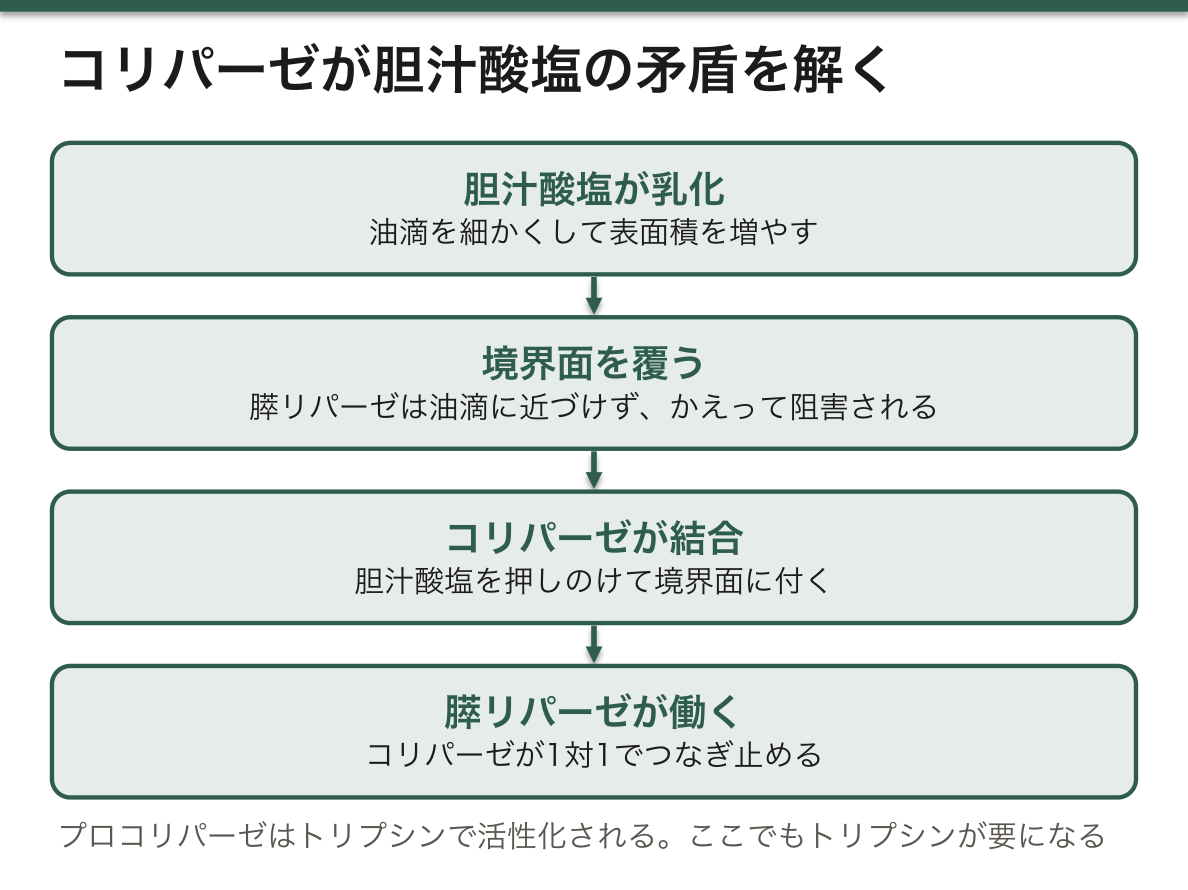
膵リパーゼとコリパーゼの関係が、このページでいちばん理屈のいるところである。脂肪を消化するには胆汁酸塩で油滴を細かくする必要があるが、胆汁酸塩は油と水の境界面を覆ってしまうので、膵リパーゼは油滴に近づけずにかえって阻害される。そこでコリパーゼが胆汁酸塩を押しのけて境界面に結合し、膵リパーゼを1対1でつなぎ止める。だから「胆汁酸塩が無いと乳化できない」と「胆汁酸塩があるとリパーゼが働けない」の矛盾を、コリパーゼが解いていることになる。プロコリパーゼがトリプシンで活性化されるので、ここでもトリプシンが要になっている。
なぜ膵リパーゼは前駆体でなく活性型で出せるのか。TAG は水に溶けず、膵の細胞内には油と水の境界面がほとんど無いので、活性型で出しても細胞を傷つけにくい。一方、PLA₂ は膜そのもの(リン脂質)を壊せるので、前駆体として出し、腸管腔でトリプシンに活性化させる。
舌リパーゼと胃リパーゼが3位を好み、短鎖・中鎖を好むことは、乳の脂肪の構造と合っている。乳の TAG は短鎖・中鎖の脂肪酸を3位に多く持つので、膵の働きが未熟な新生児でも胃の中で消化が始められる。母乳にはさらに CEL と同じ酵素(胆汁酸塩刺激リパーゼ)が含まれている。
膵外分泌不全では膵の酵素がまとめて失われ、胃リパーゼだけでは脂肪の大部分を消化できないので脂肪便になる。PLA₂ は急性膵炎の組織破壊にも関わり、リゾリン脂質が細胞膜を溶かす。血清リパーゼが膵炎の診断に使われるのは、ほぼ膵からしか来ないためである。
English version
Core
Over 90% of dietary fat is triacylglycerol (TAG); the rest is phospholipids, cholesteryl esters and galactolipids (plant membrane lipids). All are built with ester bonds, so the digesting enzymes are esterases (hydrolases).
| Enzyme | Source | Substrate / position | Products / notes |
|---|---|---|---|
| Lingual lipase | von Ebner’s glands of the tongue | Position 3 (sn-3) of TAG; prefers short/medium chains | Fatty acid + 1,2-diacylglycerol; important for milk fat in newborns |
| Gastric lipase | Chief cells | Position 3; pH optimum 4–6 | Fatty acid + 1,2-diacylglycerol; works in gastric acid |
| Pancreatic lipase | Acinar cells | Positions 1 and 3 | Secreted active; 2-monoacylglycerol + 2 fatty acids; needs colipase |
| Colipase | Pancreas (procolipase) | No enzyme activity | Activated by trypsin; anchors lipase to the droplet surface |
| Phospholipase A₂ | Pancreas (precursor) | Position 2 (sn-2) of phospholipids | Activated by trypsin; needs Ca²⁺ and bile salts; lysophospholipid + fatty acid |
| Carboxyl ester lipase (CEL) | Pancreas (active) | Cholesteryl esters, TAG, phospholipids, galactolipids | Activated by bile salts (bile-salt-dependent lipase); free cholesterol + fatty acid |
| Pancreatic lipase-related protein 2 | Pancreas | Galactolipids, phospholipids, TAG | Digests plant membrane lipids |
Going further
The pancreatic lipase–colipase pair needs the most thought. Bile salts are needed to break fat into small droplets, but they also cover the oil–water surface and inhibit pancreatic lipase. Colipase pushes the bile salts aside, binds the surface and holds lipase there one-to-one. So colipase solves the conflict ‘no emulsion without bile salts’ versus ‘no lipase action with bile salts’. Procolipase is activated by trypsin — trypsin again.
Why can pancreatic lipase be secreted active? TAG does not dissolve in water and the cell has almost no oil–water surface, so active lipase does little harm there. PLA₂ can destroy membranes, so it is secreted as a precursor and activated in the lumen.
Lingual and gastric lipases prefer position 3 and short/medium chains, which suits milk fat: milk TAG carries many short and medium chains at position 3, so a newborn with an immature pancreas can start digesting fat in the stomach. Breast milk also contains a bile-salt-stimulated lipase, the same enzyme as CEL.
In the clinic
In exocrine pancreatic insufficiency all pancreatic enzymes are lost and gastric lipase alone cannot digest most fat, so steatorrhoea follows. PLA₂ also takes part in tissue damage in acute pancreatitis, as lysophospholipids dissolve cell membranes. Serum lipase is used for pancreatitis because it comes almost only from the pancreas.
胆汁酸と胆汁酸塩・乳化とミセル — 「酸」と「塩」は pKa の話である
胆汁は肝で作られ、胆嚢で濃縮・貯蔵され、CCK の刺激で十二指腸へ出る。成分は水が大部分で、胆汁酸塩・リン脂質(レシチン)・コレステロール・ビリルビン・電解質(HCO₃⁻ を含む)を含み、肝胆汁の pH は7〜8。消化酵素は含まない。
胆汁の働きは4つ:①排泄(ビリルビン・コレステロール・薬物・重金属を捨てる)②消化(脂肪を乳化して酵素の働く面積を増やす)③吸収(ミセルを作って脂質を上皮まで運ぶ)④抗菌(小腸の細菌の増えすぎを抑える)。
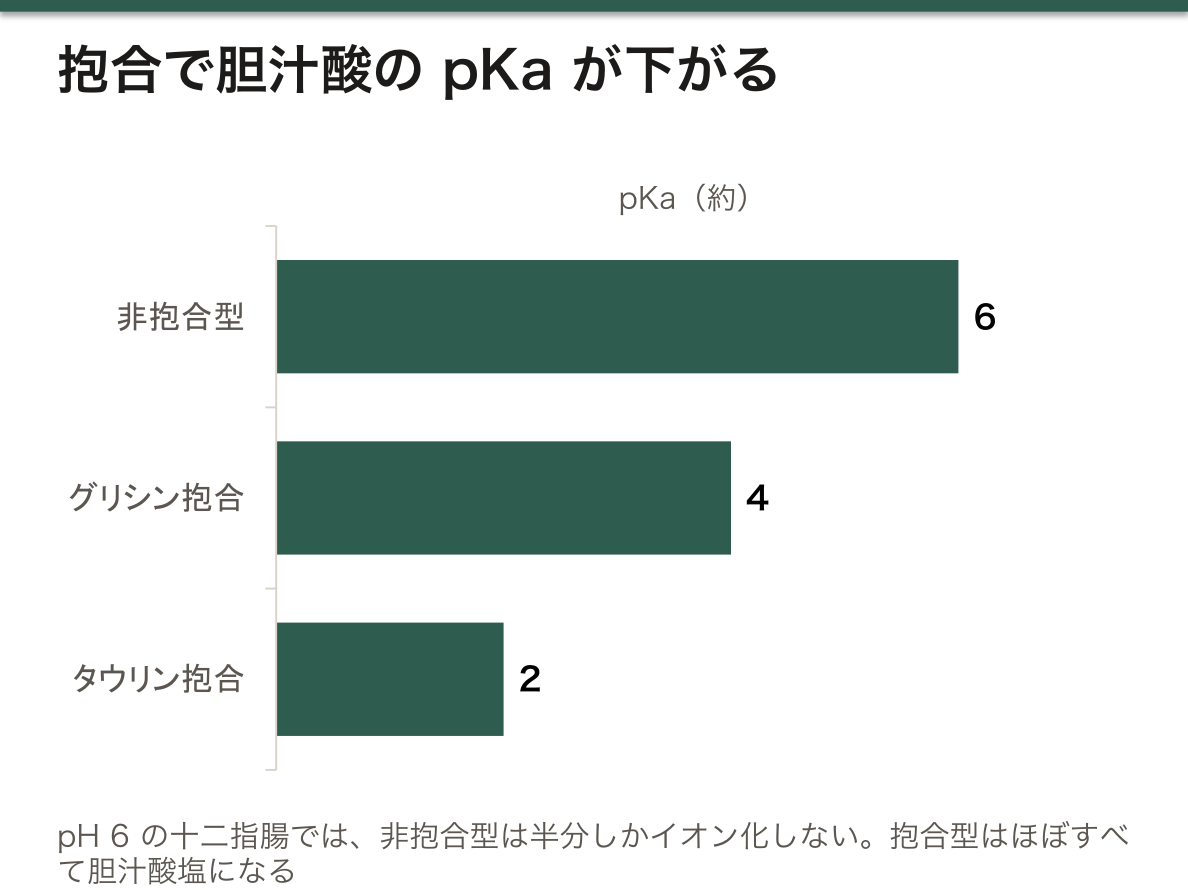
胆汁酸と胆汁酸塩の違い:同じ分子の、プロトンが付いた形(–COOH)が胆汁酸、外れてイオンになった形(–COO⁻、Na⁺・K⁺ と塩を作る)が胆汁酸塩である。抱合されていない胆汁酸の pKa は約6なので、pH 6 の十二指腸では半分しかイオン化しない。肝でグリシンまたはタウリンと抱合すると pKa が下がり(グリシン抱合で約4、タウリン抱合で約2)、十二指腸ではほぼすべてがイオン型=胆汁酸塩になる。イオン型のほうが水に溶け、沈殿しにくく、洗剤としてよく働く。
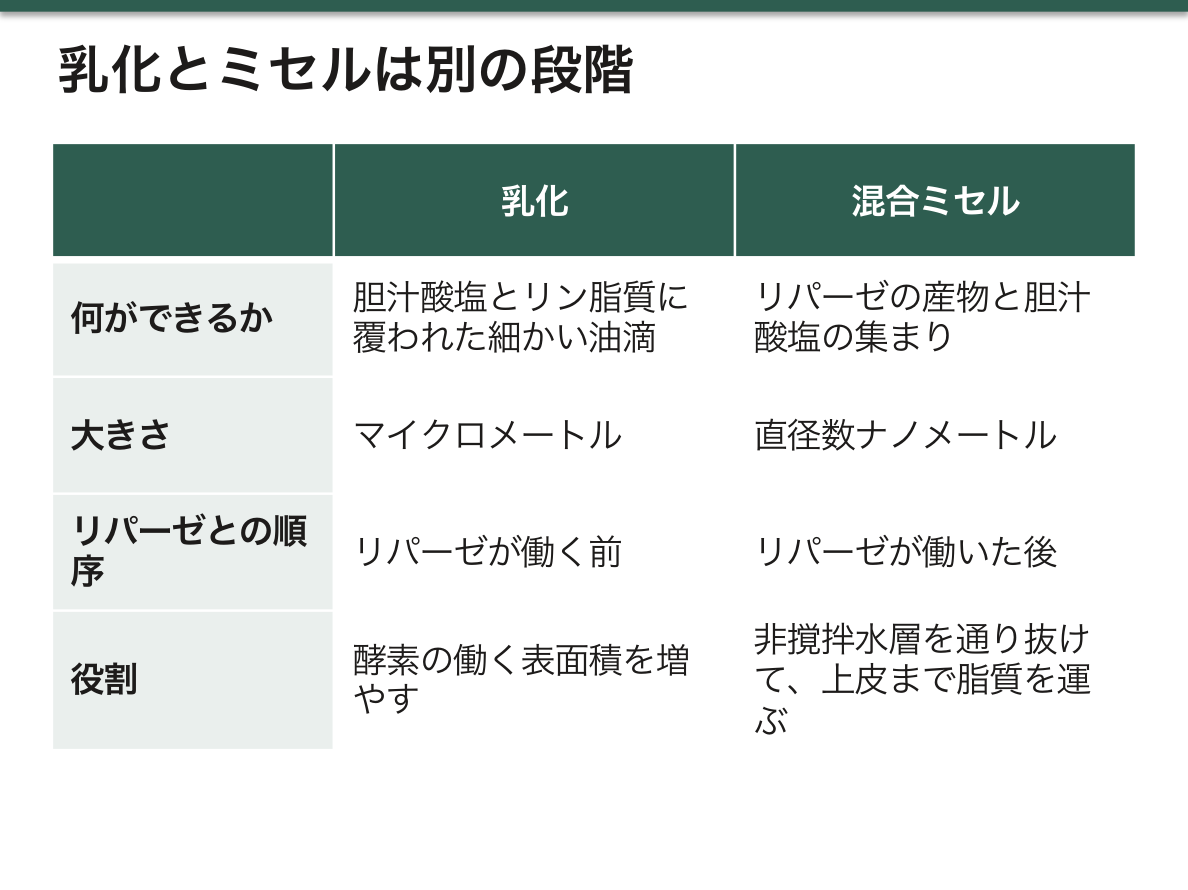
乳化とミセルは別の段階である。乳化は、胆汁酸塩とリン脂質が大きな油滴の表面を覆い、腸の動きで細かい油滴(マイクロメートルの大きさ)に砕いた状態で、酵素の働く表面積を増やす。リパーゼの産物(脂肪酸・2-モノアシルグリセロール・リゾリン脂質・コレステロール)は、胆汁酸塩と一緒に混合ミセル(直径数ナノメートル)を作る。ミセルは水の層(非撹拌水層)を通り抜けて、上皮の表面まで脂質を運ぶ運び屋である。
胆汁酸塩が洗剤として働けるのは、分子の片面に –OH と –COO⁻ が集まり、反対の面が炭化水素だけという「表と裏」の構造を持つからである(両親媒性)。コレステロールは –OH を1つしか持たず水に溶けないが、肝で水酸基を足し、側鎖をカルボキシ基にすることで、親水面と疎水面を持つ分子に作り変えられる。
二次胆汁酸(腸内細菌が脱抱合・7α位の脱水酸化をしたもの)は、肝に戻ると再び抱合されるが、外れた水酸基は戻らない。抱合型は回腸末端の Na⁺ 依存性輸送体で能動的に、非抱合型は大腸で受動的に再吸収される。
胆汁酸塩がミセルを作れる濃度(臨界ミセル濃度)を下回ると、脂肪と脂溶性ビタミン(A・D・E・K)が吸収できなくなる。閉塞性黄疸で灰白色便・脂肪便・ビタミン K 欠乏による出血傾向(PT 延長)が出るのはこのためで、ビタミン K を注射すると PT が戻るかどうかが、肝細胞の障害と胆汁の流れの障害を見分ける手がかりになる。小腸で細菌が増えすぎると(盲係蹄症候群)、胆汁酸が脱抱合されて pKa が上がり、沈殿してミセルが作れなくなる。
English version
Core
Bile is made in the liver, concentrated and stored in the gallbladder, and released into the duodenum by CCK. It is mostly water with bile salts, phospholipid (lecithin), cholesterol, bilirubin and electrolytes including HCO₃⁻; hepatic bile has pH 7–8. It has no enzymes.
Four functions: (1) excretion (bilirubin, cholesterol, drugs, heavy metals); (2) digestion (emulsifies fat, giving enzymes more surface); (3) absorption (micelles carry lipids to the epithelium); (4) antimicrobial (limits bacterial overgrowth in the small intestine).
Bile acid versus bile salt: the same molecule with the proton on (–COOH) is the bile acid; without it (–COO⁻, paired with Na⁺ or K⁺) it is the bile salt. Unconjugated bile acids have a pKa of about 6, so only half are ionised at duodenal pH 6. Conjugation with glycine or taurine in the liver lowers the pKa (about 4 with glycine, about 2 with taurine), so in the duodenum almost all are ionised, i.e. bile salts. The ionised form dissolves better, precipitates less and is a better detergent.
Going further
Emulsification and micelles are different steps. In emulsification, bile salts and phospholipid coat large fat drops, and gut movement breaks them into small droplets (micrometres), increasing the surface for enzymes. The lipase products (fatty acids, 2-monoacylglycerol, lysophospholipid, cholesterol) then form mixed micelles with bile salts (a few nanometres). Micelles carry lipid across the unstirred water layer to the cell surface.
Bile salts work as detergents because the –OH groups and –COO⁻ sit on one face, and the other face is pure hydrocarbon (amphipathic). Cholesterol has only one –OH and does not dissolve; the liver adds hydroxyl groups and turns the side chain into a carboxyl group, making a molecule with a polar face and a non-polar face.
Secondary bile acids (deconjugated and 7α-dehydroxylated by bacteria) are conjugated again in the liver, but the lost hydroxyl is not put back. Conjugated forms are taken up actively in the terminal ileum by a Na⁺-dependent transporter; unconjugated forms are absorbed passively in the colon.
In the clinic
Below the critical micelle concentration, fat and the fat-soluble vitamins (A, D, E, K) cannot be absorbed. That is why obstructive jaundice gives pale stools, steatorrhoea and bleeding from vitamin K deficiency (long PT); whether injected vitamin K corrects the PT helps separate liver-cell damage from blocked bile flow. In small-bowel bacterial overgrowth (blind loop syndrome) bacteria deconjugate bile acids, raising the pKa, so they precipitate and cannot form micelles.
上皮細胞の中で起きること — 長鎖はカイロミクロンでリンパへ、短鎖・中鎖は門脈へ
ミセルで運ばれた長鎖脂肪酸(炭素12個を超えるもの)と 2-モノアシルグリセロールは、膜を拡散で通るほか、脂肪酸の輸送体(CD36 など)で上皮細胞に入る。コレステロールは NPC1L1 で入る。
細胞の中では、これらが滑面小胞体でもう一度エステルに組み直される(2-モノアシルグリセロールに脂肪酸を2つ付けて TAG に、コレステロールはエステルに、リゾリン脂質はリン脂質に)。組み直した脂質はアポ B-48 と一緒にカイロミクロンに包まれ、Golgi 装置を通って基底側からエキソサイトーシスで出て、リンパ管(乳び管)に入る。胸管を経て左鎖骨下静脈から血液に入るので、最初に届く臓器は肝ではない。
短鎖・中鎖脂肪酸(炭素12個以下)は道筋がまったく違う。中鎖脂肪酸のTAG(MCT)は胆汁酸塩もミセルもなしに、そのまま上皮に入れる。細胞の中で組み直されず、カイロミクロンにも入らず、遊離の脂肪酸として門脈へ出て、アルブミンに乗って直接肝へ行く。
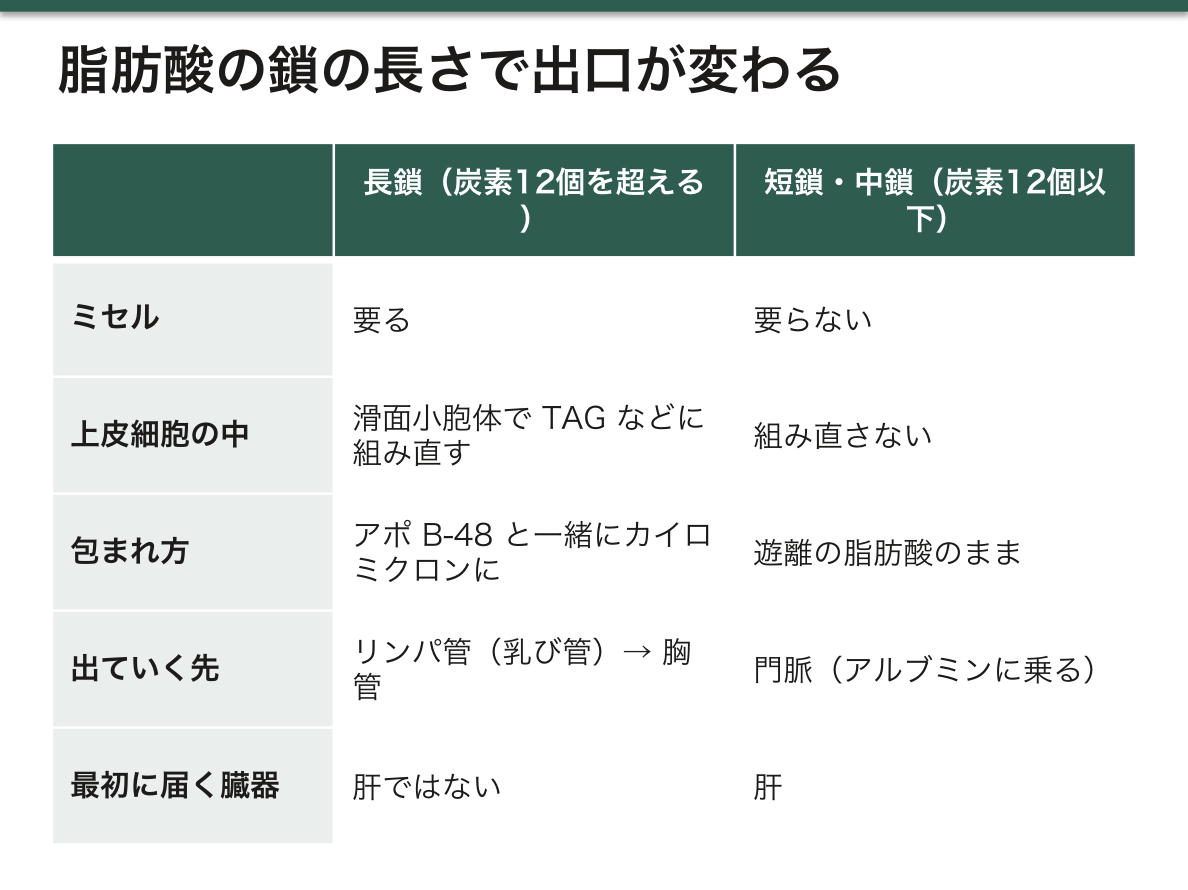
なぜ鎖の長さで道が分かれるのか。中鎖脂肪酸は水にある程度溶けるので、ミセルという運び屋が要らず、細胞内でも脂肪酸結合蛋白なしで動ける。また、組み直しに使うアシル CoA 合成酵素は長鎖を好むので、中鎖は CoA に付けられないまま細胞を通り抜ける。肝に着いた中鎖脂肪酸は、カルニチンなしでミトコンドリアに入れるので、すぐにβ酸化される。
なぜ長鎖はわざわざリンパに出るのか。カイロミクロンは直径が大きく(数百ナノメートル)、毛細血管の内皮をすり抜けられないが、乳び管の内皮には大きな隙間がある。食後に血漿が白く濁る(乳び)のは、このカイロミクロンが血液に入ったためである。
MCT オイルは、脂肪の吸収障害(膵外分泌不全・胆汁うっ滞・短腸症候群)でエネルギーを補う手段になる。リンパに乗らないので、乳び胸・乳び腹水やリンパ管の異常でも使える。カイロミクロンを作れない無βリポ蛋白血症(MTP の欠損)では、上皮に脂肪が溜まり、脂肪便と脂溶性ビタミン(特に E)の欠乏による神経障害・網膜症が出る。
English version
Core
Long-chain fatty acids (more than 12 carbons) and 2-monoacylglycerol, brought by micelles, enter the cell by diffusion and by fatty-acid transporters such as CD36. Cholesterol enters by NPC1L1.
Inside the cell they are re-esterified in the smooth ER: two fatty acids are added to 2-monoacylglycerol to make TAG, cholesterol becomes an ester, lysophospholipid becomes phospholipid. These lipids are packed with apoB-48 into chylomicrons, pass the Golgi, leave by exocytosis on the basal side and enter the lymphatic lacteals. They reach the blood through the thoracic duct and the left subclavian vein, so the liver is not the first organ they meet.
Short- and medium-chain fatty acids (12 carbons or fewer) take a different road. Medium-chain TAG (MCT) can enter the cell intact without bile salts or micelles. They are not re-esterified, not put into chylomicrons, and leave as free fatty acids into the portal vein, carried by albumin straight to the liver.
Going further
Why does chain length decide the route? Medium-chain fatty acids dissolve in water to some extent, so they need no micelle and no binding protein in the cell. The acyl-CoA synthetase used for re-esterification prefers long chains, so medium chains pass through without being attached to CoA. In the liver they enter mitochondria without carnitine and are oxidised at once.
Why do long chains go into lymph? Chylomicrons are large (hundreds of nanometres) and cannot pass the blood capillary wall, but lacteals have wide gaps. The milky plasma after a fatty meal is these chylomicrons in the blood.
In the clinic
MCT oil gives energy in fat malabsorption (pancreatic insufficiency, cholestasis, short bowel). Because it bypasses the lymph, it is also used in chylothorax, chylous ascites and lymphatic disorders. In abetalipoproteinaemia (no MTP) chylomicrons cannot be made; fat collects in the enterocytes, with steatorrhoea and nerve and retinal damage from lack of fat-soluble vitamins, especially vitamin E.
脂肪の消化が止まる場所 — オルリスタット・膵外分泌不全・胆汁うっ滞・胆石
脂肪の消化と吸収は「乳化 → リパーゼ → ミセル → 上皮」の鎖で、どこが切れても結果は同じ脂肪便(脂っぽく、悪臭のある、水に浮く便)と脂溶性ビタミンの欠乏になる。切れる場所で原因を分けて考える。
| 止まる場所 | 原因 | 要点 |
|---|---|---|
| リパーゼそのもの | オルリスタット(肥満の治療薬) | 胃・膵リパーゼの活性部位のセリンに共有結合して不可逆に阻害。食事の脂肪の約3割が吸収されずに出る |
| リパーゼの量 | 膵外分泌不全(慢性膵炎・嚢胞性線維症・膵切除) | 膵の酵素がまとめて失われる。脂肪便は酵素が1割以下に減ってから出る |
| リパーゼの働く環境 | 十二指腸の酸性化(Zollinger-Ellison 症候群) | 胃酸が中和しきれず、膵リパーゼが失活し、胆汁酸が沈殿する |
| 胆汁酸塩 | 胆汁うっ滞・閉塞性黄疸・回腸末端の切除 | 乳化とミセルができない |
| 上皮 | セリアック病・Crohn 病・短腸症候群 | 吸収面そのものが失われる |
オルリスタットは、リパーゼの触媒の仕組みをそのまま利用した薬である。リパーゼはセリンプロテアーゼと同じく、活性部位のセリンの –OH がエステルの炭素を攻撃して、いったん酵素と結合した中間体を作る。オルリスタットはこの位置に結合したまま離れないので、酵素は元に戻れない。全身にはほとんど吸収されず、腸の中だけで働く。副作用はすべて「消化されなかった脂肪」から説明でき、油の混じった便・便の漏れ・脂溶性ビタミンの吸収低下が起きる。だからビタミン剤は、薬と時間をずらして(就寝前などに)飲む。
胆石の8〜9割はコレステロール結石である。胆汁中でコレステロールが溶けていられるのは、胆汁酸塩とレシチンが作るミセルの中に入っているからで、コレステロールがこの2つに対して多すぎる(過飽和)と結晶になって析出する。肥満・急な減量・妊娠・エストロゲンはコレステロール側を増やし、胆嚢の動きが悪いと析出した結晶が溜まる。残りの色素結石はビリルビン由来で、溶血や胆道の感染で増える。
脂肪便の患者では「どこで止まったか」を検査で確かめる。便中エラスターゼが低ければ膵、ビリルビンと ALP・γ-GTP が高ければ胆汁の流れ、抗体検査や生検で上皮の病気を調べる。膵外分泌不全の治療は食事中に膵酵素製剤を飲むことで、胃酸で失活しないよう腸溶性の製剤が使われる。
English version
Core
Fat digestion is a chain: emulsion → lipase → micelle → epithelium. Wherever it breaks, the result is the same: steatorrhoea (greasy, foul, floating stools) and lack of fat-soluble vitamins. Sort the causes by where the chain breaks.
| Where it stops | Cause | Key point |
|---|---|---|
| The lipase itself | Orlistat (anti-obesity drug) | Binds covalently to the active-site serine of gastric and pancreatic lipases; about 30% of dietary fat is not absorbed |
| Amount of lipase | Exocrine pancreatic insufficiency (chronic pancreatitis, cystic fibrosis, resection) | All pancreatic enzymes lost; steatorrhoea appears when enzymes fall below about 10% |
| Lipase environment | Acid duodenum (Zollinger-Ellison syndrome) | Acid is not neutralised; lipase is inactivated and bile acids precipitate |
| Bile salts | Cholestasis, obstructive jaundice, terminal ileal resection | No emulsion, no micelles |
| Epithelium | Coeliac disease, Crohn’s disease, short bowel | The absorbing surface is lost |
Going further
Orlistat uses the lipase’s own catalytic mechanism. Like serine proteases, lipase attacks the ester carbon with the –OH of an active-site serine and forms an enzyme-bound intermediate. Orlistat binds there and does not leave, so the enzyme cannot recover. It is hardly absorbed and acts only in the gut. Every side effect comes from undigested fat: oily stools, leakage and poor absorption of fat-soluble vitamins, so vitamin supplements are taken at a different time (e.g. at bedtime).
Gallstones: 80–90% are cholesterol stones. Cholesterol stays dissolved in bile only inside micelles of bile salts and lecithin; when cholesterol is too high relative to these two (supersaturation), it crystallises. Obesity, rapid weight loss, pregnancy and oestrogen raise the cholesterol side; poor gallbladder emptying lets crystals collect. Pigment stones come from bilirubin and increase with haemolysis and biliary infection.
In the clinic
In a patient with steatorrhoea, test where the chain broke: low faecal elastase points to the pancreas; high bilirubin, ALP and γ-GT point to bile flow; antibodies and biopsy look for epithelial disease. Pancreatic insufficiency is treated with enzyme capsules taken with meals, enteric-coated so that acid does not destroy them.
核酸の消化 — ヌクレアーゼ・ヌクレオチダーゼ・ヌクレオシダーゼの3段階
食物の DNA と RNA は、大きいほうから順に3種類の結合を切って分解される。
| 段階 | 酵素(場所) | 切る結合(酵素の型) | 産物 |
|---|---|---|---|
| 1 | リボヌクレアーゼ・デオキシリボヌクレアーゼ(膵) | ヌクレオチドどうしをつなぐホスホジエステル結合(エステラーゼ) | オリゴヌクレオチド → モノヌクレオチド |
| 2 | ヌクレオチダーゼ(刷子縁) | 糖とリン酸のエステル結合(エステラーゼ) | ヌクレオシド+リン酸 |
| 3 | ヌクレオシダーゼ・ヌクレオシドホスホリラーゼ(刷子縁・上皮) | 塩基と糖の N-グリコシド結合(グリコシダーゼ) | 塩基(プリン・ピリミジン)+ペントース |
口と胃には核酸を切る酵素が無く、消化は十二指腸から始まる。DNA と RNA は糖で見分ける——RNA のリボースは 2′位に –OH を持ち、DNA のデオキシリボースは持たない。塩基では、RNA はウラシル、DNA はチミンを使う。
結合の種類が分かれば、酵素の分類も自動的に決まる。リン酸とのエステル結合を切るヌクレアーゼとヌクレオチダーゼはエステラーゼ、糖と塩基の結合を切るヌクレオシダーゼはグリコシダーゼ(グリコシド結合の一種である N-グリコシド結合を切る)で、どれも加水分解酵素である。ヌクレオシドホスホリラーゼは水ではなくリン酸で切り、ペントース-1-リン酸を作る(グリコーゲンホスホリラーゼと同じ「加リン酸分解」)。
吸収されたヌクレオシドと塩基のほとんどは、核酸の材料としては使われず、上皮細胞と肝で分解される。プリンは尿酸まで、ピリミジンは CO₂・NH₃・β-アラニンなどまで壊される。小腸の粘膜にはキサンチンオキシダーゼが多い。体が使う核酸は、ほとんどが自分で新しく作るか、細胞の中で再利用(サルベージ)したものである。
食事のプリンが血清尿酸を上げるのは、吸収されたプリンがほぼすべて尿酸になるからである。レバー・魚の干物・ビールなど、細胞の多い食品や酵母由来の食品にプリンが多い。高尿酸血症・痛風でプリンを控える食事指導は、この代謝の流れに基づいている。
English version
Core
Dietary DNA and RNA are taken apart by cutting three kinds of bond, from large to small.
| Step | Enzyme (site) | Bond cut (enzyme type) | Products |
|---|---|---|---|
| 1 | Ribonuclease, deoxyribonuclease (pancreas) | Phosphodiester bond between nucleotides (esterase) | Oligonucleotides → mononucleotides |
| 2 | Nucleotidase (brush border) | Ester bond between sugar and phosphate (esterase) | Nucleoside + phosphate |
| 3 | Nucleosidase, nucleoside phosphorylase (brush border, enterocyte) | N-glycosidic bond between base and sugar (glycosidase) | Base (purine or pyrimidine) + pentose |
Mouth and stomach have no nucleic-acid enzymes; digestion begins in the duodenum. Tell DNA from RNA by the sugar: ribose in RNA has a 2′-OH, deoxyribose in DNA does not. For bases, RNA uses uracil and DNA uses thymine.
Going further
Know the bond and you know the enzyme class. Nucleases and nucleotidases cut phosphate ester bonds (esterases); nucleosidases cut the N-glycosidic bond between sugar and base (glycosidases). All are hydrolases. Nucleoside phosphorylase cuts with phosphate instead of water and makes pentose-1-phosphate (phosphorolysis, as in glycogen phosphorylase).
Most absorbed nucleosides and bases are not used to build nucleic acids; the enterocyte and liver break them down. Purines go to uric acid, pyrimidines to CO₂, NH₃ and β-alanine. The intestinal mucosa is rich in xanthine oxidase. The body’s nucleic acids are made new or recycled inside cells (salvage).
In the clinic
Dietary purines raise serum urate because almost all absorbed purine becomes uric acid. Organ meats, dried fish and beer — foods rich in cells or yeast — contain much purine. Low-purine diets for hyperuricaemia and gout rest on this pathway.
胃酸と内因子 — 1つの細胞が、2つの別々の仕事をしている
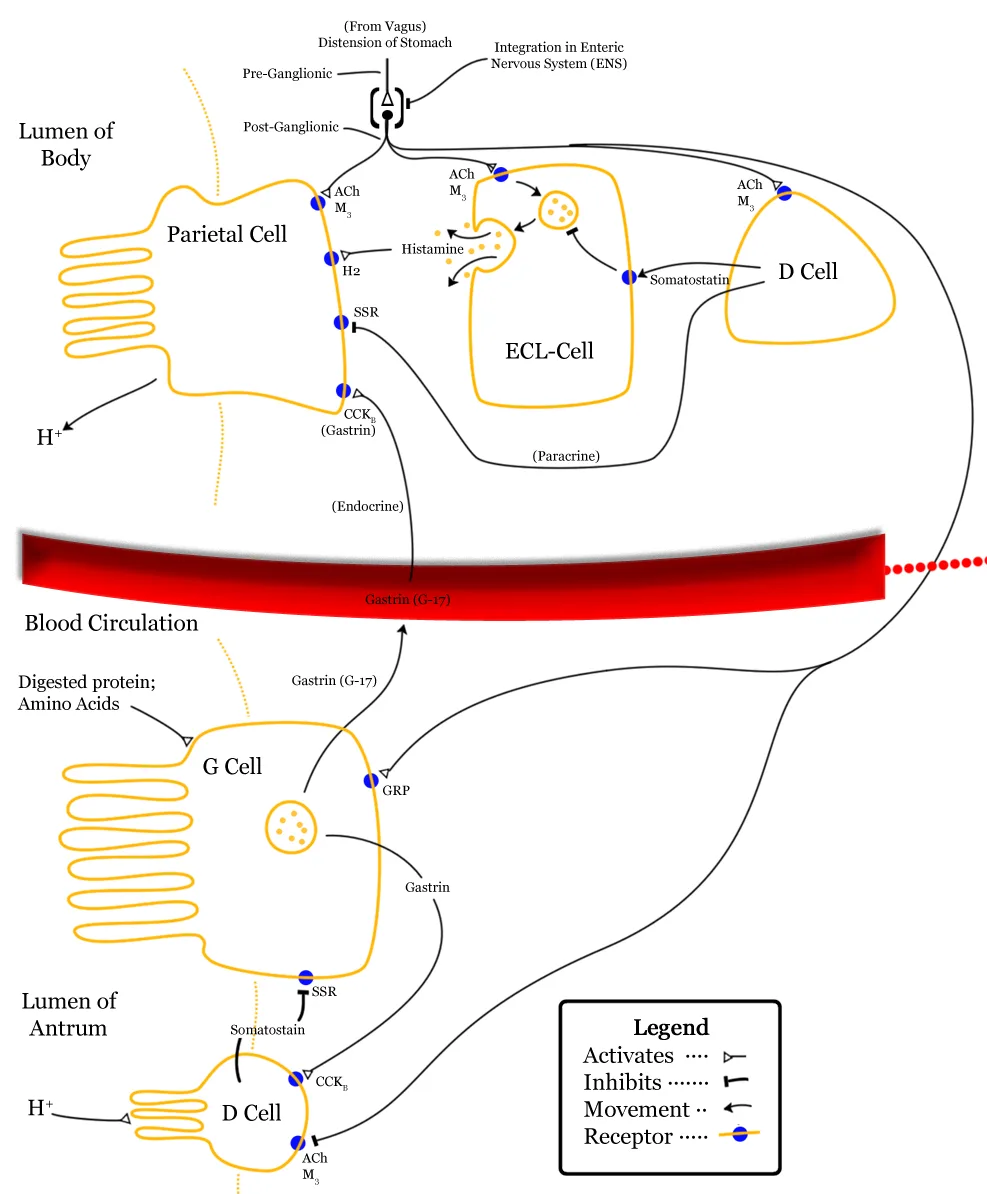
胃の壁細胞は、まったく違う2つのものを出している——塩酸と、内因子。
酸の作られ方——細胞内で炭酸脱水酵素が H⁺ と HCO₃⁻ を作り、H⁺ は H⁺/K⁺-ATPase(プロトンポンプ)で管腔へ、HCO₃⁻ は血液側へ出る。
だから食後は血液がアルカリに傾く(alkaline tide)。
分泌を促す3つ——ガストリン・アセチルコリン(迷走神経)・ヒスタミン(ECL 細胞)。ヒスタミンが最終共通路になり、他の2つを増幅する。
酸の役割——ペプシノゲンの活性化・蛋白の変性・殺菌・鉄とカルシウムの可溶化。
「ヒスタミンが最終共通路である」ことが、薬の効き方の差を作っている。H₂ 遮断薬は増幅を止めるだけだが、プロトンポンプ阻害薬は出口そのものを塞ぐ(消化器の薬の章)——「だから酸の抑制の強さが、桁で違う」。
プロトンポンプ阻害薬は、活性化しているポンプにしか結合できない——「食前に飲むのは、食事で動き出すポンプを狙うためになる」。
酸を止めることの代償が、長期使用の副作用として現れる(ミネラルの章)——「鉄・カルシウム・マグネシウム・ビタミンB12 の吸収低下、腸管感染症の増加、そして高ガストリン血症」。
1つの細胞が2つを出すことは、萎縮性胃炎の帰結を決めている(ビタミンB12 と葉酸の項)——「壁細胞が失われれば、酸も内因子も同時に失われる。無酸症と悪性貧血が並ぶ」。
そのとき抑制が外れて、ガストリンが上がり続ける(びまん性神経内分泌系の項)——「ECL 細胞が刺激され続け、胃の神経内分泌腫瘍の危険が上がる」。
Zollinger-Ellison 症候群は、逆に酸が過剰になる(胃の各論の章)——「難治性・多発性の潰瘍、下痢、そして膵リパーゼが酸で失活して脂肪便が出る」。
English version
Core
The gastric parietal cell releases two quite different things — hydrochloric acid and intrinsic factor.
How the acid is made — carbonic anhydrase makes H⁺ and HCO₃⁻ within the cell; the H⁺ goes to the lumen by the H⁺/K⁺-ATPase (the proton pump) and the HCO₃⁻ to the blood. Hence the blood turns alkaline after a meal (the alkaline tide).
Three things promote secretion — gastrin, acetylcholine (vagus) and histamine (ECL cell). Histamine is the final common path and amplifies the other two.
The roles of acid — activating pepsinogen, denaturing protein, killing organisms, and solubilising iron and calcium.
Going further
That histamine is the final common path creates the difference between the drugs. An H₂ blocker only stops the amplification, whereas a proton pump inhibitor blocks the exit itself — hence a difference of an order of magnitude in the suppression of acid.
A PPI can bind only a pump that is active — which is why it is taken before food, to catch the pumps that the meal sets going.
The price of stopping the acid appears as the adverse effects of long use — reduced absorption of iron, calcium, magnesium and B12, increased intestinal infection, and hypergastrinaemia.
That one cell releases two things decides the consequence of atrophic gastritis — lose the parietal cells and both acid and intrinsic factor are lost together: achlorhydria and pernicious anaemia side by side.
And the inhibition released, gastrin goes on rising — the ECL cells are continuously stimulated and the risk of a gastric neuroendocrine tumour increases.
Zollinger–Ellison syndrome is the converse, an excess of acid — intractable multiple ulcers, diarrhoea, and steatorrhoea because pancreatic lipase is inactivated by the acid.
ミネラルの吸収は、化学の条件で決まる — 酸・還元・競合
ミネラルは「食べた量」ではなく「吸収された量」で効く。吸収率は条件次第で数倍変わる。鉄がその典型である。
| ヘム鉄 | 吸収率 15〜35% | 肉・魚。ポルフィリン環に包まれたまま専用の経路で入る |
| 非ヘム鉄 | 吸収率 2〜20% | 植物・強化食品。3 価のままでは入れず、2 価に還元されて DMT1 で入る |
非ヘム鉄には条件が要る。
- 胃酸——酸性でないと溶けず、還元も進まない
- ビタミン C——還元して吸収を助ける。同時に摂ると効果がある
- 妨げるもの——フィチン酸(穀物・豆)、タンニン(茶・コーヒー)、カルシウム、食物繊維。キレートを作って沈殿させる
金属どうしは、同じ輸送体を奪い合う。DMT1 は鉄だけでなく亜鉛・銅・マンガン・鉛・カドミウムも運ぶ。だから次のことが起こる。
- 鉄欠乏があると、鉛の吸収が増える——小児の鉛中毒の危険因子になる
- 亜鉛を長く大量に補充すると、銅欠乏になる——亜鉛が腸上皮のメタロチオネインを誘導し、銅を細胞内に捕まえて便へ捨ててしまう。貧血と白血球減少、そして脊髄症を起こす。この機序を逆用したのが Wilson 病の亜鉛療法である
- カルシウムと鉄は同時に摂らない——サプリメントは時間をずらす
薬が吸収を変える場面が、実際にはいちばん多い。
| プロトンポンプ阻害薬・H2 遮断薬 | 酸が減る | 鉄・カルシウム・マグネシウム・ビタミン B12 の吸収が落ちる |
| 制酸薬・鉄剤・亜鉛・乳製品 | 薬とキレートを作る | テトラサイクリン系・ニューキノロン系・レボチロキシン・ビスホスホネートが効かなくなる。2 時間以上あける |
「飲んでいるのに効かない」ときは、飲み合わせと時間を確認する。
鉄剤が効かない患者には、いつ・何と一緒に飲んでいるかを聞く。食後にお茶で飲んでいる、制酸薬と同時、という例が多い。
English version
Core
Minerals act by the amount absorbed, not the amount eaten, and the fraction absorbed varies several-fold with conditions. Iron is the classic case.
| Absorption | ||
|---|---|---|
| Haem iron | 15–35% | Meat and fish. Enters by a dedicated route while still enclosed in the porphyrin ring |
| Non-haem iron | 2–20% | Plants and fortified foods. Cannot enter as ferric; must be reduced to ferrous and enter by DMT1 |
Non-haem iron has requirements.
- Gastric acid — without an acid environment it does not dissolve and is not reduced.
- Vitamin C — reduces it and aids absorption. Effective taken at the same time.
- What hinders it — phytate (grains, pulses), tannins (tea, coffee), calcium, dietary fibre. They chelate it and precipitate it.
Going further
The metals compete for the same transporter. DMT1 carries not only iron but zinc, copper, manganese, lead and cadmium. So:
- Iron deficiency increases the absorption of lead — a risk factor for lead poisoning in children.
- Long-term high-dose zinc causes copper deficiency — zinc induces metallothionein in the intestinal epithelium, which traps the copper in the cell and discards it in the faeces. Anaemia, leucopenia and myelopathy. Turning that mechanism to use gives zinc therapy in Wilson’s disease.
- Do not take calcium and iron together — space the supplements.
In practice, drugs are the commonest cause of altered absorption.
| Drug | What happens | Consequence |
|---|---|---|
| PPI, H2 blocker | Less acid | Reduced absorption of iron, calcium, magnesium and B12 |
| Antacids, iron, zinc, dairy products | Chelate the drug | Tetracyclines, quinolones, levothyroxine and bisphosphonates stop working. Separate by two hours or more |
When something "is being taken but is not working", check what it is taken with and when.
In the clinic
When iron does not work, ask when and with what it is taken. Taking it after a meal with tea, or with an antacid, is a common finding.
胃酸を止めるということ — 便利さと引き換えに何が起きるか
胃酸は消化のためだけにあるのではない。3 つの役目を同時に果たしている。
- 殺菌——pH 2 の環境が、口から入る細菌の大半を止めている
- 溶かす・還元する——ミネラルとビタミン B12 を吸収できる形にする
- ペプシンを働かせる——ペプシノゲンは酸で活性化し、酸性でのみ働く
プロトンポンプ阻害薬(PPI)は壁細胞の H⁺/K⁺-ATPase を不可逆に止めるので、効果が強く、長い。潰瘍と逆流性食道炎の治療を大きく変えた薬である。
ただし「念のため続ける」ことの代償が、後から分かってきた。
長期投与で問題になることを、機序ごとに整理する。
| 感染が増える | 殺菌の関門が外れる | Clostridioides difficile 腸炎・細菌性腸炎・誤嚥性肺炎 |
| 吸収が落ちる | 酸が要る過程が止まる | ビタミン B12・鉄・カルシウム・マグネシウム。低 Mg 血症は難治性の低 Ca・不整脈を招く |
| ガストリンが上がる | 酸による負のフィードバックが外れる | 壁細胞と腸クロム親和性様細胞が増える。急にやめると酸が跳ね返る(リバウンド)——「やめられない」原因になる |
| 薬の吸収が変わる | 溶けるのに酸が要る薬がある | イトラコナゾール・一部の抗ウイルス薬・鉄剤の効果が落ちる |
⚠️ 診断を隠すことも忘れてはならない。PPI を飲んでいるとHelicobacter pylori の検査(尿素呼気試験・便中抗原)が偽陰性になるので、2 週間以上休薬してから検査する。胃癌の症状を和らげて受診を遅らせる、という問題も指摘されている。
正しい使い方は「必要な期間だけ、必要な強さで」である。適応が明確なとき(潰瘍の治療、除菌、NSAID 潰瘍の予防、重症の逆流性食道炎)は利益がはっきりしている。漫然と続いている処方を見つけたら、やめられるかを検討する(減量してから中止する)——これは処方の見直しの実例としてよく取り上げられる。
入院時に「なぜこの PPI が始まったのか」を確認する。ストレス潰瘍の予防で始まり、そのまま何年も続いているという例が非常に多い。
English version
Core
Gastric acid is not there for digestion alone. It does three things at once.
- Kills organisms — an environment of pH 2 stops most of the bacteria that enter by mouth.
- Dissolves and reduces — puts minerals and B12 into a form that can be absorbed.
- Lets pepsin work — pepsinogen is activated by acid and works only in acid.
A proton pump inhibitor (PPI) irreversibly blocks the parietal cell H⁺/K⁺-ATPase, so its effect is strong and long. It transformed the treatment of ulcer and reflux oesophagitis. But the price of "continuing just in case" has become clear later.
Going further
Set out what becomes a problem with long-term use, by mechanism.
| Problem | Mechanism | Consequence |
|---|---|---|
| More infection | The bactericidal barrier is removed | Clostridioides difficile colitis, bacterial enteritis, aspiration pneumonia |
| Reduced absorption | Processes that need acid stop | Vitamin B12, iron, calcium, magnesium. Hypomagnesaemia causes refractory hypocalcaemia and arrhythmia |
| Gastrin rises | The negative feedback of acid is released | Parietal and ECL cells increase. Stopping suddenly causes rebound acid — the reason it "cannot be stopped" |
| Drug absorption changes | Some drugs need acid to dissolve | Itraconazole, some antivirals and iron become less effective |
⚠️ It also conceals diagnoses. On a PPI the tests for Helicobacter pylori (urea breath test, faecal antigen) become falsely negative, so withhold it for two weeks or more before testing. It has also been pointed out that it eases the symptoms of gastric cancer and delays presentation.
The right use is "for as long as needed, at the strength needed". Where the indication is clear (treating an ulcer, eradication, prevention of NSAID ulcer, severe reflux oesophagitis) the benefit is plain. Finding a prescription that has drifted on, consider whether it can be stopped (reduce before stopping) — a standard example of reviewing a prescription.
In the clinic
On admission, check why this PPI was started. Very often it began as stress ulcer prophylaxis and has simply continued for years.
まとめ
| 分解する酵素と、活性化の順序 | 栄養素酵素最終形デンプン唾液・膵アミラーゼ → 刷子縁の二糖類分解酵素単糖蛋白ペプシン → トリプシン・キモトリプシン → 刷子縁のペプチダーゼアミノ酸・ジペプチド/トリペプチド脂… |
|---|---|
| 消化液の一覧 — pH・作る細胞・呼び出すホルモン | 消化液は4つ(唾液・胃液・膵液・腸液)に胆汁を加えた5つで考える。 |
| ペプチダーゼの切断規則 — 誰が、どの結合を切るか | 蛋白の消化に関わるペプチダーゼは8つで、「鎖の内側を切る(エンド型)か、端から1つずつ外す(エキソ型)か」と「どのアミノ酸を見分けるか」の2つで整理できる。 |
| ペプチドを手で消化する — 側鎖を5群に分けて、消化管の順に切る | ペプチドの配列が与えられたら、次の4手順で最後のアミノ酸まで切っていける。 |
| アミノ酸とジペプチド・トリペプチドの吸収 — Na⁺ で入るものと、H⁺ で入るもの | 蛋白の消化産物は、遊離アミノ酸とジペプチド・トリペプチドの2つの形で上皮細胞に入る。 |
| 吸収の地図 — どこで何が入るか | 部位吸収されるもの十二指腸・空腸上部鉄・カルシウム・葉酸・糖・アミノ酸空腸大部分の栄養素・脂溶性ビタミン回腸末端ビタミンB12(内因子と共に)・胆汁酸大腸水・電解質・短鎖脂肪酸・ビ… |
| 二糖類分解酵素 — 一番端の一歩が、症状を決める | 糖の消化は、腸上皮の刷子縁で最後の一歩を踏む。 |
| アミロペクチンが単糖になるまで — 口・胃・十二指腸・刷子縁の4段階 | デンプンの7〜8割を占めるアミロペクチンは、α1→4 結合の鎖に α1→6 結合の枝が付いた分子である。 |
| 糖の消化が止まるとき — スクラーゼ-イソマルターゼ欠損症と α-グルコシダーゼ阻害薬 | 先天性スクラーゼ-イソマルターゼ欠損症(常染色体潜性)では、刷子縁でショ糖と α1→6 結合(イソマルトース・α-限界デキストリン)が切れない。 |
| 脂質の消化酵素 — 3つのリパーゼと、コリパーゼ・PLA₂・CEL | 食事の脂質は、9割以上がトリアシルグリセロール(TAG)で、残りがリン脂質・コレステロールエステル・ガラクト脂質(植物の膜の脂質)である。 |
| 胆汁酸と胆汁酸塩・乳化とミセル — 「酸」と「塩」は pKa の話である | 胆汁は肝で作られ、胆嚢で濃縮・貯蔵され、CCK の刺激で十二指腸へ出る。 |
| 上皮細胞の中で起きること — 長鎖はカイロミクロンでリンパへ、短鎖・中鎖は門脈へ | ミセルで運ばれた長鎖脂肪酸(炭素12個を超えるもの)と 2-モノアシルグリセロールは、膜を拡散で通るほか、脂肪酸の輸送体(CD36 など)で上皮細胞に入る。 |
| 脂肪の消化が止まる場所 — オルリスタット・膵外分泌不全・胆汁うっ滞・胆石 | 脂肪の消化と吸収は「乳化 → リパーゼ → ミセル → 上皮」の鎖で、どこが切れても結果は同じ脂肪便(脂っぽく、悪臭のある、水に浮く便)と脂溶性ビタミンの欠乏になる。 |
| 核酸の消化 — ヌクレアーゼ・ヌクレオチダーゼ・ヌクレオシダーゼの3段階 | 食物の DNA と RNA は、大きいほうから順に3種類の結合を切って分解される。 |
| 胃酸と内因子 — 1つの細胞が、2つの別々の仕事をしている | 胃の壁細胞は、まったく違う2つのものを出している——塩酸と、内因子。 |
| ミネラルの吸収は、化学の条件で決まる — 酸・還元・競合 | ミネラルは「食べた量」ではなく「吸収された量」で効く。 |
| 胃酸を止めるということ — 便利さと引き換えに何が起きるか | 胃酸は消化のためだけにあるのではない。3 つの役目を同時に果たしている。 |
このノートは医学生が授業の内容を自分の言葉でまとめたもので、診療の判断に使うものではありません。誤りに気づいたらお知らせください。