解糖と糖新生は向きが逆の経路で、大部分の反応は同じ酵素が両方向に使われる。しかし3か所だけは別々の酵素で、そこが調節の場になっている。ここを押さえると、食後は解糖、空腹では糖新生という切り替えが1枚の図で説明できる。
両方が同時に全開になると、ATPを消費するだけで何も生まない(無益回路)。体はそれを避けるために、1つの物質で片方を上げ、もう片方を下げるという設計を採っている。
- 律速の3か所 — ここだけ酵素が別になっている
- フルクトース2,6ビスリン酸 — 1つの物質が両方を逆向きに動かす
- インスリンとグルカゴンの比 — 同じ酵素が、逆向きに動く
- AMPK — 細胞が、エネルギーの残高を読んでいる仕組み
- 低血糖に対する防御は、順番に立ち上がる
- 朝の高血糖 — 眠っているあいだにも、血糖を上げるホルモンは動いている
律速の3か所 — ここだけ酵素が別になっている
解糖と糖新生で酵素が別になっている3か所。
| 段階 | 解糖(下り) | 糖新生(上り) |
|---|---|---|
| グルコース⇄グルコース6リン酸 | ヘキソキナーゼ/グルコキナーゼ | グルコース6ホスファターゼ |
| フルクトース6リン酸⇄1,6ビスリン酸 | ホスホフルクトキナーゼ1 | フルクトース1,6ビスホスファターゼ |
| ホスホエノールピルビン酸⇄ピルビン酸 | ピルビン酸キナーゼ | ピルビン酸カルボキシラーゼ+ホスホエノールピルビン酸カルボキシキナーゼ |
- 解糖の最大の律速はホスホフルクトキナーゼ1
- グルコース6ホスファターゼは肝と腎にしかない。だから筋のグリコーゲンは血糖にならない
- 糖新生は細胞質とミトコンドリアをまたぐ(ピルビン酸カルボキシラーゼはミトコンドリア内)
ヘキソキナーゼとグルコキナーゼの違いが、臓器の役割分担そのものである。
| ヘキソキナーゼ | グルコキナーゼ | |
|---|---|---|
| 分布 | ほぼ全身 | 肝・膵β細胞 |
| 基質への親和性 | 高い(Kmが低い) | 低い(Kmが高い) |
| 生成物による阻害 | 受ける | 受けない |
意味はこうである。全身の細胞は血糖が低くてもグルコースを取り込めなければ困るので、親和性の高いヘキソキナーゼを使う。一方肝は「余ったときだけ引き取る」役なので、血糖が高いときにだけ働くグルコキナーゼが適している。膵β細胞ではグルコキナーゼが血糖センサーそのものとして働く——だからグルコキナーゼの変異は若年発症成人型糖尿病の一型を起こし、軽い高血糖が生涯続くが合併症は少ないという独特の像になる。
糖新生の材料は3つに限られる——乳酸(Cori回路)、アミノ酸(主にアラニン)、グリセロール。脂肪酸は材料にならない。アセチルCoAは2炭素で、ピルビン酸へ戻る道が無い(ピルビン酸脱水素酵素は不可逆)からである。だから「脂肪から血糖は作れない」——飢餓でケトン体が要る理由がここにある(脂質代謝の章)。
English version
Core
The three places where the enzymes differ between glycolysis and gluconeogenesis.
| Step | Glycolysis (down) | Gluconeogenesis (up) |
|---|---|---|
| Glucose ⇄ glucose 6-phosphate | Hexokinase / glucokinase | Glucose 6-phosphatase |
| Fructose 6-phosphate ⇄ 1,6-bisphosphate | Phosphofructokinase 1 | Fructose 1,6-bisphosphatase |
| Phosphoenolpyruvate ⇄ pyruvate | Pyruvate kinase | Pyruvate carboxylase + PEP carboxykinase |
- The chief rate-limiting step of glycolysis is phosphofructokinase 1.
- Glucose 6-phosphatase exists only in liver and kidney. Hence muscle glycogen does not become blood glucose.
- Gluconeogenesis straddles cytosol and mitochondrion (pyruvate carboxylase is within the mitochondrion).
Going further
The difference between hexokinase and glucokinase is the division of labour between organs itself.
| Hexokinase | Glucokinase | |
|---|---|---|
| Distribution | Almost everywhere | Liver, pancreatic β cell |
| Affinity for substrate | High (low Km) | Low (high Km) |
| Inhibition by product | Yes | No |
The meaning is this. Cells everywhere would be in trouble if they could not take up glucose when the blood level is low, so they use the high-affinity hexokinase. The liver, on the other hand, has the part of taking it in only when there is a surplus, so glucokinase, which works only when the blood glucose is high, suits it. In the β cell glucokinase acts as the glucose sensor itself — hence a mutation of glucokinase causes one form of maturity-onset diabetes of the young, with the distinctive picture that a mild hyperglycaemia lasts a lifetime with few complications.
The materials of gluconeogenesis are limited to three — lactate (the Cori cycle), amino acid (chiefly alanine) and glycerol. Fatty acid is not a material. Acetyl-CoA has two carbons and there is no route back to pyruvate (pyruvate dehydrogenase is irreversible). Hence "blood glucose cannot be made from fat" — and here is the reason ketone bodies are needed in starvation (the chapter on lipid metabolism).
フルクトース2,6ビスリン酸 — 1つの物質が両方を逆向きに動かす
フルクトース2,6ビスリン酸は解糖の中間体ではなく、調節だけのために作られる分子である。
- ホスホフルクトキナーゼ1を活性化(解糖を進める)
- フルクトース1,6ビスホスファターゼを阻害(糖新生を止める)
作るのも壊すのも同じ1本の酵素(ホスホフルクトキナーゼ2/フルクトース2,6ビスホスファターゼ、二重機能酵素)で、リン酸化されるとどちらの働きをするかが入れ替わる。
| 状況 | ホルモン | 二重機能酵素 | フルクトース2,6ビスリン酸 | 結果 |
|---|---|---|---|---|
| 食後 | インスリン | 脱リン酸化 | 増える | 解糖 |
| 空腹 | グルカゴン | リン酸化 | 減る | 糖新生 |
1つの分子で2つの経路を逆向きに動かす——これが無益回路を避ける最も効率的な設計である。もし解糖と糖新生を別々の信号で制御していたら、両方が同時に動く瞬間が必ず生じる。正負を1本の信号に束ねれば、その瞬間は原理的に存在しない。
アロステリック調節の全体像も同じ論理で読める。
- ホスホフルクトキナーゼ1——ATPとクエン酸で阻害、AMPとフルクトース2,6ビスリン酸で活性化。ATPが基質でありながら阻害物質でもあるのが要点で、足りているなら作るなという信号になる。クエン酸は「TCA回路が満杯」の合図
- ピルビン酸キナーゼ——フルクトース1,6ビスリン酸で活性化(前の段階の産物が後ろを促す=順行性活性化)。グルカゴンによるリン酸化で阻害
- ピルビン酸カルボキシラーゼ——アセチルCoAで活性化。脂肪酸酸化が進んでアセチルCoAが溜まる=空腹なので、糖新生を促す
肝と筋でピルビン酸キナーゼの制御が違う点も臨床に効く。筋型はグルカゴンで抑制されない——筋には糖新生が無く、血糖を守る義務も無いからである。赤血球のピルビン酸キナーゼ欠損症ではATPが作れず、膜のポンプが止まって溶血する。赤血球はミトコンドリアを持たないため、解糖だけがATP源だからである。
English version
Core
Fructose 2,6-bisphosphate is not an intermediate of glycolysis but a molecule made for regulation alone.
- It activates phosphofructokinase 1 (driving glycolysis).
- It inhibits fructose 1,6-bisphosphatase (stopping gluconeogenesis).
- Making it and destroying it are done by a single enzyme (phosphofructokinase 2 / fructose 2,6-bisphosphatase, a bifunctional enzyme), and phosphorylation switches which of the two activities it has.
| State | Hormone | Bifunctional enzyme | Fructose 2,6-bisphosphate | Result |
|---|---|---|---|---|
| After a meal | Insulin | Dephosphorylated | Increases | Glycolysis |
| Fasting | Glucagon | Phosphorylated | Decreases | Gluconeogenesis |
Going further
Moving two pathways in opposite directions with one molecule — this is the most efficient design for avoiding a futile cycle. Were glycolysis and gluconeogenesis controlled by separate signals, there would necessarily be moments when both ran at once. Bundle the positive and the negative into one signal and that moment cannot exist in principle.
The whole picture of allosteric regulation reads by the same logic.
- Phosphofructokinase 1 — inhibited by ATP and citrate, activated by AMP and fructose 2,6-bisphosphate. The crux is that ATP is both substrate and inhibitor, giving the signal do not make it if there is enough. Citrate is the sign that "the TCA cycle is full".
- Pyruvate kinase — activated by fructose 1,6-bisphosphate (the product of an earlier step promoting a later one = feed-forward activation). Inhibited by phosphorylation from glucagon.
- Pyruvate carboxylase — activated by acetyl-CoA. Fatty acid oxidation advancing and acetyl-CoA accumulating means fasting, so gluconeogenesis is promoted.
That pyruvate kinase is regulated differently in liver and muscle also tells clinically. The muscle form is not suppressed by glucagon — muscle has no gluconeogenesis and no duty to protect the blood glucose. In pyruvate kinase deficiency of the red cell ATP cannot be made and the membrane pumps stop, causing haemolysis. The red cell has no mitochondria, so glycolysis is its only source of ATP.
インスリンとグルカゴンの比 — 同じ酵素が、逆向きに動く
血糖の調節は「どちらのホルモンが多いか」という比で決まる。
| 食後(インスリン優位) | 空腹(グルカゴン優位) | |
|---|---|---|
| 細胞内の cAMP | 低い | 高い |
| 酵素のリン酸化 | 脱リン酸化 | リン酸化 |
| グリコーゲン合成酵素 | 活性化 | 不活性化 |
| グリコーゲンホスホリラーゼ | 不活性化 | 活性化 |
| 解糖/糖新生 | 解糖 | 糖新生 |
| 脂肪 | 合成 | 分解・ケトン体産生 |
リン酸化という1つの修飾が、酵素によって逆の意味を持つ——合成の酵素は止まり、分解の酵素は動く。
筋には、グルカゴンの受容体が無い——筋のグリコーゲンは血糖にならない。
「1つのスイッチで、全部が同時に切り替わる」ことが、この設計の要点になる。合成と分解が同時に走ると、ATP を無駄に消費する無益回路になる(この章の律速の3か所の項)——「だから、まとめて逆向きに動かす」。
筋にグルカゴン受容体が無いことは、低血糖の理解に直結する。筋はグルコース6-ホスファターゼも持たないので、自分の在庫を血中へ出せない(グリコーゲンの章)——「血糖を守っているのは、肝だけになる」。
だから肝を失う病態では、低血糖が前面に出る(急性肝不全の章)——「意識障害の原因として、まず血糖を測る理由の1つになる」。
糖尿病性ケトアシドーシスは、比が極端に振れた状態になる。インスリンが無くグルカゴンが優位なので、脂肪分解とケトン体産生が止まらない(糖尿病の各論の章)——「血糖を下げることではなく、インスリンを入れて比を戻すことが治療になる」。
だから点滴のブドウ糖を加えてでも、インスリンを続ける(酸塩基の実際の章)——「目的が血糖でないと分かっていれば、この指示が読める」。
English version
Core
Regulation of the blood glucose is settled by the ratio — which hormone is in excess.
| After a meal (insulin predominant) | Fasting (glucagon predominant) | |
|---|---|---|
| Intracellular cAMP | Low | High |
| Phosphorylation of enzymes | Dephosphorylated | Phosphorylated |
| Glycogen synthase | Activated | Inactivated |
| Glycogen phosphorylase | Inactivated | Activated |
| Glycolysis / gluconeogenesis | Glycolysis | Gluconeogenesis |
| Fat | Synthesis | Breakdown, ketone body production |
One modification, phosphorylation, has opposite meanings according to the enzyme — the synthetic enzymes stop and the degradative ones move.
Muscle has no glucagon receptor — muscle glycogen does not become blood glucose.
Going further
- The crux of this design is that one switch changes everything at once. If synthesis and breakdown ran together it would be a futile cycle wasting ATP (the section on the three rate-limiting steps in this chapter) — hence they are moved in opposite directions together.
- That muscle has no glucagon receptor bears directly on understanding hypoglycaemia. Muscle also lacks glucose 6-phosphatase, so it cannot release its own stock into the blood (the chapter on glycogen) — the liver alone is protecting the blood glucose.
- Hence hypoglycaemia comes to the front when the liver is lost (the chapter on acute liver failure) — one of the reasons for measuring the blood glucose first in impaired consciousness.
- Diabetic ketoacidosis is the state with the ratio swung to an extreme. With no insulin and glucagon predominant, lipolysis and ketone production do not stop (the chapter on the particulars of diabetes) — the treatment is not to lower the blood glucose but to put insulin in and restore the ratio.
- Hence insulin is continued even at the cost of adding glucose to the infusion (the chapter on acid–base in practice) — knowing the object is not the blood glucose, this instruction can be read.
AMPK — 細胞が、エネルギーの残高を読んでいる仕組み
AMPK は、AMP/ATP の比が上がったとき(=エネルギーが減ったとき)に活性化する。
活性化すると、方針が一律に切り替わる。
- ATP を作る経路をオンにする——糖の取り込み(GLUT4 の移動)・解糖・脂肪酸酸化
- ATP を使う経路をオフにする——脂肪酸合成・コレステロール合成・蛋白合成(mTOR を抑える)・糖新生
活性化するもの——運動・飢餓・低酸素・アディポネクチン・レプチン・メトホルミン。
mTOR は逆の役割を持つ——栄養とアミノ酸が十分なときに、合成と増殖を進める。
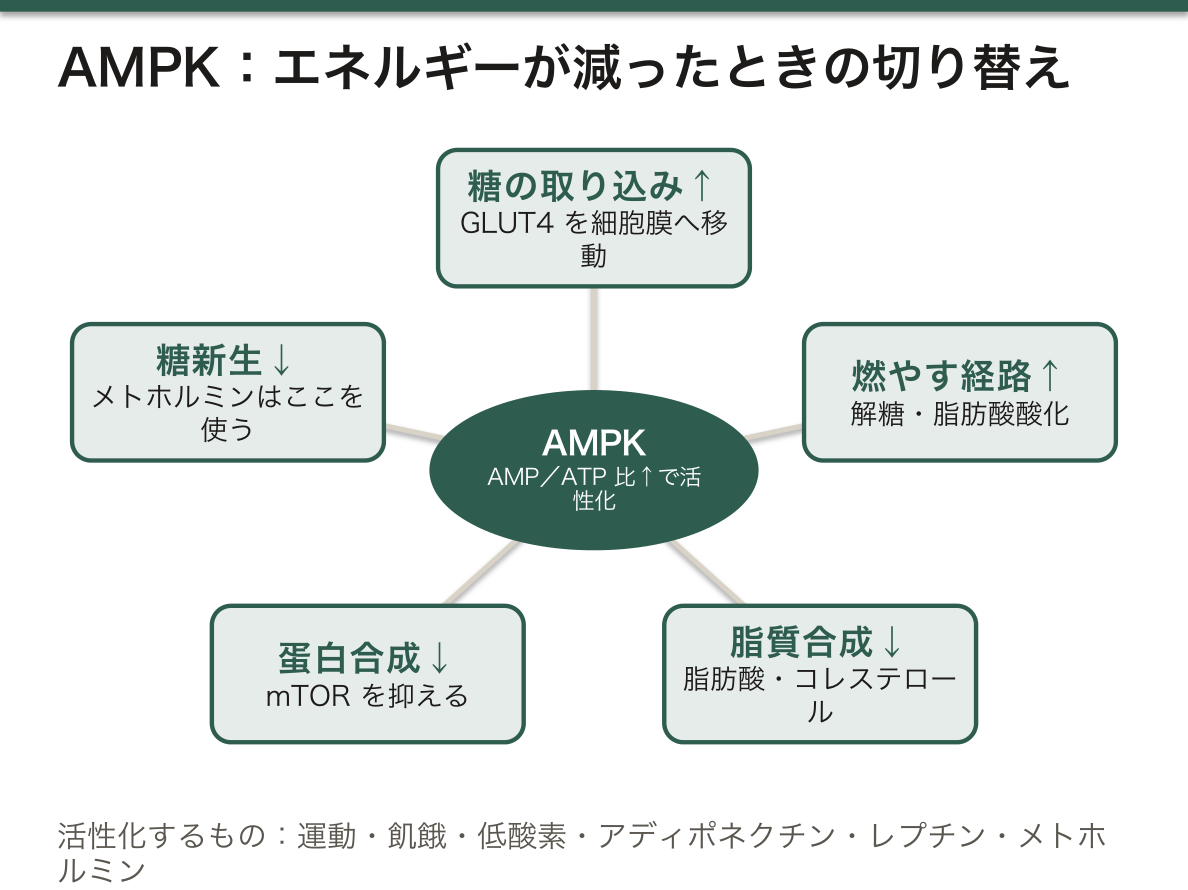
「残高が減ったら、支出を止めて収入を増やす」という単純な原則が、細胞の代謝の司令塔になっている。個々のホルモンより下流で、細胞が自分の状態を直接読んでいる(代謝の見取り図の章)——「外の指令と、中の実測の2系統がある」。
だから運動は、インスリンを介さずに糖を取り込ませる。筋収縮そのものが GLUT4 を細胞膜へ移動させる(インスリンシグナルの章)——「インスリン抵抗性があっても、運動で血糖が下がる理由になる」。
メトホルミンの作用も、ここに位置づけられる。ミトコンドリアの複合体I を弱く阻害して AMP/ATP 比を上げ、AMPK を介して肝の糖新生を抑える(糖尿病の各論の章)——「膵を働かせないので、単独では低血糖を起こしにくい」。
mTOR を止める薬は、免疫抑制薬であり抗腫瘍薬でもある(免疫抑制薬の章)——「増殖を止めるという1つの作用が、2つの用途になっている」。
カロリー制限と長寿の研究も、この2つの経路を軸にしている(老化の生化学の章)——「足りない状態が、修復と維持のほうへ資源を回させる」。
English version
Core
AMPK is activated when the AMP/ATP ratio rises (that is, when energy has fallen).
Activated, the policy switches uniformly.
- It turns on the pathways that make ATP — glucose uptake (translocation of GLUT4), glycolysis, fatty acid oxidation.
- It turns off the pathways that use ATP — fatty acid synthesis, cholesterol synthesis, protein synthesis (suppressing mTOR), gluconeogenesis.
Activators — exercise, starvation, hypoxia, adiponectin, leptin, metformin.
mTOR has the opposite role — with ample nutrients and amino acids it drives synthesis and proliferation.
Going further
- The simple principle "when the balance falls, stop spending and increase income" is the commander of cellular metabolism. Downstream of the individual hormones, the cell reads its own state directly (the chapter on the map of metabolism) — there are two systems, orders from outside and measurement within.
- Hence exercise brings glucose in without insulin. Muscle contraction itself moves GLUT4 to the membrane (the chapter on insulin signalling) — the reason blood glucose falls with exercise even with insulin resistance.
- The action of metformin is placed here too. Weakly inhibiting complex I of the mitochondrion, it raises the AMP/ATP ratio and suppresses hepatic gluconeogenesis through AMPK (the chapter on the particulars of diabetes) — it does not drive the pancreas, so alone it rarely causes hypoglycaemia.
- Drugs stopping mTOR are both immunosuppressants and antitumour drugs (the chapter on immunosuppressants) — one action, stopping proliferation, serving two uses.
- Research on calorie restriction and longevity turns on these same two pathways (the chapter on the biochemistry of ageing) — a state of insufficiency directing resources towards repair and maintenance.
低血糖に対する防御は、順番に立ち上がる
血糖が下がると、決まった順序で反応が起きる。閾値が違うので、段階として現れる。
| 約 80 mg/dL | インスリン分泌が止まる | 最初の防御。これだけで済むことが多い |
| 約 65〜70 | グルカゴンとアドレナリンが出る | グリコーゲン分解と糖新生を回す。グルカゴンが主役 |
| 約 55〜60 | 自律神経症状が出る | 動悸・発汗・振戦・空腹感。本人が気づける警告 |
| 約 50 以下 | 中枢神経症状が出る | 集中力低下・言動の異常・意識障害・痙攣 |
コルチゾールと成長ホルモンも動くが、効くまでに数時間かかるので急性期には間に合わない。長引く低血糖で効いてくる。
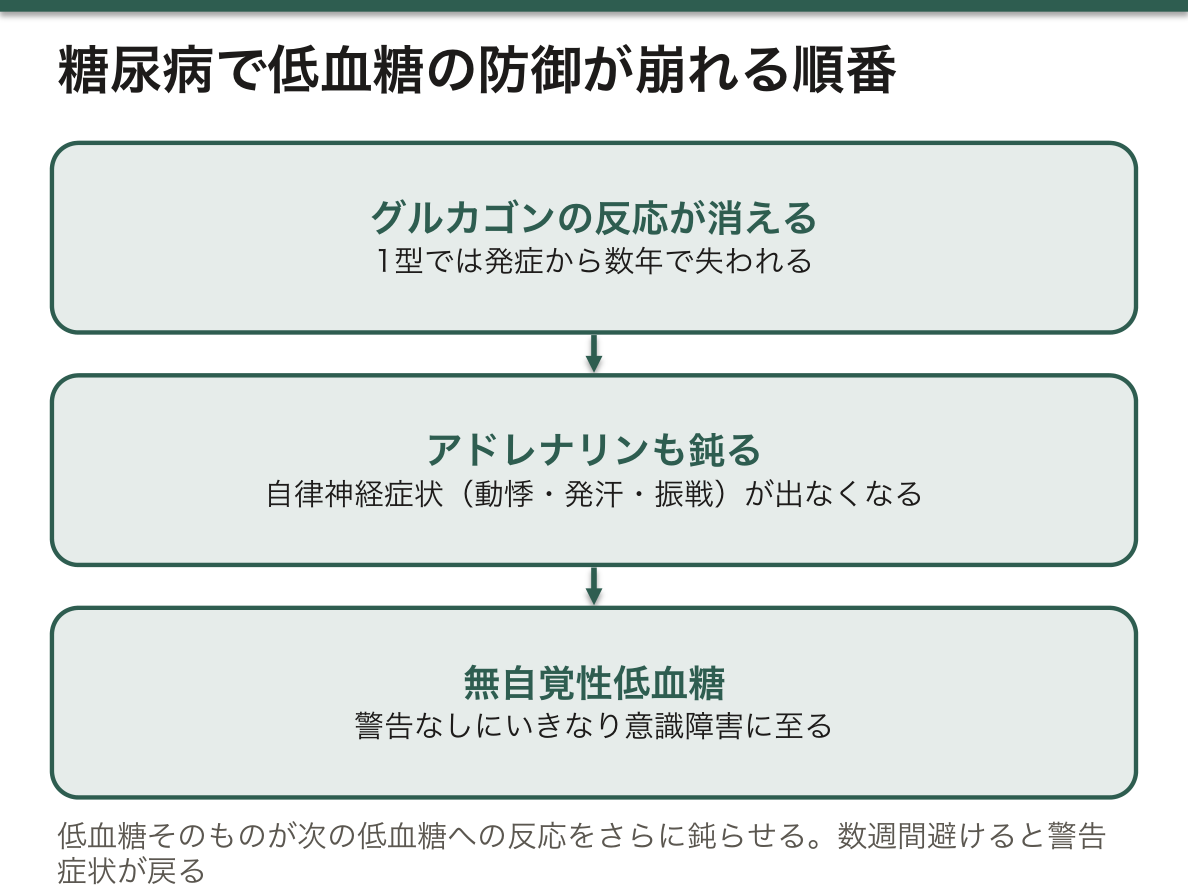
糖尿病が長くなると、この順序が上から順に壊れる。これが臨床上いちばん重要な点である。
- 1型糖尿病では、発症から数年でグルカゴンの反応が失われる(α細胞がβ細胞からの局所的な指令を受けられなくなるため)
- 次にアドレナリンの反応も鈍る。すると自律神経症状が出なくなり、警告なしにいきなり意識障害に至る(無自覚性低血糖)
- しかも低血糖そのものが、次の低血糖への反応をさらに鈍らせる——繰り返すほど閾値が下がっていく悪循環になる
だから治療は「厳格な血糖管理」一辺倒にはならない。無自覚性低血糖のある患者では目標値をあえて緩め、数週間低血糖を起こさせないことで、警告症状が戻ってくることが知られている。血糖を上げることが治療になるという逆転が起きる。
⚠️ β遮断薬は警告症状を隠す。動悸と振戦が出なくなるので、発汗だけが残る(発汗はコリン作動性なので遮断されない)。糖尿病患者でβ遮断薬を使うときに知っておく。
低血糖と言うには Whipple の三徴(症状がある・そのとき血糖が低い・糖で改善する)を揃える。症状だけ、あるいは数値だけでは診断にしない。
English version
Core
When the blood glucose falls, the responses occur in a fixed order. The thresholds differ, so they appear in stages.
| About 80 mg/dL | Insulin secretion stops | The first defence. Often this alone suffices |
| About 65–70 | Glucagon and adrenaline are released | They turn glycogenolysis and gluconeogenesis. Glucagon is the principal one |
| About 55–60 | Autonomic symptoms appear | Palpitation, sweating, tremor, hunger. A warning the person can notice |
| Below about 50 | Central nervous symptoms appear | Poor concentration, abnormal behaviour, impaired consciousness, seizures |
Cortisol and growth hormone also move, but they take hours to act and are not in time for the acute phase. They tell in a prolonged hypoglycaemia.
Going further
As diabetes goes on, this order breaks from the top down. This is the most important point clinically.
- In type 1 diabetes the glucagon response is lost within a few years of onset (the α cell no longer receives the local instruction from the β cell).
- Next the adrenaline response also dulls. The autonomic symptoms then cease and impaired consciousness arrives without warning (hypoglycaemia unawareness).
- And hypoglycaemia itself further dulls the response to the next one — a vicious circle in which the threshold falls the more it repeats.
So treatment is not single-mindedly "strict glycaemic control". In a patient with hypoglycaemia unawareness, deliberately relaxing the target and allowing no hypoglycaemia for some weeks is known to bring the warning symptoms back. An inversion occurs in which raising the blood glucose is the treatment.
⚠️ β-blockers hide the warning symptoms. Palpitation and tremor cease, so sweating alone remains (sweating is cholinergic and is not blocked). Know this when using a β-blocker in a diabetic patient.
In the clinic
To call it hypoglycaemia, assemble Whipple’s triad (symptoms are present, the blood glucose is low at that moment, sugar relieves it). Do not diagnose on symptoms alone or a number alone.
朝の高血糖 — 眠っているあいだにも、血糖を上げるホルモンは動いている
健常人でも明け方に血糖が上がる。夜間に成長ホルモンとコルチゾールが分泌され、起きて活動を始めるための燃料をあらかじめ用意しているからである。
糖尿病ではこの生理的な上昇を打ち消せず、朝の空腹時血糖だけが高いという形で現れる(暁現象)。
朝の高血糖には、まったく逆の原因もありうる。
| 暁現象 | 明け方のホルモンによる上昇 | 夜間の血糖は下がらない。持効型インスリンを増やすのが正しい |
| Somogyi 現象 | 夜間の低血糖に対する反跳性の上昇 | 深夜に低血糖がある。インスリンを減らすのが正しい |
| 単にインスリンが切れている | 持効型の作用時間が足りない | 打つ時刻か製剤を変える |
朝の値だけを見て増減を決めてはいけない。深夜 3 時の血糖を見て初めて方向が決まる。
平均だけを見ていると、危ない患者を見逃す。HbA1c は平均の指標なので、低血糖と高血糖を往復している人と、安定して少し高い人が同じ値になる。しかも前者のほうが予後は悪い。
そこで持続血糖測定(CGM)が普及し、平均以外の指標が使われるようになった。
- 目標範囲内時間(TIR)——70〜180 mg/dL に居た時間の割合。多くの成人で 70% 以上を目標にする
- 低血糖の時間(TBR)——70 未満が 4% 未満、54 未満が 1% 未満。TIR を上げることより、まずこちらを守る
- 変動係数(CV)——36% 未満なら安定していると見なす
目安として、TIR が 10% 増えると HbA1c が約 0.5% 下がる関係が知られている。
血糖変動そのものが害になるという考え方も根拠を得つつある。急激な上下は、安定した高血糖より強く酸化ストレスと内皮障害を起こすと報告されている。食後高血糖を抑える薬(α-グルコシダーゼ阻害薬・グリニド薬・速効型インスリン)が平均値をあまり下げなくても意味を持ちうるのは、この理屈による。
⚠️ HbA1c が当てにならない状況を先に確認する。貧血・溶血・輸血・妊娠・腎不全・肝硬変では赤血球の寿命が変わるため、グリコアルブミンや CGM の指標で補う。
朝だけ高い患者に、反射的に眠前インスリンを増やさない。夜間の低血糖を1回でも確認してから方向を決める。
English version
Core
Even in a healthy person the blood glucose rises towards dawn. Growth hormone and cortisol are secreted overnight, preparing the fuel for waking and beginning activity.
In diabetes this physiological rise cannot be cancelled, and it appears as the fasting morning glucose alone being high (the dawn phenomenon).
Morning hyperglycaemia can also have exactly the opposite cause.
| Dawn phenomenon | A rise from the hormones of dawn | The overnight glucose does not fall. Increasing the long-acting insulin is correct |
| Somogyi phenomenon | A rebound rise after overnight hypoglycaemia | There is hypoglycaemia in the small hours. Reducing the insulin is correct |
| The insulin has simply run out | The duration of the long-acting preparation is insufficient | Change the hour of injection or the preparation |
Do not decide to increase or reduce on the morning value alone. Only on seeing the blood glucose at 3 a.m. is the direction settled.
Going further
Watching the average alone misses the patient at risk. HbA1c is an index of the mean, so someone swinging between hypoglycaemia and hyperglycaemia and someone steadily a little high give the same value. And the former has the worse outcome.
Hence continuous glucose monitoring (CGM) has spread and indices other than the mean have come into use.
- Time in range (TIR) — the proportion of time between 70 and 180 mg/dL. For most adults the target is 70 per cent or more.
- Time below range (TBR) — below 70 under 4 per cent, below 54 under 1 per cent. Protect this before raising the TIR.
- Coefficient of variation (CV) — under 36 per cent counts as stable.
As a rule of thumb, a 10 per cent gain in TIR corresponds to about a 0.5 per cent fall in HbA1c.
The idea that glycaemic variability is itself harmful is gaining ground. Sharp swings are reported to cause oxidative stress and endothelial injury more strongly than a steady hyperglycaemia. It is by this reasoning that drugs suppressing postprandial hyperglycaemia (α-glucosidase inhibitors, glinides, rapid-acting insulin) can matter even without lowering the mean much.
⚠️ Check first for the situations in which HbA1c is not reliable. In anaemia, haemolysis, transfusion, pregnancy, renal failure and cirrhosis the red cell lifespan changes, so supplement with glycated albumin or the CGM indices.
In the clinic
Do not reflexively increase the bedtime insulin in a patient who is high only in the morning. Confirm overnight hypoglycaemia even once before deciding the direction.
まとめ
| 律速の3か所 — ここだけ酵素が別になっている | 解糖と糖新生で酵素が別になっている3か所。 |
|---|---|
| フルクトース2,6ビスリン酸 — 1つの物質が両方を逆向きに動かす | フルクトース2,6ビスリン酸は解糖の中間体ではなく、調節だけのために作られる分子である。 |
| インスリンとグルカゴンの比 — 同じ酵素が、逆向きに動く | 血糖の調節は「どちらのホルモンが多いか」という比で決まる。 |
| AMPK — 細胞が、エネルギーの残高を読んでいる仕組み | AMPK は、AMP/ATP の比が上がったとき(=エネルギーが減ったとき)に活性化する。 |
| 低血糖に対する防御は、順番に立ち上がる | 血糖が下がると、決まった順序で反応が起きる。 |
| 朝の高血糖 — 眠っているあいだにも、血糖を上げるホルモンは動いている | 健常人でも明け方に血糖が上がる。夜間に成長ホルモンとコルチゾールが分泌され、起きて活動を始めるための燃料をあらかじめ用意しているからである。 |
このノートは医学生が授業の内容を自分の言葉でまとめたもので、診療の判断に使うものではありません。誤りに気づいたらお知らせください。