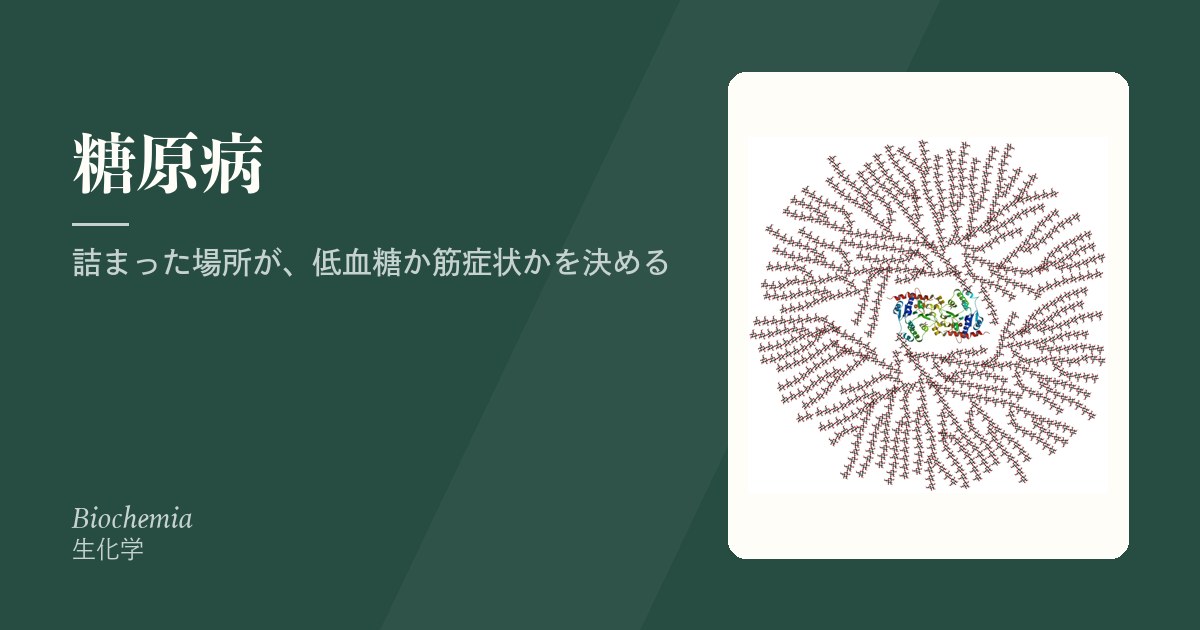
グリコーゲンは肝と筋に蓄えられるが、役割が違う。肝のグリコーゲンは血糖を守るため、筋のグリコーゲンは自分が動くためである。
だから糖原病はどちらの臓器の、どの段階が詰まったかで症状が決まる。肝型なら低血糖と肝腫大、筋型なら運動時の筋症状——この2本立てで整理すれば、型番号を丸暗記しなくてよい。
- 肝型 — 血糖を出せない
- 筋型 — 動かすと痛む、そして二段息継ぎ
- Pompe 病 — 唯一のリソソーム型で、酵素補充が効く
- 糖原病をどう見つけるか — 空腹の時間と、測る項目
- 糖原病は治療で寿命が延びた — その先に出てくる合併症
- グリコーゲンは、なぜ枝分かれしているのか
肝型 — 血糖を出せない
| 型 | 名前 | 欠損酵素 | 特徴 |
|---|---|---|---|
| I | von Gierke病 | グルコース6ホスファターゼ | 重い低血糖・肝腫大・高乳酸血症・高尿酸血症・高中性脂肪血症・人形様顔貌 |
| III | Cori病 | 脱分枝酵素 | 低血糖はI型より軽い・筋症状も出る・限界デキストリンが溜まる |
| IV | Andersen病 | 分枝酵素 | 肝硬変で早期に死亡。溜まるのは枝の少ない異常グリコーゲン |
| VI | Hers病 | 肝ホスホリラーゼ | 軽症。低血糖と肝腫大のみ |
- I型で乳酸が上がるのは、グルコース6リン酸が出口を失って解糖へ流れるから
- 尿酸が上がるのは、グルコース6リン酸がペントースリン酸経路へ回ってリボースが増え、プリン合成が亢進するため。乳酸が尿酸の腎排泄を妨げることも重なる
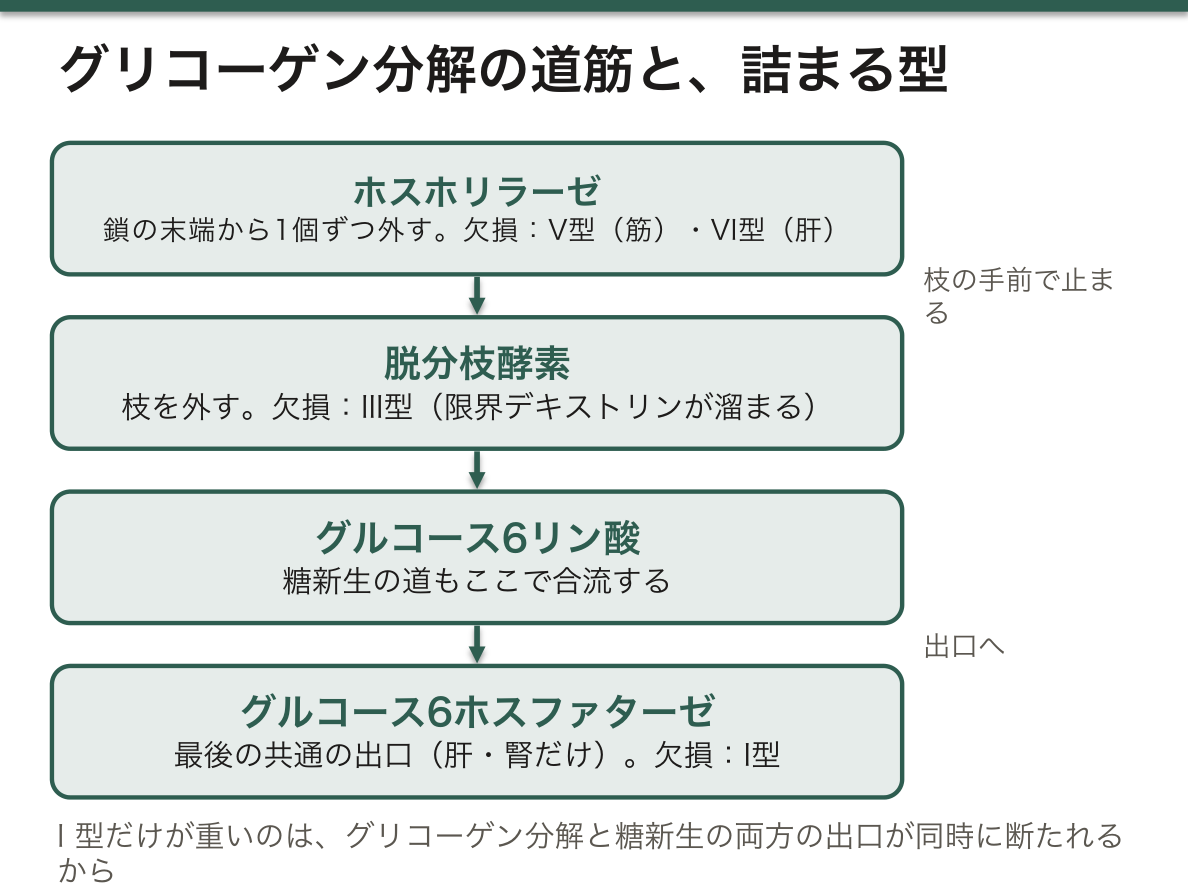
I型だけが際立って重いのはなぜか。グルコース6ホスファターゼはグリコーゲン分解と糖新生の共通の出口だからである。ここが詰まると2つの血糖供給路が同時に断たれる。他の型は片方しか止まらない。
治療は生化学から直接に導ける。出口が無い以上、外から絶やさず入れるしかない。
- 頻回の経口摂取と、夜間の経管栄養
- 生のコーンスターチ——ゆっくり消化されて数時間にわたりグルコースを供給する
- 果糖・ガラクトースを制限——どちらもグルコース6リン酸より上流で合流するので、入れても血糖にならず乳酸を増やすだけ
Ia型とIb型の違いも押さえておく。Ia型は酵素そのものの欠損、Ib型はグルコース6リン酸を小胞体へ運ぶ輸送体の欠損で、好中球減少と炎症性腸疾患様の腸炎を伴う。同じ低血糖でも易感染性が加わるので、発熱の扱いが変わる。
III型で限界デキストリンが溜まるのは、ホスホリラーゼが枝分かれの手前4残基までしか削れないためである。枝を外す酵素が無いと、そこで分解が止まる。III型に筋症状が出るのは、脱分枝酵素が肝にも筋にもあるからである。
English version
Core
| Type | Name | Enzyme | Features |
|---|---|---|---|
| I | von Gierke | Glucose 6-phosphatase | Severe hypoglycaemia, hepatomegaly, lactic acidosis, hyperuricaemia, hypertriglyceridaemia, doll-like face |
| III | Cori | Debranching enzyme | Hypoglycaemia milder than type I; muscle symptoms too; limit dextrin accumulates |
| IV | Andersen | Branching enzyme | Death from cirrhosis early. What accumulates is abnormal glycogen with few branches |
| VI | Hers | Hepatic phosphorylase | Mild. Hypoglycaemia and hepatomegaly only |
- Lactate rises in type I because glucose 6-phosphate has lost its exit and flows into glycolysis.
- Urate rises because glucose 6-phosphate is diverted into the pentose phosphate pathway, ribose increases and purine synthesis is driven; and lactate also impedes the renal excretion of urate.
Going further
Why type I alone is so much the most severe: glucose 6-phosphatase is the shared exit of both glycogenolysis and gluconeogenesis. Block it and both routes of glucose supply are cut at once. The other types block only one.
The treatment derives directly from the biochemistry. With no exit, it must be supplied continuously from outside.
- Frequent oral feeds, with nasogastric feeding overnight.
- Uncooked cornstarch — digested slowly and supplying glucose over several hours.
- Restrict fructose and galactose — both join above glucose 6-phosphate, so giving them does not raise the blood glucose and only increases the lactate.
Note the difference between types Ia and Ib. Ia is a deficiency of the enzyme itself; Ib is a deficiency of the transporter carrying glucose 6-phosphate into the endoplasmic reticulum, and is accompanied by neutropenia and an inflammatory bowel disease-like enteritis. The same hypoglycaemia with added susceptibility to infection — so a fever is handled differently.
Limit dextrin accumulates in type III because phosphorylase can only trim to within four residues of a branch point. Without the debranching enzyme, breakdown stops there. Type III has muscle symptoms because the debranching enzyme is in muscle as well as liver.
筋型 — 動かすと痛む、そして二段息継ぎ
| 型 | 名前 | 欠損酵素 | 特徴 |
|---|---|---|---|
| V | McArdle病 | 筋ホスホリラーゼ | 運動時の筋痛・こむら返り・ミオグロビン尿・二段息継ぎ現象・血中乳酸が運動で上がらない |
| II | Pompe病 | 酸性αグルコシダーゼ(リソソーム) | 心肥大と筋力低下。乳児型は1年以内に心不全。血糖は正常 |
| VII | 垂井病 | 筋ホスホフルクトキナーゼ | McArdle病に似るが溶血を伴う |
- 筋型では低血糖にならない——筋にグルコース6ホスファターゼが無く、もともと血糖に貢献していないため
- Pompe病だけは細胞質ではなくリソソームの病気で、糖原病であると同時にリソソーム蓄積症でもある
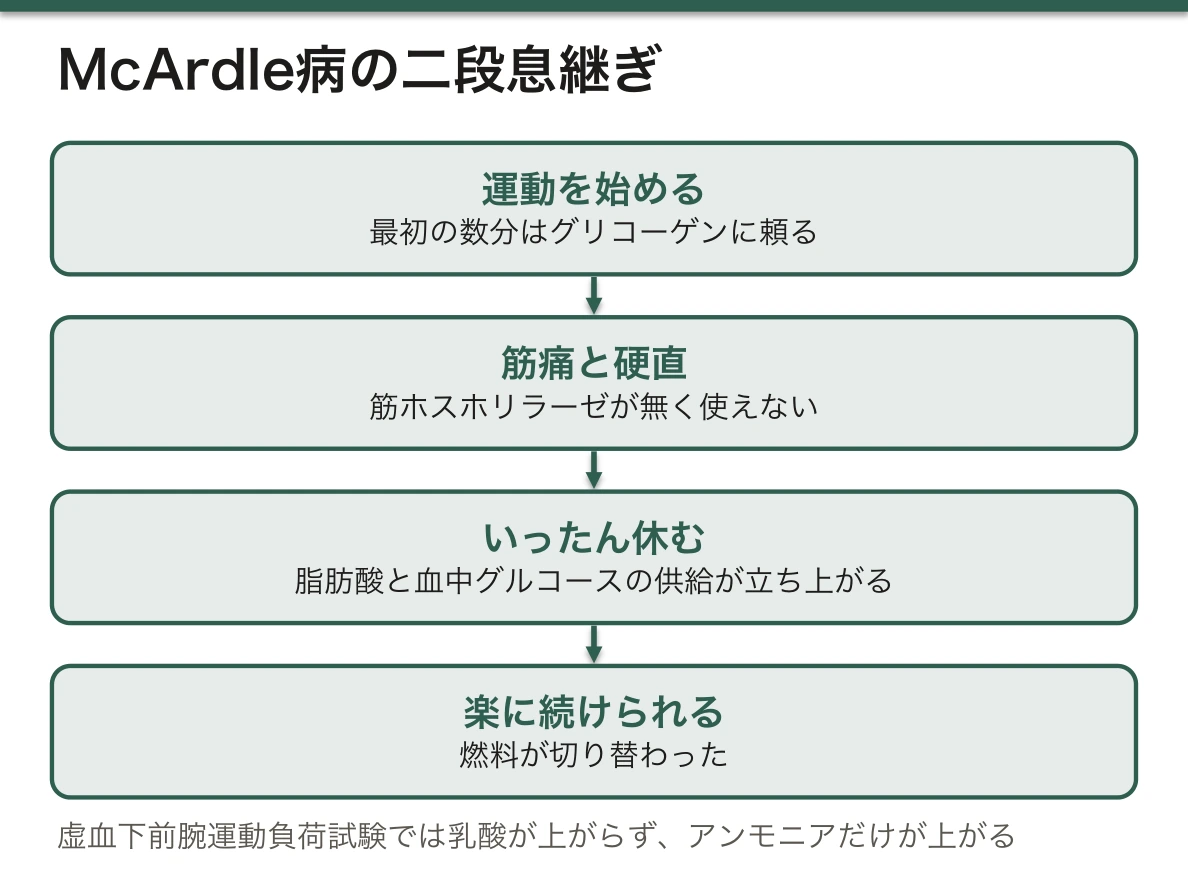
二段息継ぎ現象が McArdle病の決め手になる。運動を始めると数分で筋痛と硬直が起きるが、いったん休んで再開すると楽に続けられる。理由は燃料の切り替えにある。最初の数分はグリコーゲンに頼るので詰まって苦しいが、その間に脂肪酸と血中グルコースの供給が立ち上がると、それで走れるようになる。
虚血下前腕運動負荷試験では、健常なら乳酸が上がりアンモニアも上がる。McArdle病では乳酸が上がらず、アンモニアだけが上がる(筋は働いているのに解糖が使えていない証拠)。どちらも上がらなければ、そもそも運動が足りていない——検査の妥当性の判定にアンモニアを使う。
Pompe病は治療のある糖原病である。酵素補充療法が確立しており、乳児型では診断の遅れがそのまま予後を決める。日本では新生児マススクリーニングの一部の自治体で対象になっている。心電図で短いPR間隔と高電位を見たら想起する。
横紋筋融解症としての側面も重要である。McArdle病・垂井病では激しい運動でミオグロビン尿が出て、急性腎障害に至りうる。運動時の筋痛を「よくあること」で片付けないための知識である(運動の生化学の章)。
English version
Core
| Type | Name | Enzyme | Features |
|---|---|---|---|
| V | McArdle | Muscle phosphorylase | Muscle pain and cramp on exercise, myoglobinuria, the second wind phenomenon, the blood lactate does not rise with exercise |
| II | Pompe | Acid α-glucosidase (lysosomal) | Cardiomegaly and weakness. The infantile form dies of heart failure within a year. The blood glucose is normal |
| VII | Tarui | Muscle phosphofructokinase | Resembles McArdle but with haemolysis |
- The muscle types do not cause hypoglycaemia — muscle has no glucose 6-phosphatase and never contributed to the blood glucose.
- Pompe alone is a disease of the lysosome rather than the cytosol — a glycogen storage disease and a lysosomal storage disease at once.
Going further
The second wind phenomenon is decisive for McArdle disease. Muscle pain and stiffness come within minutes of beginning exercise, but after a rest it can be resumed comfortably. The reason is a change of fuel: the first minutes depend on glycogen and are blocked and painful, but in that time the supply of fatty acids and blood glucose comes up and running becomes possible on those.
On the ischaemic forearm exercise test, in health both lactate and ammonia rise. In McArdle disease the lactate does not rise and only the ammonia does (evidence that the muscle is working but cannot use glycolysis). If neither rises, the exercise was inadequate — the ammonia is used to judge the validity of the test.
Pompe disease is the glycogen storage disease with a treatment. Enzyme replacement is established, and in the infantile form a delay in diagnosis decides the outcome. It is included in newborn screening in some Japanese local authorities. Think of it on seeing a short PR interval with high voltage on the ECG.
The aspect of rhabdomyolysis matters too. In McArdle and Tarui disease, vigorous exercise gives myoglobinuria and can lead to acute kidney injury. Knowledge that prevents muscle pain on exercise being dismissed as "something that happens".
Pompe 病 — 唯一のリソソーム型で、酵素補充が効く
糖原病II型。欠損酵素は酸性α-グルコシダーゼ(GAA、リソソーム内)。
他の糖原病と決定的に違う点——細胞質の糖代謝ではなく、リソソームでの分解が止まる。だから低血糖にならない。
| 型 | 発症 | 特徴 |
|---|---|---|
| 乳児型 | 生後数か月 | 著明な心肥大・筋緊張低下(floppy infant)・巨舌・肝腫大。無治療では1年以内に死亡 |
| 遅発型 | 小児期〜成人 | 体幹と近位筋の筋力低下・呼吸筋障害(睡眠時の低換気から気づかれる)。心肥大は乏しい |
検査——CK 高値・乾燥濾紙血での GAA 活性測定・遺伝子検査。
酵素補充療法(アルグルコシダーゼα)がある。
「どこに溜まるか」で、糖原病の中でこれだけが別の顔になる。血糖を出せないのではなく、細胞の中にゴミが溜まる病気になる(リソソーム病の総論の章)——「糖原病でありながら、性質はリソソーム病になる」。
だから治療の型も、リソソーム病と同じになる(治療できる先天代謝異常の項)——「食事療法ではなく、酵素を入れるという発想」。
酵素補充が効くのは、リソソームへの取り込み経路があるからになる。マンノース6-リン酸が付いた酵素を、細胞表面の受容体が取り込む(リソソームの章)——「細胞が持っている郵便の仕組みを、薬が借りている」。
遅発型は、原因不明の近位筋力低下として神経内科を受診する(筋疾患の章)——「多発筋炎や肢帯型筋ジストロフィーとの鑑別に入る。治せる筋疾患なので、外せない」。
呼吸筋が早くから侵されることが、予後を決めている(呼吸を動かす筋の章)——「臥位での呼吸困難と、日中の眠気を聞く」。
English version
Core
Glycogen storage disease type II. The enzyme is acid α-glucosidase (GAA), within the lysosome. The decisive difference from the other glycogenoses is that what stops is degradation in the lysosome, not cytosolic carbohydrate metabolism. Hence there is no hypoglycaemia.
| Form | Onset | Features |
|---|---|---|
| Infantile | A few months | Marked cardiomegaly, hypotonia (a floppy infant), macroglossia, hepatomegaly. Death within a year untreated |
| Late-onset | Childhood to adult | Weakness of the trunk and proximal muscles, respiratory muscle involvement (noticed as nocturnal hypoventilation). Little cardiomegaly |
Tests — a high CK, GAA activity on a dried blood spot, genetic testing. Enzyme replacement (alglucosidase alfa) exists.
Going further
Where it accumulates is what gives this one a different face among the glycogenoses. It is not that glucose cannot be released but that rubbish accumulates within the cell — a glycogen storage disease whose nature is lysosomal.
So the form of the treatment is that of a lysosomal disease — the idea of putting in the enzyme, not of a diet.
Enzyme replacement works because there is a route into the lysosome: an enzyme carrying mannose 6-phosphate is taken up by a receptor on the cell surface — a drug borrowing the postal system the cell already has.
The late-onset form presents to neurology as an unexplained proximal weakness — it enters the differential of polymyositis and limb-girdle muscular dystrophy. Being a treatable muscle disease, it cannot be left out.
That the respiratory muscles are affected early decides the prognosis — ask about breathlessness lying flat and daytime sleepiness.
糖原病をどう見つけるか — 空腹の時間と、測る項目
肝型か筋型かは、「いつ症状が出るか」で分かれる。
| 肝型 | 筋型 | |
|---|---|---|
| 症状が出るとき | 空腹時 | 運動時 |
| 主な所見 | 低血糖・肝腫大・低身長・人形様顔貌 | 筋痛・こむら返り・ミオグロビン尿 |
| 代表 | I型(von Gierke)・III型・VI型・IX型 | V型(McArdle)・VII型 |
I型で揃う所見——低血糖・乳酸アシドーシス・高尿酸血症・高中性脂肪血症。
V型の特徴——二段息継ぎ(second wind)・運動時に血中乳酸が上がらない。
診断は遺伝子検査が中心になり、虚血下前腕運動負荷試験は横紋筋融解の危険から慎重に扱う。
I型の4つの所見が、1つの酵素欠損から全部出てくる。グルコース6-ホスファターゼが無いので、グルコース6-リン酸が行き場を失って別の経路へ流れる
| 流れ先 | 結果 |
|---|---|
| 解糖 → ピルビン酸 → 乳酸 | 乳酸アシドーシス |
| 乳酸が尿酸の排泄と競合 | 高尿酸血症 |
| ペントースリン酸経路 → NADPH | 脂肪酸合成 → 高中性脂肪血症 |
(解糖と糖新生の章)——「詰まった手前に溜まったものが、どこへ流れるかを追う」。
治療は「切らさない」ことになる(飢餓の章)——「頻回の食事と、夜間の非加熱コーンスターチで、ゆっくり糖を供給し続ける」。
McArdle 病の二段息継ぎは、燃料の切り替えとして説明できる(運動の生化学の章)——「最初はグリコーゲンが使えず苦しいが、脂肪酸と血中グルコースが動員されると楽になる」。
横紋筋融解症を繰り返す若年者では、代謝性ミオパチーを考える(横紋筋融解症の項)——「脂肪酸酸化異常症は長時間の運動で、糖原病は短時間の強い運動で出る」。
English version
Core
Hepatic and muscle types are divided by when the symptoms appear.
| Hepatic | Muscle | |
|---|---|---|
| When | Fasting | On exercise |
| Main findings | Hypoglycaemia, hepatomegaly, short stature, doll-like face | Muscle pain, cramps, myoglobinuria |
| Representative | Type I (von Gierke), III, VI, IX | Type V (McArdle), VII |
The findings that go together in type I — hypoglycaemia, lactic acidosis, hyperuricaemia, hypertriglyceridaemia.
The features of type V — the second wind; the blood lactate does not rise on exercise.
Diagnosis now rests chiefly on genetic testing, and the ischaemic forearm exercise test is used cautiously because of the risk of rhabdomyolysis.
Going further
The four findings of type I all come out of one enzyme deficiency. Without glucose 6-phosphatase, glucose 6-phosphate has nowhere to go and flows down other routes.
| Where it flows | Result |
|---|---|
| Glycolysis → pyruvate → lactate | Lactic acidosis |
| Lactate competing for urate excretion | Hyperuricaemia |
| Pentose phosphate pathway → NADPH | Lipogenesis → hypertriglyceridaemia |
Follow where what has accumulated behind the block flows.
The treatment is not to let it run out — frequent meals and uncooked cornstarch overnight, supplying sugar slowly and continuously.
The second wind of McArdle disease is explained as a change of fuel — hard at first because glycogen cannot be used, easier once fatty acids and blood glucose are mobilised.
In a young person with recurrent rhabdomyolysis, think of a metabolic myopathy — fatty acid oxidation disorders appear with prolonged exercise and glycogen storage diseases with short, intense exercise.
糖原病は治療で寿命が延びた — その先に出てくる合併症
肝型糖原病(特に I 型)は、頻回の栄養とコーンスターチで低血糖を防げるようになり、成人まで生きられる病気になった。すると、以前は見られなかった長期の問題が現れてきた。
| 肝腺腫 | 思春期以降に多発する | 肝細胞癌へ移行しうる。定期的な画像検査が要る |
| 腎障害 | 糸球体過剰濾過 → 蛋白尿 → 腎不全 | 糖尿病性腎症に似た経過をたどる |
| 痛風・尿路結石 | 高尿酸血症が続く | 乳酸が尿酸の排泄を妨げる |
| 骨粗鬆症・低身長 | 慢性の代謝性アシドーシスと栄養の偏り | |
| 出血傾向 | 血小板の機能異常 | 数は正常なのに出血する。手術前に確認が要る |
血糖の管理が、そのまま合併症の予防になっているという点が重要である。
I 型でグルコース 6-ホスファターゼが働かないと、行き場を失ったグルコース 6-リン酸が解糖へ流れて乳酸になり、ペントースリン酸経路へ流れて尿酸の材料になり、脂質合成へ流れて高中性脂肪血症と脂肪肝になる。1 か所の閉塞が、下流の 3 本の道すべてを溢れさせている。
だから血糖を切らさないこと(=上流の圧を下げること)が、乳酸も尿酸も中性脂肪も同時に下げる。尿酸を下げる薬や脂質の薬を足す前に、まず夜間の低血糖が起きていないかを確認する。
治療の実際は「時間との勝負」である。
- 乳児——2〜3 時間ごとの授乳、夜間は経管栄養で持続的に糖を入れる
- 幼児以降——生のコーンスターチを用いる。ゆっくり消化されるので4〜6 時間血糖を支えられる。加熱すると速く分解されて効果が短くなる
- 果糖とガラクトースは制限する——I 型では乳酸に変わってしまうため
⚠️ 感染・嘔吐で食べられないときが最も危険である。低血糖と乳酸アシドーシスが同時に来るので、早めにブドウ糖の点滴を始める。家族に受診の目安を書いた指示書を持たせておく。
成人まで生きる先天代謝異常が増えている。小児科から成人科へ引き継ぐとき、何を定期的に見るかを申し送ることが実務上の課題になる。
English version
Core
The hepatic glycogenoses (type I especially) have become diseases in which hypoglycaemia can be prevented with frequent feeding and cornstarch, and patients live into adult life. Long-term problems not seen before have then appeared.
| Complication | Course | Note |
|---|---|---|
| Hepatic adenoma | Multiple, from adolescence | May transform to hepatocellular carcinoma. Regular imaging is required |
| Renal disease | Glomerular hyperfiltration → proteinuria → renal failure | A course resembling diabetic nephropathy |
| Gout, urinary stones | Continuing hyperuricaemia | Lactate impedes the excretion of urate |
| Osteoporosis, short stature | Chronic metabolic acidosis and an unbalanced diet | — |
| Bleeding tendency | Platelet dysfunction | The count is normal yet the patient bleeds. Check before surgery |
Going further
The important point is that control of the blood glucose is itself the prevention of the complications. In type I, with glucose 6-phosphatase not working, glucose 6-phosphate with nowhere to go flows into glycolysis to lactate, into the pentose phosphate pathway as substrate for urate, and into lipogenesis giving hypertriglyceridaemia and fatty liver. One blockage overflowing all three roads downstream.
So not letting the blood glucose fall — lowering the pressure upstream — lowers the lactate, the urate and the triglyceride at once. Before adding a urate-lowering or a lipid drug, check first whether nocturnal hypoglycaemia is occurring.
In practice the treatment is a contest against time.
- Infants — feeds every 2–3 hours, with continuous nasogastric glucose overnight.
- From toddlerhood — uncooked cornstarch. Digested slowly, it supports the blood glucose for 4–6 hours. Heated, it is broken down quickly and the effect is short.
- Fructose and galactose are restricted — in type I they are converted to lactate.
⚠️ The most dangerous time is when infection or vomiting prevents eating. Hypoglycaemia and lactic acidosis arrive together, so start intravenous glucose early. Give the family a written instruction stating when to attend.
In the clinic
More inborn errors are surviving into adult life. Handing over from paediatrics to adult services, what must be monitored regularly is the practical problem.
グリコーゲンは、なぜ枝分かれしているのか
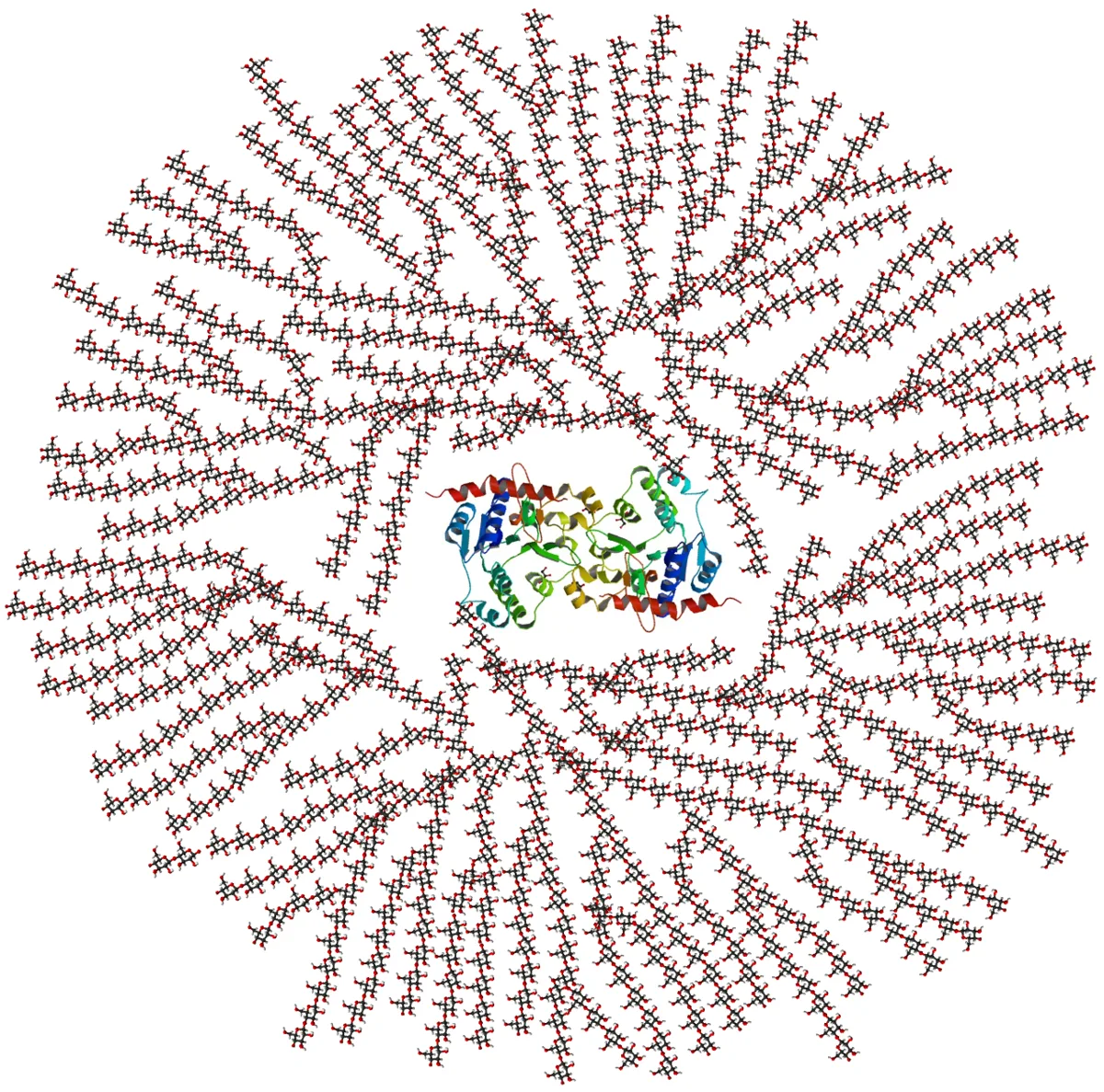
グリコーゲンはブドウ糖が繋がった巨大分子だが、直鎖ではなく、激しく枝分かれしている。この形には理由がある。
- 結合が2種類ある——鎖を伸ばすのが α1,4 結合、枝を作るのが α1,6 結合(8〜12 残基ごとに1つ)
- 分解は末端からしかできない——ホスホリラーゼは鎖の非還元末端から1個ずつ外す
- 枝が多いほど末端が増える——同時に何か所からも切り出せるので、必要なときに一気にブドウ糖を出せる
- 球状にまとまるので場所を取らない——溶けたブドウ糖として置けば浸透圧で細胞が壊れる
つまり枝分かれは「速く出せること」と「浸透圧を上げないこと」を同時に満たす設計である。
作り始めるにも足場が要る。ホスホリラーゼが末端から切るのと同じで、合成酵素も既にある鎖の先にしか繋げない。そこでグリコーゲニンという蛋白が自分自身に糖を付けて核を作り、その上にグリコーゲンが伸びる。グリコーゲンの粒は、中心に蛋白を1個抱えている。
この構造を扱う酵素が、それぞれ別の糖原病に対応している。
| 枝を作る酵素の欠損 | IV 型(Andersen 病) | 枝の少ない溶けにくい異常グリコーゲンが溜まる。肝硬変になる |
| 枝を外す酵素の欠損 | III 型(Cori 病) | 枝の手前で分解が止まる(限界デキストリン)。肝腫大と筋症状 |
| 合成酵素の欠損 | 0 型 | 溜まらない糖原病。空腹時はケトーシス性低血糖、食後は高血糖と高乳酸 |
0 型が面白いのは、「糖原病=溜まる病気」という思い込みを崩すからである。蓄えられないので肝腫大が無い。食後に余った糖の行き場が無くて高血糖になり、空腹では出す蓄えが無くて低血糖になる——両方向に振れる。
デンプンとの違いも押さえておく。植物のアミロペクチンは同じα1,4/α1,6 でできているが、枝分かれがずっと少ない。動物のほうが速い動員を必要としたということである。
肝腫大の無い低血糖でも糖原病はありうる。「肝が腫れていないから違う」と切らない。
English version
Core
Glycogen is a huge molecule of linked glucose, but branched rather than straight. There is a reason for the shape.
- Two kinds of bond — α1,4 extends the chain, α1,6 makes a branch (one every 8–12 residues).
- Breakdown occurs only from an end — phosphorylase removes one residue at a time from a non-reducing end.
- The more branches, the more ends — it can be cut from many places at once and released quickly when needed.
- It packs into a sphere and takes little room — stored as free glucose the osmotic pressure would destroy the cell.
That is, branching satisfies at once being able to release quickly and not raising the osmotic pressure.
Going further
Beginning also requires a foundation. Just as phosphorylase cuts from an end, the synthase can only add to the end of an existing chain. So the protein glycogenin attaches sugar to itself to make a nucleus and the glycogen grows on it — a granule of glycogen holds one protein at its centre.
The enzymes handling this structure each correspond to a glycogenosis.
| Enzyme lacking | Type | Consequence |
|---|---|---|
| Branching enzyme | IV (Andersen) | An abnormal, poorly soluble glycogen with few branches accumulates. Cirrhosis |
| Debranching enzyme | III (Cori) | Breakdown stops short of the branch (limit dextrin). Hepatomegaly and muscle symptoms |
| Synthase | 0 | A glycogenosis in which nothing accumulates. Ketotic hypoglycaemia when fasting, hyperglycaemia and high lactate after a meal |
Type 0 is interesting because it breaks the assumption that a glycogenosis is a disease of accumulation. Nothing can be stored, so there is no hepatomegaly. After a meal the surplus sugar has nowhere to go and the blood glucose rises; fasting, there is no store to release and it falls — it swings both ways.
Fix the difference from starch too. Plant amylopectin is made of the same α1,4 and α1,6 bonds but is far less branched. The animal needed the faster mobilisation.
In the clinic
A glycogenosis is possible even with hypoglycaemia and no hepatomegaly. Do not exclude it on the grounds that the liver is not enlarged.
まとめ
| 肝型 — 血糖を出せない | 型名前欠損酵素特徴Ivon Gierke病グルコース6ホスファターゼ重い低血糖・肝腫大・高乳酸血症・高尿酸血症・高中性脂肪血症・人形様顔貌IIICori病脱分枝酵素低血糖はI型より… |
|---|---|
| 筋型 — 動かすと痛む、そして二段息継ぎ | 型名前欠損酵素特徴VMcArdle病筋ホスホリラーゼ運動時の筋痛・こむら返り・ミオグロビン尿・二段息継ぎ現象・血中乳酸が運動で上がらないIIPompe病酸性αグルコシダーゼ(リソソ… |
| Pompe 病 — 唯一のリソソーム型で、酵素補充が効く | 糖原病II型。欠損酵素は酸性α-グルコシダーゼ(GAA、リソソーム内)。 |
| 糖原病をどう見つけるか — 空腹の時間と、測る項目 | 肝型か筋型かは、「いつ症状が出るか」で分かれる。 |
| 糖原病は治療で寿命が延びた — その先に出てくる合併症 | 肝型糖原病(特に I 型)は、頻回の栄養とコーンスターチで低血糖を防げるようになり、成人まで生きられる病気になった。 |
| グリコーゲンは、なぜ枝分かれしているのか | グリコーゲンはブドウ糖が繋がった巨大分子だが、直鎖ではなく、激しく枝分かれしている。 |
このノートは医学生が授業の内容を自分の言葉でまとめたもので、診療の判断に使うものではありません。誤りに気づいたらお知らせください。