エタノールは2段階で酢酸まで酸化される。この2つの酵素にヒト集団で明確な多型があり、東アジアでは特徴的な分布を示す。顔が赤くなるかどうかという日常の現象が、遺伝子多型と発癌リスクに直結している。
加えて、アルコールの代謝はNADHを大量に作る。この一点から、低血糖・高乳酸・脂肪肝・高尿酸血症がまとめて説明できる。
- 2つの酵素と、赤くなる体質
- 慢性のアルコール摂取が、体に何をしているか
- アルコールが代謝を歪める — NADH が余るということ
- ビタミンB1と離脱 — 順番を間違えると、脳が壊れる
- 飲酒量を数える — 「どれくらい飲むか」を、化学の量に直す
- アルコールが尿酸と中性脂肪を上げる — 3つの別々の道
2つの酵素と、赤くなる体質
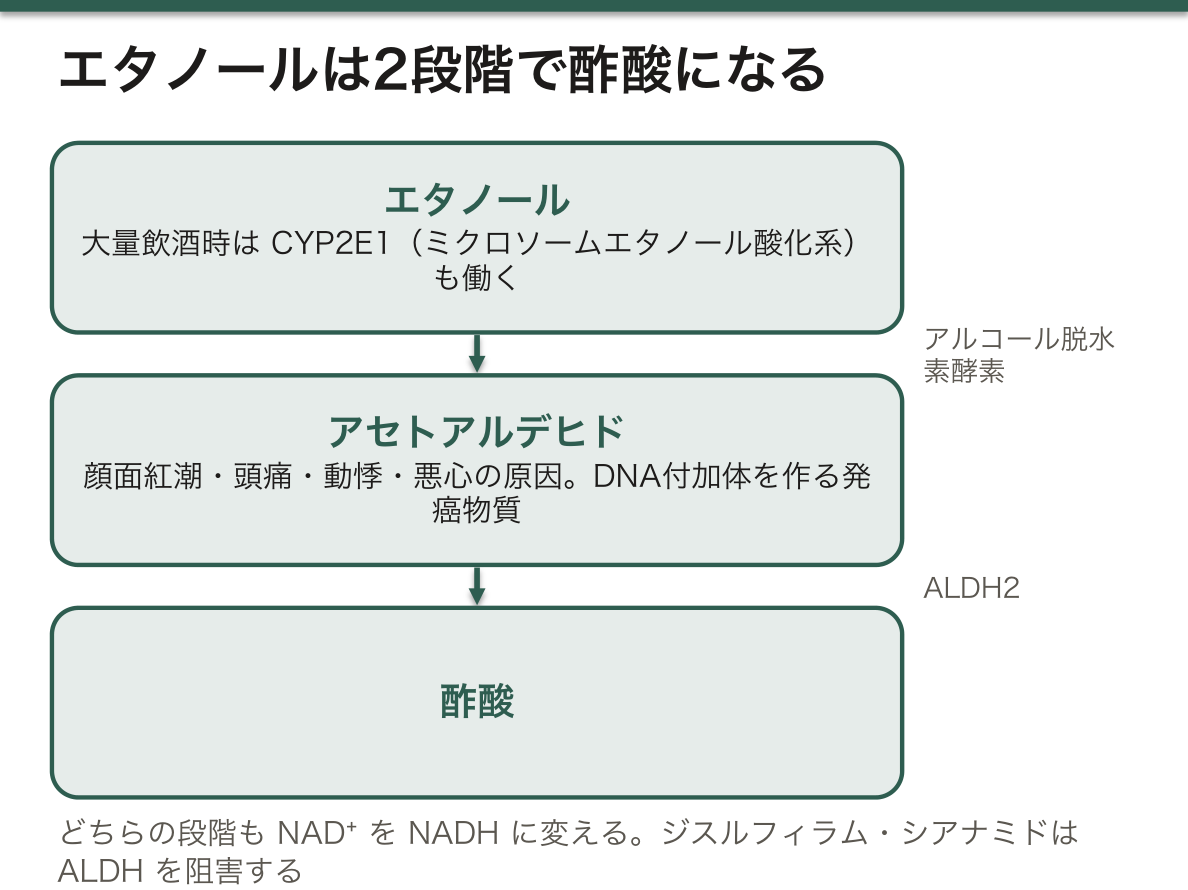
エタノール →(アルコール脱水素酵素)→ アセトアルデヒド →(アルデヒド脱水素酵素2)→ 酢酸
- どちらもNAD⁺をNADHに変える
- アセトアルデヒドが顔面紅潮・頭痛・動悸・悪心の原因
- 大量飲酒時はミクロソームエタノール酸化系(CYP2E1)も働く——誘導されるので耐性ができる
| ALDH2の型 | 活性 | 日本人での頻度 | 特徴 |
|---|---|---|---|
| 活性型 | 正常 | 約50% | 飲める |
| ヘテロ(低活性型) | 約16分の1 | 約40% | 赤くなるが飲める。食道癌のリスクが最も高い |
| 非活性型 | ほぼ無し | 約5〜10% | 飲めない |
- ジスルフィラム・シアナミドはアルデヒド脱水素酵素を阻害する(嫌酒薬)
最もリスクが高いのは「飲めない人」ではなく「赤くなるのに飲む人」である——この事実は、公衆衛生上も個人の判断としても重要である。
- 非活性型は不快が強すぎて飲まないので、結果的に曝露が少ない
- ヘテロは飲み続けられるが、アセトアルデヒドが長く高濃度で留まる
- アセトアルデヒドはDNA付加体を作る発癌物質(国際がん研究機関の分類でグループ1)
- 食道扁平上皮癌・頭頸部癌のリスクが著しく上がる。喫煙が加わると相乗的に上がる
「若い頃は赤くなったが、今は飲めるようになった」という病歴が、最も危険な組み合わせを示している——耐性がついたのはCYP2E1の誘導によるもので、ALDH2の活性は変わらない。問診で必ず聞く価値がある。
NADHが増えることの帰結を1つずつ辿ると、アルコール性肝障害の全体像が出る。
- ピルビン酸が乳酸へ傾く → 乳酸アシドーシス・糖新生の材料が奪われて低血糖
- 乳酸が尿酸の排泄を妨げる → 高尿酸血症・痛風発作
- オキサロ酢酸がリンゴ酸へ傾く → TCA回路が回らずアセチルCoAが余る → ケトン体と脂肪酸合成 → 脂肪肝・アルコール性ケトアシドーシス
「飲んで食べずに寝た翌朝の低血糖」は、グリコーゲンが尽き、糖新生も止まっている状態である。ブドウ糖を投与する際は必ずビタミンB1を先に入れる——Wernicke脳症を誘発しないためである。
English version
Core
Ethanol → (alcohol dehydrogenase) → acetaldehyde → (aldehyde dehydrogenase 2) → acetate
- Both convert NAD⁺ to NADH.
- Acetaldehyde is the cause of the flushing, headache, palpitation and nausea.
- With heavy drinking the microsomal ethanol oxidising system (CYP2E1) also works — it is inducible, so tolerance develops.
| ALDH2 type | Activity | Frequency in Japanese people | Features |
|---|---|---|---|
| Active | Normal | About 50% | Can drink |
| Heterozygous (low activity) | About 1/16 | About 40% | Flushes but can drink. The highest risk of oesophageal cancer |
| Inactive | Almost none | About 5–10% | Cannot drink |
Disulfiram and cyanamide inhibit aldehyde dehydrogenase (alcohol-aversive drugs).
Going further
The highest risk is not in the person who cannot drink but in the person who flushes and drinks anyway — a fact important both in public health and in personal judgement.
- The inactive type is too uncomfortable to drink, so exposure ends up low.
- The heterozygote can go on drinking, but acetaldehyde stays at a high concentration for a long time.
- Acetaldehyde is a carcinogen forming DNA adducts (group 1 in the classification of the International Agency for Research on Cancer).
- The risk of squamous carcinoma of the oesophagus and of head and neck cancer rises markedly. With smoking added it rises synergistically.
A history of "I used to flush when I was young but now I can drink" indicates the most dangerous combination — the tolerance came from induction of CYP2E1 and the activity of ALDH2 has not changed. Always worth asking about.
Following the consequences of the increase in NADH one by one gives the whole picture of alcoholic liver injury.
- Pyruvate leans towards lactate → lactic acidosis and hypoglycaemia as the material for gluconeogenesis is taken away.
- Lactate impedes the excretion of urate → hyperuricaemia and gout.
- Oxaloacetate leans towards malate → the TCA cycle does not turn and acetyl-CoA is left over → ketone bodies and fatty acid synthesis → fatty liver and alcoholic ketoacidosis.
The hypoglycaemia of the morning after drinking and sleeping without eating is a state in which glycogen is exhausted and gluconeogenesis has stopped as well. When giving glucose, always give thiamine first — so as not to precipitate Wernicke’s encephalopathy.
慢性のアルコール摂取が、体に何をしているか
臓器ごとの影響。
- 肝——脂肪肝 → アルコール性肝炎 → 肝硬変。AST/ALT比が2を超える
- 膵——慢性膵炎。膵液の蛋白栓が石灰化する
- 神経——ビタミンB1欠乏によるWernicke脳症・Korsakoff症候群、末梢神経障害、小脳変性
- 血液——大球性貧血(葉酸欠乏+骨髄への直接毒性)、血小板減少
- 心——アルコール性心筋症、心房細動
ビタミンB1が枯れる理由は3つ重なる——摂取不足・吸収障害・代謝需要の増大。
Wernicke脳症の3徴(眼球運動障害・失調・意識障害)がそろうのは3分の1以下である。そろうのを待っていては手遅れになるので、疑ったら投与する。ビタミンB1は過剰投与の害がほとんど無い——治療の閾値を下げてよい根拠である。
なぜビタミンB1欠乏で脳が侵されるのか。チアミンピロリン酸はピルビン酸脱水素酵素・αケトグルタル酸脱水素酵素・トランスケトラーゼの補酵素である。
- グルコースからATPを作る経路が2か所で止まる
- 脳はグルコースにほぼ完全に依存しているので、真っ先に破綻する
- 乳酸が溜まり、特に乳頭体・視床・中脳水道周囲が侵される——代謝要求が高い部位である
離脱症状の時間経過も、実務で必要な知識である。
| 時期 | 症状 |
|---|---|
| 6〜24時間 | 振戦・発汗・不安・頻脈 |
| 12〜48時間 | けいれん・アルコール幻覚症 |
| 48〜96時間 | 振戦せん妄(見当識障害・幻視・自律神経の嵐)。死亡しうる |
治療はベンゾジアゼピンである——アルコールと同じGABA_A受容体に働くので、交叉耐性がある。抗精神病薬はけいれん閾値を下げるので、単独では使わない。
入院患者で「手術後2〜3日目にせん妄」なら、まず離脱を疑う。飲酒歴の聴取が、そのまま予防になる。
English version
Core
Effects organ by organ.
- Liver — fatty liver → alcoholic hepatitis → cirrhosis. The AST/ALT ratio exceeds 2.
- Pancreas — chronic pancreatitis. Protein plugs in the pancreatic juice calcify.
- Nerve — Wernicke’s encephalopathy and Korsakoff’s syndrome from vitamin B1 deficiency, peripheral neuropathy, cerebellar degeneration.
- Blood — macrocytic anaemia (folate deficiency plus direct marrow toxicity), thrombocytopenia.
- Heart — alcoholic cardiomyopathy, atrial fibrillation.
Three reasons for the exhaustion of vitamin B1 overlap — insufficient intake, malabsorption and increased metabolic demand.
Going further
The triad of Wernicke’s encephalopathy (ocular motor disturbance, ataxia, impaired consciousness) is complete in fewer than a third. Waiting for it to be complete is to be too late, so if it is suspected, treat. Thiamine has almost no harm in excess — the ground for lowering the threshold to treat.
Why does B1 deficiency strike the brain? Thiamine pyrophosphate is the coenzyme of pyruvate dehydrogenase, α-ketoglutarate dehydrogenase and transketolase.
- The route making ATP from glucose stops in two places.
- The brain is almost wholly dependent on glucose, so it breaks down first.
- Lactate accumulates and the mammillary bodies, thalamus and periaqueductal region are affected particularly — the regions of high metabolic demand.
The time course of withdrawal is knowledge needed in practice.
| Time | Symptoms |
|---|---|
| 6–24 hours | Tremor, sweating, anxiety, tachycardia |
| 12–48 hours | Seizures, alcoholic hallucinosis |
| 48–96 hours | Delirium tremens (disorientation, visual hallucination, autonomic storm). It can kill |
Treatment is a benzodiazepine — acting on the same GABA_A receptor as alcohol, so there is cross-tolerance. Antipsychotics lower the seizure threshold and are not used alone.
Delirium on the second or third day after an operation in an inpatient should first raise the suspicion of withdrawal. Taking a drinking history is itself the prevention.
アルコールが代謝を歪める — NADH が余るということ
エタノールの酸化は、2段階とも NAD⁺ を消費して NADH を作る——エタノール →(アルコール脱水素酵素)→ アセトアルデヒド →(アルデヒド脱水素酵素2)→ 酢酸。
その結果、細胞内の NADH/NAD⁺ 比が上がる。これだけで多くの反応が一方向へ傾く。
| 反応 | 傾く向き | 臨床 |
|---|---|---|
| ピルビン酸 ⇄ 乳酸 | 乳酸へ | 乳酸アシドーシス・尿酸の排泄低下 |
| オキサロ酢酸 ⇄ リンゴ酸 | リンゴ酸へ | 糖新生が止まる → 低血糖 |
| 脂肪酸のβ酸化 | 止まる | 脂肪肝・高中性脂肪血症 |
| アセト酢酸 ⇄ β-ヒドロキシ酪酸 | β-ヒドロキシ酪酸へ | 尿ケトン試験紙が陰性に出る |
大量飲酒では CYP2E1(ミクロソームエタノール酸化系)の寄与が増える。
「NADH が余る」という一言から、飲酒者に起こることの大半が導ける。個別の症状を覚えるのではなく、酸化還元の傾きから並べる(代謝の見取り図の章)——「1つの比が、複数の平衡を同時に動かしている」。
アルコール性ケトアシドーシスは、この理屈を知らないと診断できない。ケトン体の大半が β-ヒドロキシ酪酸に偏るが、尿の試験紙はアセト酢酸しか検出しない(酸塩基平衡の章)——「尿ケトンが陰性でも、ケトアシドーシスは否定できない」。
低血糖も、この機序で起こる。糖新生が止まり、グリコーゲンも尽きているので、飲酒と絶食が重なると危険になる(糖新生の章)——「酔って倒れている人の血糖を、必ず測る」。
高尿酸血症も同じ道筋から出てくる。乳酸が尿細管で尿酸と排泄を競合する。さらにビールにはプリン体が含まれる(高尿酸血症の章)——「作りすぎと、捨てられないの両方が同時に起きている」。
CYP2E1 の誘導が、薬物代謝を変える(アセトアミノフェン中毒の項)——「常習飲酒者では、常用量のアセトアミノフェンでも肝が壊れうる」。
English version
Core
Both steps of the oxidation of ethanol consume NAD⁺ and make NADH — ethanol → (alcohol dehydrogenase) → acetaldehyde → (aldehyde dehydrogenase 2) → acetate.
The intracellular NADH/NAD⁺ ratio therefore rises, and this alone tilts many reactions one way.
| Reaction | Direction | Clinical |
|---|---|---|
| Pyruvate ⇄ lactate | Towards lactate | Lactic acidosis, reduced excretion of urate |
| Oxaloacetate ⇄ malate | Towards malate | Gluconeogenesis stops → hypoglycaemia |
| β-Oxidation of fatty acids | Stops | Fatty liver, hypertriglyceridaemia |
| Acetoacetate ⇄ β-hydroxybutyrate | Towards β-hydroxybutyrate | The urinary ketone strip reads negative |
With heavy drinking the contribution of CYP2E1 (the microsomal ethanol oxidising system) increases.
Going further
From the single phrase "NADH is in surplus", most of what happens to a drinker can be derived.
- Rather than memorising individual symptoms, line them up from the redox tilt (the chapter on the map of metabolism) — one ratio moving several equilibria at once.
- Alcoholic ketoacidosis cannot be diagnosed without knowing this reasoning. Most of the ketone body is skewed to β-hydroxybutyrate, but the urine strip detects only acetoacetate (the chapter on acid–base balance) — a negative urinary ketone does not exclude ketoacidosis.
- Hypoglycaemia arises by the same mechanism. Gluconeogenesis has stopped and glycogen is exhausted, so drinking and fasting together are dangerous (the chapter on gluconeogenesis) — always measure the blood glucose of someone found collapsed and drunk.
- Hyperuricaemia comes out of the same path. Lactate competes with urate for excretion in the tubule, and beer contains purines besides (the chapter on hyperuricaemia) — making too much and failing to discard it, both at once.
- Induction of CYP2E1 alters drug metabolism (the section on paracetamol poisoning) — in a habitual drinker even an ordinary dose of paracetamol can destroy the liver.
ビタミンB1と離脱 — 順番を間違えると、脳が壊れる
ビタミンB1(チアミン)はピロリン酸として、3つの酵素の補酵素になる——ピルビン酸脱水素酵素・α-ケトグルタル酸脱水素酵素・トランスケトラーゼ。
体内の貯蔵は 2〜3 週間ぶんしかない。
Wernicke 脳症の三徴——意識障害・眼球運動障害(眼振・外眼筋麻痺)・失調。3つ揃うのは約 1/3 だけ。
放置すると Korsakoff 症候群へ移行する——前向性健忘・作話。不可逆になる。
アルコール離脱の時間軸——6〜24時間で振戦・発汗、12〜48時間で離脱けいれん、48〜96時間で振戦せん妄。
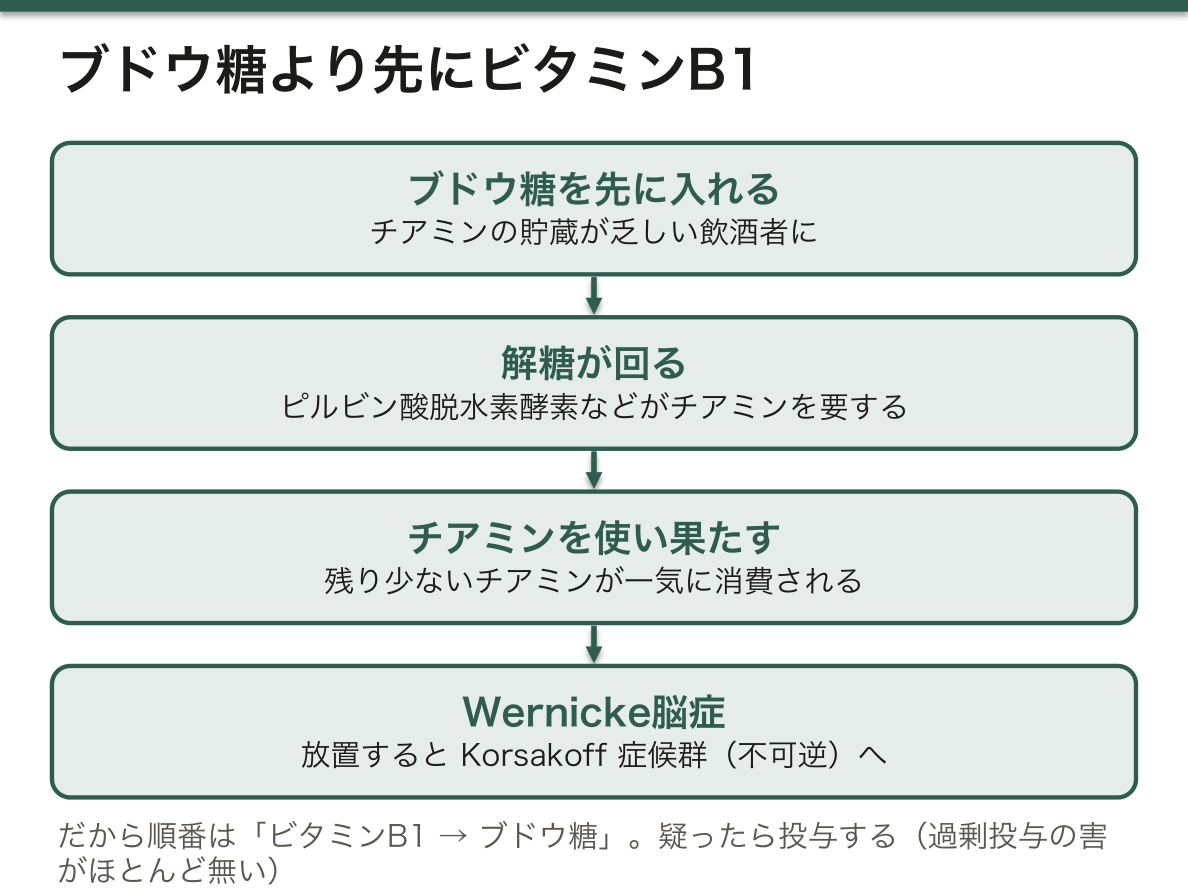
「ブドウ糖より先にビタミンB1」という順序が、この項の最重要点になる。糖を入れると解糖が回り、残り少ないチアミンが一気に消費されて Wernicke 脳症を誘発する(ピルビン酸脱水素酵素の章)——「良かれと思った点滴が、不可逆の記憶障害を作る」。
疑ったら投与する、というのが実務の原則になる。チアミンは水溶性で過剰投与の害がほとんど無く、診断を待つ利益が無い(内分泌と代謝の救急の章)——「検査結果が出る頃には、手遅れになっている」。
アルコール以外でも起こることを押さえる。妊娠悪阻・長期の絶食・胃切除後・中心静脈栄養・血液透析(栄養を再開するときの章)——「再栄養症候群と、同じ場面で並んで起こる」。
脚気は同じ欠乏の別の顔になる——「乾性脚気=末梢神経障害、湿性脚気=高拍出性心不全(衝心脚気)」。
離脱の治療はベンゾジアゼピン系になる(中枢神経作用薬の章)——「エタノールと同じ GABA-A 受容体に作用するので、置き換えて漸減できる」。
English version
Core
Vitamin B1 (thiamine), as the pyrophosphate, is the coenzyme of three enzymes — pyruvate dehydrogenase, α-ketoglutarate dehydrogenase and transketolase.
The body’s store is only two to three weeks’ worth.
The triad of Wernicke’s encephalopathy — impaired consciousness, ocular motor disturbance (nystagmus, external ophthalmoplegia) and ataxia. All three are present in only about a third.
Left alone it passes into Korsakoff’s syndrome — anterograde amnesia and confabulation. It becomes irreversible.
The time course of alcohol withdrawal — tremor and sweating at 6–24 hours, withdrawal seizures at 12–48 hours, delirium tremens at 48–96 hours.
Going further
The order "thiamine before glucose" is the most important point of this section.
- Give sugar and glycolysis turns, consuming the little thiamine that remains at a stroke and precipitating Wernicke’s encephalopathy (the chapter on pyruvate dehydrogenase) — a well-meant infusion creating an irreversible amnesia.
- If it is suspected, treat — that is the principle in practice. Thiamine is water-soluble with almost no harm in excess, and there is no benefit in waiting for the diagnosis (the chapter on emergencies of endocrinology and metabolism) — by the time the result is back it is too late.
- Note that it happens outside alcohol too — hyperemesis gravidarum, prolonged fasting, after gastrectomy, central venous nutrition, haemodialysis (the chapter on restarting nutrition) — occurring in the same settings as the refeeding syndrome.
- Beriberi is another face of the same deficiency — dry beriberi = peripheral neuropathy, wet beriberi = high-output heart failure (shoshin beriberi).
- Withdrawal is treated with a benzodiazepine (the chapter on drugs acting on the central nervous system) — acting on the same GABA-A receptor as ethanol, so it can be substituted and tapered.
飲酒量を数える — 「どれくらい飲むか」を、化学の量に直す
問診で「時々」「付き合い程度」と言われても評価にならない。純アルコール量(g)に直すと、量として扱える。
純アルコール量(g)= 量(mL)× 度数(%)÷ 100 × 0.8(0.8 はエタノールの比重)
| ビール 500 mL(5%) | 20 g | 日本では純アルコール 20 g を「1 単位」として数える |
| 日本酒 1 合 180 mL(15%) | 約 22 g | |
| ワイン グラス 2 杯 240 mL(12%) | 約 23 g | |
| 焼酎 100 mL(25%) | 20 g |
生活習慣病の危険を高める量は、1 日あたり男性 40 g 以上・女性 20 g 以上とされている。女性の閾値が低いのは、体水分量が少なく、胃の ADH 活性も低いためである。
申告された量と、体に出ている目印を突き合わせる。飲酒量は過少申告されやすい。
| γ-GTP | 誘導によって上がる。禁酒で 2〜3 週で半減する | 薬剤・脂肪肝・胆汁うっ滞でも上がる。特異度は高くない |
| MCV | 大きくなる(葉酸不足とエタノールの直接作用) | 戻るのに赤血球の寿命ぶん(数か月)かかる。長期の指標 |
| AST/ALT 比 | 2 を超えるとアルコール性を疑う | ビタミン B6 が不足して ALT が作れないことが一因 |
速く戻る指標と、ゆっくり戻る指標を組み合わせると、「いつから減らしたか」まで読める。γ-GTP が下がって MCV がまだ大きければ、最近やめたところだと分かる。
減らす目標は、断酒でなくてよい場合がある。依存が確立していなければ減酒(節酒)でも肝機能と血圧は改善する。「やめられないなら意味がない」と伝えると受診が途切れるので、量を数える習慣そのものを目標にするほうが続く。
⚠️ 離脱の危険がある人に、いきなり断酒させない。毎日多量に飲んでいる人が急にやめると、けいれん・振戦せん妄を起こしうる。計画された減量と、ビタミン B1 の補充を先に用意する。
問診では「週に何日」「1 回に何を何杯」を聞き、その場で g に直す。患者と一緒に計算すること自体が介入になる。
English version
Core
"Now and then" or "only socially" in a history is not an assessment. Converted into grams of pure alcohol, it can be handled as a quantity.
Pure alcohol (g) = volume (mL) × strength (%) ÷ 100 × 0.8 (0.8 being the specific gravity of ethanol)
| Beer 500 mL (5%) | 20 g | In Japan 20 g of pure alcohol counts as one unit |
| Sake, 1 gō, 180 mL (15%) | About 22 g | |
| Wine, 2 glasses, 240 mL (12%) | About 23 g | |
| Shōchū 100 mL (25%) | 20 g |
The amount raising the risk of lifestyle-related disease is taken as 40 g a day or more in men and 20 g or more in women. The threshold is lower in women because body water is less and gastric ADH activity lower.
Going further
Match the reported amount against the markers showing in the body. Consumption is readily under-reported.
| γ-GT | Rises by induction. Halves in 2–3 weeks with abstinence | Also rises with drugs, fatty liver and cholestasis. Not specific |
| MCV | Increases (folate deficiency and the direct action of ethanol) | Takes the lifespan of the red cell (some months) to return. A long-term index |
| AST/ALT ratio | Above 2 suggests an alcoholic cause | Partly because vitamin B6 is deficient and ALT cannot be made |
Combining an index that returns quickly with one that returns slowly, even "since when they cut down" can be read. A γ-GT that has fallen with an MCV still large says they stopped recently.
The goal of reduction need not be abstinence. Where dependence is not established, reduced drinking improves liver function and blood pressure. Saying "there is no point unless you stop" breaks the attendance, so making the habit of counting the amount itself the goal lasts better.
⚠️ Do not have someone at risk of withdrawal stop abruptly. A person drinking heavily every day who suddenly stops may have seizures or delirium tremens. Prepare a planned reduction and thiamine supplementation first.
In the clinic
In the history ask "how many days a week" and "what and how many glasses at a time", and convert to grams on the spot. Calculating together with the patient is itself an intervention.
アルコールが尿酸と中性脂肪を上げる — 3つの別々の道
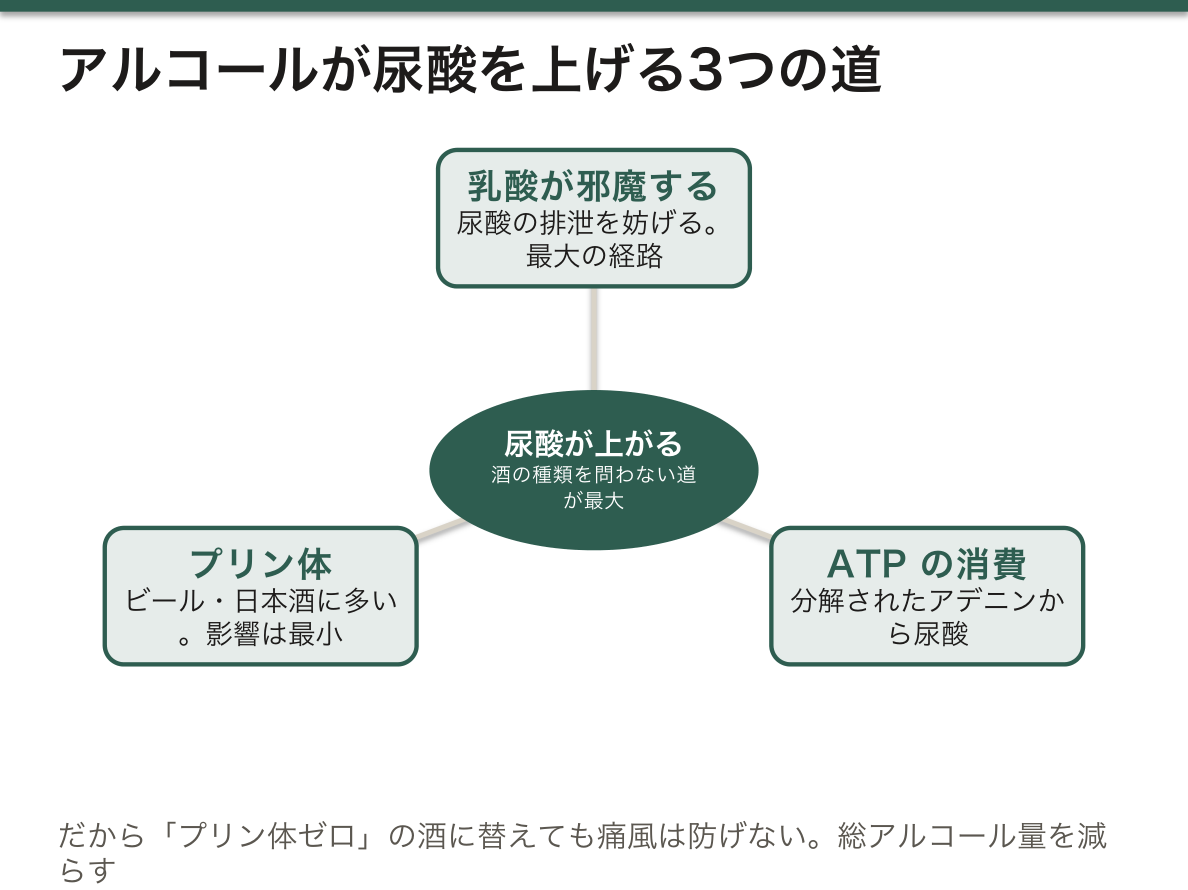
「ビールはプリン体が多いから痛風になる」という説明は、半分しか当たっていない。アルコールは3つの独立した経路で尿酸を上げる。
- 乳酸が尿酸の排泄を邪魔する——エタノールの代謝で NADH が余り、ピルビン酸が乳酸へ傾く。乳酸は腎の尿酸トランスポーターで尿酸と交換に再吸収されるので、尿酸が体に残る。これが最大の経路で、酒の種類を問わない
- ATP を消費して尿酸を作る——エタノールの代謝で ATP が使われ、分解されてアデニンからそのまま尿酸ができる
- プリン体そのもの——ビールと日本酒に多い。3 つのうち最も影響は小さい
だから「プリン体ゼロ」の酒に替えても、痛風は防げない。
中性脂肪が上がる理由も、同じ NADH の余りから説明できる。
- NADH が余るとβ酸化が止まる——脂肪酸が燃やされずに残る
- 同時に糖新生も止まる——だから飲酒後に低血糖が起きうる(食事を摂っていない場合に危険)
- 余った脂肪酸が中性脂肪に組み立てられ、肝に溜まり(脂肪肝)、VLDL として血中へ出る
1 つの生化学的な変化(NADH/NAD⁺ 比の上昇)から、高尿酸血症・高中性脂肪血症・脂肪肝・低血糖・ケトアシドーシスが同時に出てくる。アルコール関連の検査異常が「まとめて」現れるのはこのためで、バラバラの合併症ではなく1 つの原因の別々の顔として読む。
⚠️ 中性脂肪が 500 mg/dL を超えたら、急性膵炎の危険を考える。アルコールと高中性脂肪血症は膵炎の原因として並ぶ二大要因であり、同じ患者に重なることが多い。
痛風発作の誘因として実際に多いのは「大量飲酒の翌朝」である。脱水も加わって尿酸が濃縮され、末梢の関節で溶解度を超える。
高尿酸血症の患者に「ビールを焼酎に替える」よう勧めても効果は限られる。総アルコール量を減らすことと、水分を伝える。
English version
Core
The explanation that "beer is high in purines so it causes gout" is only half right. Alcohol raises urate by three independent routes.
- Lactate impedes the excretion of urate — the metabolism of ethanol leaves NADH in surplus and pyruvate leans towards lactate. Lactate is reabsorbed in exchange for urate by the renal urate transporter, so urate stays in the body. This is the largest route and it does not depend on the kind of drink.
- ATP is consumed to make urate — the metabolism of ethanol uses ATP, which is broken down and urate is made from adenine directly.
- The purines themselves — high in beer and sake. The least influential of the three.
So changing to a "purine-free" drink does not prevent gout.
Going further
The reason the triglycerides rise can be explained from the same surplus of NADH.
- With NADH in surplus, β-oxidation stops — fatty acids are left unburnt.
- At the same time gluconeogenesis stops — hence hypoglycaemia can follow drinking (dangerous when no food has been taken).
- The surplus fatty acids are assembled into triglyceride, accumulate in the liver (fatty liver) and go out into the blood as VLDL.
From one biochemical change (a rise in the NADH/NAD⁺ ratio) come hyperuricaemia, hypertriglyceridaemia, fatty liver, hypoglycaemia and ketoacidosis at once. This is why the abnormal results of alcohol appear "all together", and they are to be read not as separate complications but as different faces of one cause.
⚠️ Once the triglycerides pass 500 mg/dL, think of the danger of acute pancreatitis. Alcohol and hypertriglyceridaemia stand as the two great causes of pancreatitis and often overlap in the same patient.
The commonest actual trigger of a gout attack is the morning after heavy drinking. Dehydration is added, urate is concentrated, and the solubility is exceeded in a peripheral joint.
In the clinic
Advising a patient with hyperuricaemia to change from beer to shōchū has limited effect. Tell them to reduce the total alcohol, and to drink water.
まとめ
| 2つの酵素と、赤くなる体質 | エタノール →(アルコール脱水素酵素)→ アセトアルデヒド →(アルデヒド脱水素酵素2)→ 酢酸どちらもNAD⁺をNADHに変えるアセトアルデヒドが顔面紅潮・頭痛・動悸・悪心の原因… |
|---|---|
| 慢性のアルコール摂取が、体に何をしているか | 臓器ごとの影響。肝——脂肪肝 → アルコール性肝炎 → 肝硬変。 |
| アルコールが代謝を歪める — NADH が余るということ | エタノールの酸化は、2段階とも NAD⁺ を消費して NADH を作る——エタノール →(アルコール脱水素酵素)→ アセトアルデヒド →(アルデヒド脱水素酵素2)→ 酢酸。 |
| ビタミンB1と離脱 — 順番を間違えると、脳が壊れる | ビタミンB1(チアミン)はピロリン酸として、3つの酵素の補酵素になる——ピルビン酸脱水素酵素・α-ケトグルタル酸脱水素酵素・トランスケトラーゼ。 |
| 飲酒量を数える — 「どれくらい飲むか」を、化学の量に直す | 問診で「時々」「付き合い程度」と言われても評価にならない。 |
| アルコールが尿酸と中性脂肪を上げる — 3つの別々の道 | 「ビールはプリン体が多いから痛風になる」という説明は、半分しか当たっていない。 |
このノートは医学生が授業の内容を自分の言葉でまとめたもので、診療の判断に使うものではありません。誤りに気づいたらお知らせください。