DNA → RNA → 蛋白質という一方向の流れ(セントラルドグマ)。逆転写ウイルスだけが逆向きに戻る。
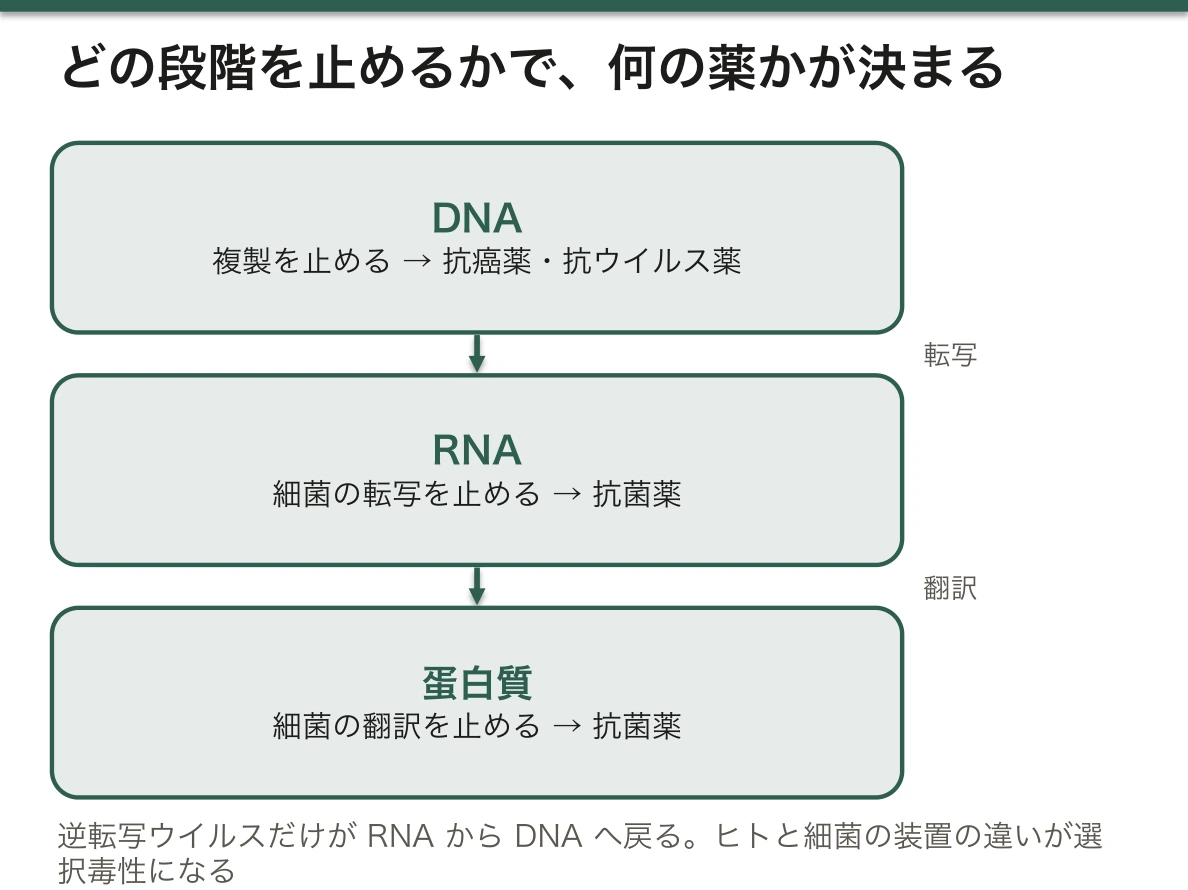
この章を医学として読む鍵は、「どの段階を止めるかで、何の薬になるかが決まる」という視点である。
- 複製を止める → 抗癌薬・抗ウイルス薬
- 細菌の転写・翻訳を止める → 抗菌薬(ヒトと細菌で装置が違うことが選択毒性の根拠)
- 転写因子に効かせる → ステロイド・甲状腺ホルモン
もう一つの柱が変異の読み方である。同じ1塩基の変化でも、どこで起きたかで影響がまるで違う。
分子生物学は暗記に見えて、実は「装置の違いが薬の選択性を作る」という一つの原理でほとんど繋がる。
- 複製 — 半保存的に、片方だけが連続で
- 転写とスプライシング — どこで切るかで別の蛋白になる
- 翻訳 — 装置の違いが抗菌薬の選択性になる
- 遺伝子発現の調節 — 同じゲノムから、違う細胞ができる理由
- ミトコンドリアDNA — 核とは別の、もう1組のゲノム
- RNA を薬にする — 配列そのものが治療になる時代
複製 — 半保存的に、片方だけが連続で
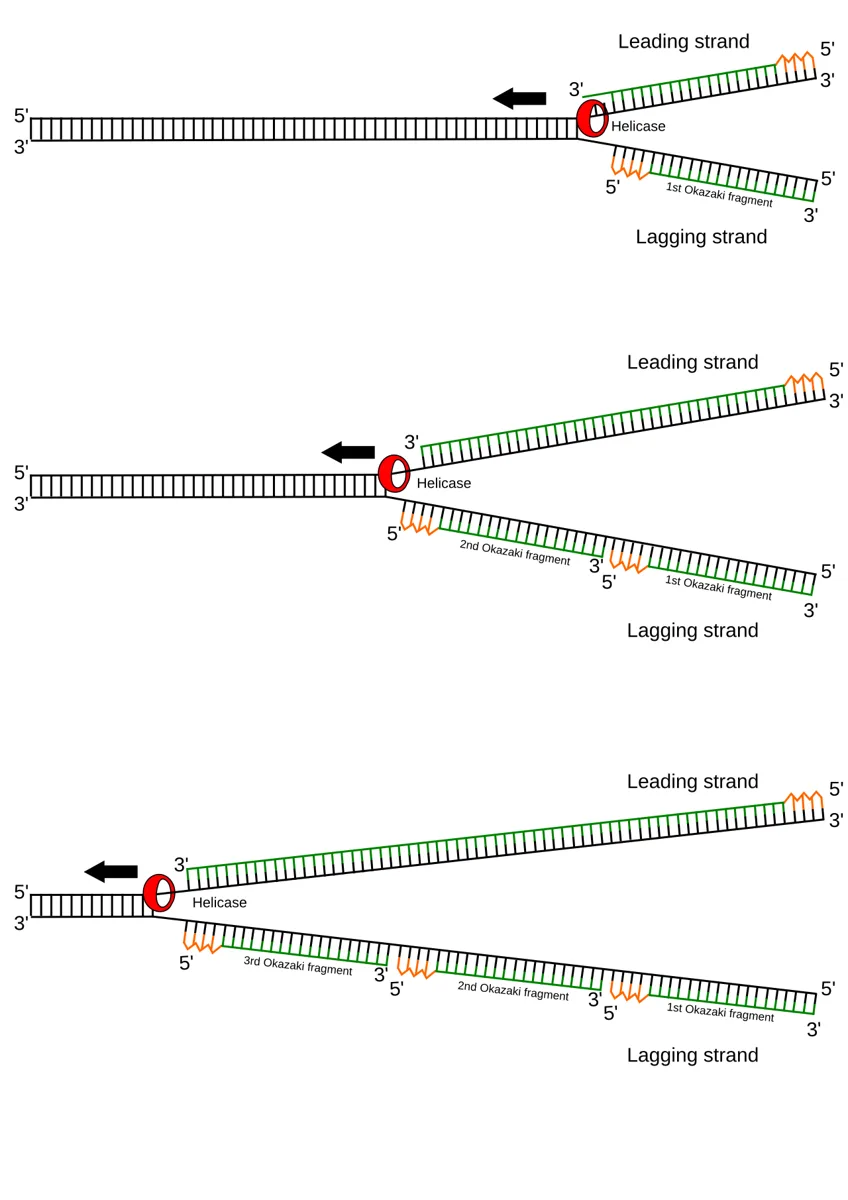
半保存的複製。1本ずつを鋳型に新しい鎖を作る。
- ヘリカーゼ——二重らせんをほどく
- トポイソメラーゼ——ほどいた先のねじれを解く
- プライマーゼ——RNAプライマーを置く(DNAポリメラーゼはゼロから始められない)
- DNAポリメラーゼ——5’→3′ にしか伸ばせない
- リガーゼ——切れ目を繋ぐ
伸長方向が一方向なので、リーディング鎖は連続、ラギング鎖は岡崎フラグメントとして断続的に作られる。
末端は複製しきれないのでテロメアが短くなる。テロメラーゼは生殖細胞・幹細胞・多くの癌で働く。
DNAポリメラーゼが 5’→3′ にしか伸ばせないという1つの制約から、ラギング鎖もテロメアの短縮も出てくる。制約が構造を作り、構造が老化の限界を作る。
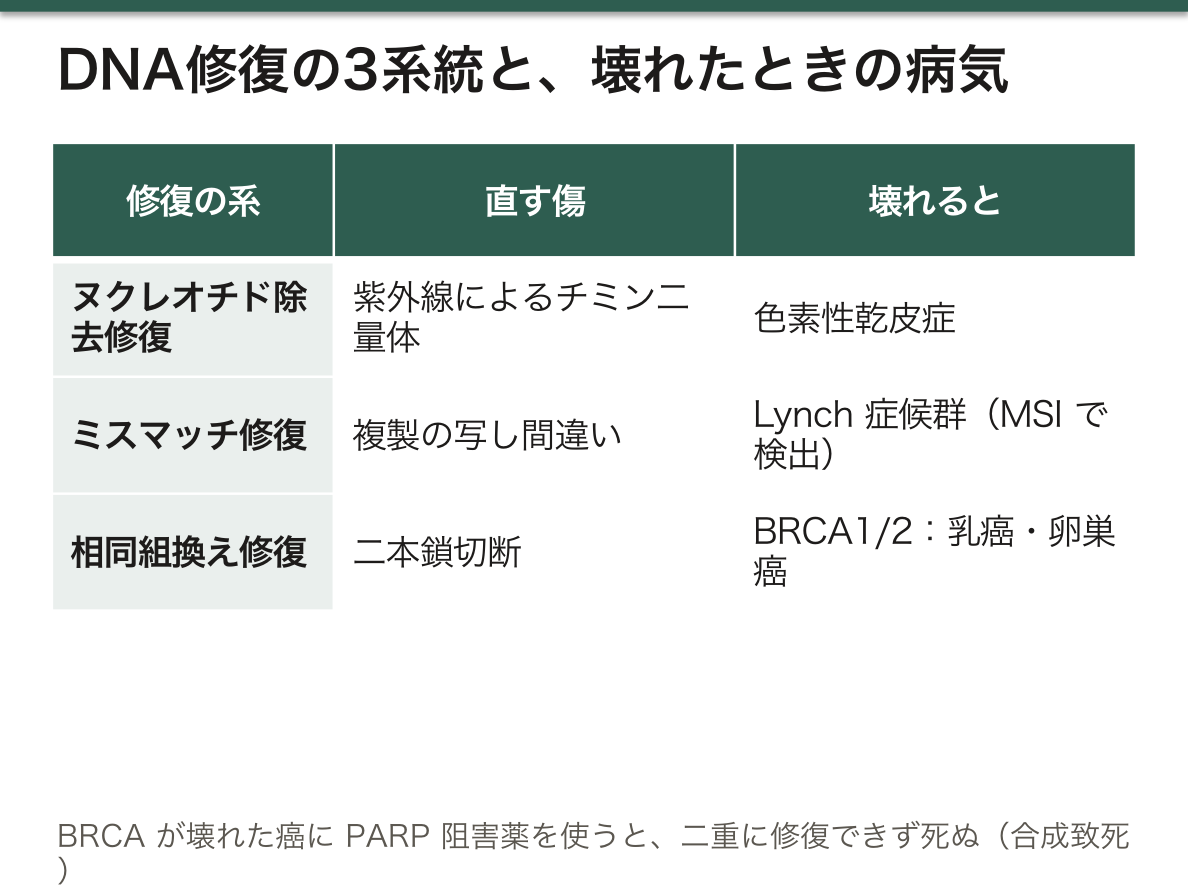
修復の系統も、壊れ方に応じて分かれる。
- ヌクレオチド除去修復——紫外線によるチミン二量体。壊れると色素性乾皮症(日光過敏・若年からの皮膚癌)
- ミスマッチ修復——複製の写し間違い。壊れるとLynch 症候群(遺伝性非ポリポーシス大腸癌)。マイクロサテライト不安定性として検出される
- 相同組換え修復——二本鎖切断。BRCA1/2 がここ。壊れると乳癌・卵巣癌
修復の穴が、そのまま治療の的になるのが現代の要点である。BRCA が壊れた癌では相同組換えが使えないので、もう一方の修復経路であるPARP を阻害すると、二重に修復不能になって癌細胞だけが死ぬ(合成致死)。正常細胞は BRCA が生きているので耐える——弱点を2つ重ねる発想である。
同じ考えが免疫療法にも繋がる。ミスマッチ修復が壊れた腫瘍は変異が多く、異常な蛋白(ネオ抗原)を多く作るので、免疫チェックポイント阻害薬が効きやすい。臓器を問わず「MSI-High なら適応」という考え方の根拠がこれである。
English version
Core
Semiconservative replication: each strand is a template for a new one.
- Helicase — unwinds the double helix.
- Topoisomerase — relieves the supercoiling ahead of it.
- Primase — lays down an RNA primer (DNA polymerase cannot start from nothing).
- DNA polymerase — can extend only 5′→3′.
- Ligase — seals the nicks.
Because extension is one-way, the leading strand is continuous and the lagging strand is made discontinuously as Okazaki fragments.
The ends cannot be fully replicated, so the telomeres shorten. Telomerase is active in germ cells, stem cells and most cancers.
Going further
From the single constraint that DNA polymerase extends only 5′→3′ come both the lagging strand and the shortening of the telomeres. A constraint creates a structure, and the structure creates the limit of ageing.
The repair systems likewise divide according to how the damage occurred.
- Nucleotide excision repair — thymine dimers from ultraviolet light. Broken, it gives xeroderma pigmentosum (photosensitivity, skin cancer from a young age).
- Mismatch repair — copying errors of replication. Broken, it gives Lynch syndrome (hereditary non-polyposis colorectal cancer), detected as microsatellite instability.
- Homologous recombination repair — double-strand breaks. BRCA1/2 belong here. Broken, they give breast and ovarian cancer.
That a hole in the repair is itself the target of treatment is the modern point. A cancer with broken BRCA cannot use homologous recombination, so inhibiting PARP, the other repair pathway, leaves it doubly unable to repair and the cancer cells alone die (synthetic lethality). Normal cells, with BRCA intact, survive — the idea of stacking two weaknesses.
The same thinking leads to immunotherapy. A tumour with defective mismatch repair carries many mutations and makes many abnormal proteins (neoantigens), so checkpoint inhibitors work well. This is the basis of the tissue-agnostic principle that MSI-High is an indication.
転写とスプライシング — どこで切るかで別の蛋白になる
RNAポリメラーゼが DNA を鋳型に RNA を作る。真核生物では3種。
- I——rRNA/II——mRNA(α-アマニチンに阻害される)/III——tRNA
できた hnRNA は3つの加工を受けて成熟する。
- 5′ キャップ/3′ ポリA尾部——安定化と輸送・翻訳開始
- スプライシング——イントロンを除きエキソンを繋ぐ。スプライソソームが行う
選択的スプライシングにより、1つの遺伝子から複数種類の蛋白ができる。
遺伝子の数(約2万)より蛋白の種類がはるかに多いのは、この切り分けの自由度による。「1遺伝子1蛋白」ではない。
転写の調節は、DNAの配列を変えずに読める/読めないを切り替える層(エピジェネティクス)でも行われる。
- DNAメチル化(CpG アイランド)——読めなくする。癌抑制遺伝子がメチル化で沈黙することが発癌の一因
- ヒストンのアセチル化——クロマチンを緩めて読めるようにする
- ゲノム刷り込み——父由来か母由来かで発現が違う。同じ15q11-13 の欠失でも、父由来なら Prader-Willi、母由来なら Angelman
配列が同じでも、どちらの親から来たかで別の病気になる——遺伝が塩基配列だけで決まらないことの、最も明快な例である。
スプライシングは治療の的にもなっている。脊髄性筋萎縮症では SMN1 が失われているが、ほぼ同じ SMN2 が残っている。ただし SMN2 はスプライシングでエキソン7が抜けてしまい、使い物にならない。ヌシネルセンはスプライシングの向きを変えてエキソン7を残させる薬である。遺伝子を入れ替えるのではなく、読み方を変えて治す。
English version
Core
RNA polymerase makes RNA on a DNA template. Three kinds in eukaryotes: I — rRNA / II — mRNA (inhibited by α-amanitin) / III — tRNA.
The hnRNA is processed in three ways to mature.
- 5′ cap and 3′ poly(A) tail — stability, export and initiation of translation.
- Splicing — introns removed and exons joined, by the spliceosome.
Alternative splicing lets one gene make several kinds of protein.
Going further
That there are far more proteins than genes (about 20,000) is due to the freedom of that cutting. It is not "one gene, one protein".
Transcription is also regulated at a level that switches readability on and off without changing the sequence (epigenetics).
- DNA methylation (CpG islands) — makes it unreadable. Silencing of a tumour suppressor by methylation is one cause of carcinogenesis.
- Histone acetylation — loosens the chromatin and makes it readable.
- Genomic imprinting — expression differs according to whether it came from the father or the mother. The same deletion at 15q11-13 gives Prader–Willi if paternal and Angelman if maternal.
With the same sequence, which parent it came from makes it a different disease — the clearest example that inheritance is not settled by the base sequence alone.
Splicing has become a target of treatment too. In spinal muscular atrophy SMN1 is lost but the nearly identical SMN2 remains; SMN2, however, loses exon 7 in splicing and is useless. Nusinersen alters the direction of splicing so that exon 7 is retained. Not replacing the gene, but changing how it is read.
翻訳 — 装置の違いが抗菌薬の選択性になる
リボソームが mRNA を読み、tRNA が対応するアミノ酸を運ぶ。
- コドンは3塩基。開始は AUG(メチオニン)、終止は UAA・UAG・UGA
- 遺伝暗号は縮重している(複数のコドンが同じアミノ酸)
- リボソーム——真核は 80S(60S+40S)、原核は 70S(50S+30S)
この大きさの違いが、抗菌薬がヒトの細胞を傷めない理由である。
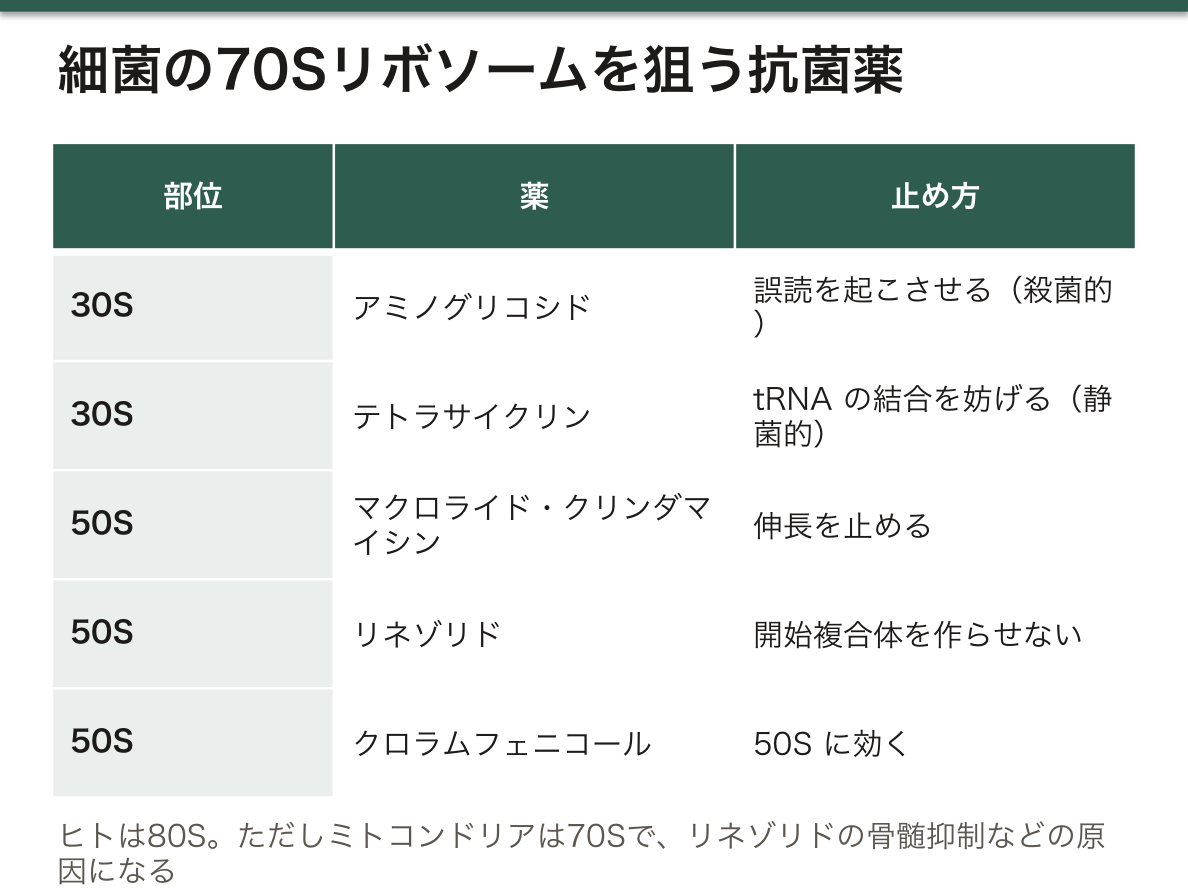
抗菌薬は「細菌にあってヒトに無いもの」を狙う——翻訳装置はその最大の標的である。
- 30S に効く——アミノグリコシド(誤読を起こさせる。殺菌的)、テトラサイクリン(tRNA の結合を妨げる。静菌的)
- 50S に効く——マクロライド・クリンダマイシン(伸長を止める)、リネゾリド(開始複合体を作らせない)、クロラムフェニコール
「30 と 50 に分けて覚える」のは丸暗記ではなく、リボソームが2つの部分からできているという構造の反映である。
ただしミトコンドリアのリボソームは 70S(細菌に由来するため)で、ここが副作用の説明になる。リネゾリドの骨髄抑制・乳酸アシドーシス・視神経障害や、アミノグリコシドの内耳障害(m.1555A>G を持つ人)は、ヒトの細胞内に残る細菌の名残を巻き添えにしているからである。選択毒性が完全でない理由が、細胞内共生という進化の事実に行き着く。
変異の影響もこの段階で決まる。同義(サイレント)/ミスセンス/ナンセンス/フレームシフト。3の倍数でない挿入・欠失は以降の読み枠が全部ずれるので最も重い。Duchenne 型(枠がずれる)と Becker 型(枠が保たれる)が同じ遺伝子でありながら重症度が違うのは、枠がずれるかどうかという一点による。
English version
Core
The ribosome reads the mRNA and tRNA brings the corresponding amino acid. A codon is three bases.
- Initiation at AUG (methionine); termination at UAA, UAG, UGA.
- The code is degenerate (several codons for one amino acid).
- Ribosomes — eukaryotic 80S (60S + 40S), prokaryotic 70S (50S + 30S).
This difference in size is why antibiotics do not damage human cells.
Going further
Antibiotics aim at what bacteria have and we do not — and the translational machinery is the greatest such target.
- Acting on the 30S — aminoglycosides (cause misreading; bactericidal), tetracyclines (block tRNA binding; bacteriostatic).
- Acting on the 50S — macrolides and clindamycin (stop elongation), linezolid (prevents formation of the initiation complex), chloramphenicol.
Learning them as "30 and 50" is not rote but a reflection of the fact that the ribosome is built of two parts.
But the mitochondrial ribosome is 70S (being of bacterial descent), and this explains the adverse effects. The marrow suppression, lactic acidosis and optic neuropathy of linezolid, and the inner ear damage of aminoglycosides in a person carrying m.1555A>G, are collateral damage to the bacterial remnant within our own cells. The reason the selective toxicity is imperfect goes back to the evolutionary fact of endosymbiosis.
The effect of a mutation is settled at this stage too: synonymous (silent) / missense / nonsense / frameshift. An insertion or deletion that is not a multiple of three shifts the whole reading frame from that point and is the most severe. That Duchenne (frame shifted) and Becker (frame preserved) differ in severity while affecting the same gene turns on that one point.
遺伝子発現の調節 — 同じゲノムから、違う細胞ができる理由
すべての体細胞は同じDNAを持つ。それでも神経細胞と肝細胞が違うのは、どの遺伝子を、いつ、どれだけ読むかが違うため。調節はいくつもの段階でかかる。
| 段階 | 仕組み |
|---|---|
| クロマチン構造 | ヒストンのアセチル化 → 緩んで転写される/脱アセチル化・DNAメチル化 → 閉じて沈黙 |
| 転写開始 | プロモーター(TATAボックス)に基本転写因子とRNAポリメラーゼII、エンハンサー/サイレンサーに調節因子が結合 |
| スプライシング | 選択的スプライシング——1つの遺伝子から複数の蛋白 |
| mRNAの安定性・輸送 | ポリA尾部、miRNAによる分解・翻訳抑制 |
| 翻訳後 | リン酸化・ユビキチン化による活性と寿命の制御 |
転写因子はモチーフで分類される——ジンクフィンガー(核内受容体)、ロイシンジッパー(AP-1、CREB)、ヘリックス・ターン・ヘリックス(ホメオボックス)、ヘリックス・ループ・ヘリックス(MyoD)。
「調節が何段階にも分かれている」ことが、癌と治療の両方を説明する。 どの段階が壊れても発現が狂うので、癌遺伝子は転写因子(MYC)・受容体(HER2)・シグナル分子(RAS)・クロマチン修飾因子のいずれにも見つかる。
| 段階を狙う薬 | 作用 |
|---|---|
| 核内受容体のリガンド | ステロイド・甲状腺ホルモン・ビタミンD・レチノイド——受容体そのものが転写因子。効くのが遅く、長く続く |
| 全トランス型レチノイン酸〈ATRA〉 | 急性前骨髄球性白血病の PML-RARα に作用し、止まっていた分化を再開させる——殺すのではなく成熟させる治療 |
| DNAメチル化阻害薬(アザシチジン) | 沈黙させられた癌抑制遺伝子を再び読ませる。骨髄異形成症候群 |
| HDAC阻害薬 | ヒストンの脱アセチル化を止めてクロマチンを開く |
| 核酸医薬 | アンチセンス・siRNA——mRNA の段階で止める。ヌシネルセン(脊髄性筋萎縮症)はスプライシングを書き換える |
エピジェネティックな調節は「配列を変えずに読み方を変える」ので、可逆的という点が治療上決定的に重要になる。変異は元に戻せないが、メチル化やアセチル化は薬で戻せる。
ゲノムインプリンティングも同じ仕組み——父由来か母由来かでメチル化の様式が異なり、片方だけが発現する。15q11-q13 で父由来が失われれば Prader-Willi 症候群、母由来が失われれば Angelman 症候群——同じ場所の欠失が、由来によって別の病気になる。
English version
Core
Every somatic cell carries the same DNA. A neurone and a hepatocyte differ because of which genes are read, when and how much.
| Stage | Mechanism |
|---|---|
| Chromatin structure | Histone acetylation → loosened and transcribed / deacetylation and DNA methylation → closed and silent |
| Initiation of transcription | Basal factors and RNA polymerase II at the promoter (TATA box); regulators at enhancers and silencers |
| Splicing | Alternative splicing — several proteins from one gene |
| Stability and export of mRNA | Poly(A) tail; degradation and translational repression by miRNA |
| Post-translational | Activity and lifespan controlled by phosphorylation and ubiquitination |
Transcription factors are classified by motif — zinc finger (nuclear receptors), leucine zipper (AP-1, CREB), helix-turn-helix (homeobox), helix-loop-helix (MyoD).
Going further
That regulation is divided into many stages explains both cancer and its treatment. A fault at any stage distorts expression, so oncogenes are found among transcription factors (MYC), receptors (HER2), signalling molecules (RAS) and chromatin modifiers alike.
| Drug aimed at a stage | Action |
|---|---|
| Ligands of nuclear receptors | Steroids, thyroid hormone, vitamin D, retinoids — the receptor is itself a transcription factor. Slow to act and long-lasting |
| All-trans retinoic acid (ATRA) | Acts on PML-RARα in acute promyelocytic leukaemia and restarts the arrested differentiation — a treatment that matures rather than kills |
| DNA methylation inhibitors (azacitidine) | Make silenced tumour suppressors readable again. Myelodysplastic syndrome |
| HDAC inhibitors | Stop histone deacetylation and open the chromatin |
| Nucleic acid drugs | Antisense and siRNA — stop it at the level of the mRNA. Nusinersen (spinal muscular atrophy) rewrites the splicing |
Epigenetic regulation changes how the sequence is read without changing it, and that it is reversible is decisive for treatment. A mutation cannot be undone; methylation and acetylation can be undone with a drug.
Genomic imprinting is the same mechanism — the pattern of methylation differs by parental origin and only one allele is expressed. Loss of the paternal copy at 15q11-q13 gives Prader–Willi syndrome and loss of the maternal gives Angelman syndrome — the same deletion, a different disease according to its origin.
ミトコンドリアDNA — 核とは別の、もう1組のゲノム
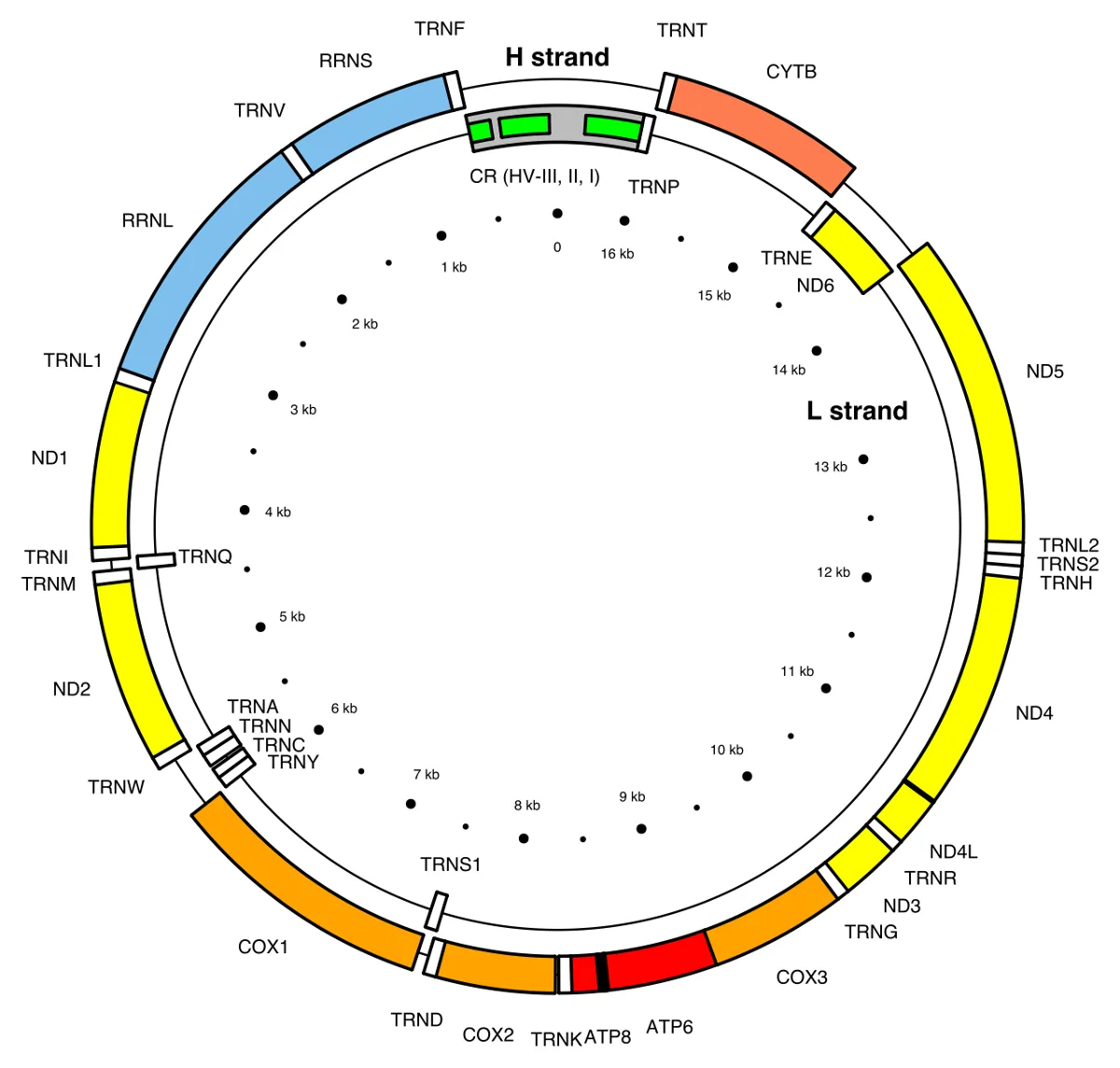
環状の二本鎖 DNA が約 16,569 塩基。37 個の遺伝子(13 の蛋白・2 の rRNA・22 の tRNA)を持つ。
核ゲノムと違う点が多い。
| 核DNA | ミトコンドリアDNA | |
|---|---|---|
| コピー数 | 1細胞に2組 | 1細胞に数百〜数千 |
| 遺伝 | 両親から | 母のみ(母系遺伝) |
| イントロン | ある | ほぼ無い |
| 修復 | 充実 | 乏しい。変異率が約10倍 |
| 遺伝暗号 | 標準 | 一部が異なる |
ヘテロプラスミー——正常と変異の mtDNA が同じ細胞に混在する状態。
閾値効果——変異の割合がある比率を超えて初めて症状が出る。閾値は、エネルギー需要の大きい組織ほど低い。
「割合で決まる」ことが、ミトコンドリア病の分かりにくさを全部説明する。同じ変異でも、組織ごと・個人ごとに変異の割合が違うので、症状も重さもばらばらになる(ミトコンドリア病の章)——「1つの遺伝子型に、1つの表現型が対応しない」。
需要の大きい組織から順に症状が出る——「脳・骨格筋・心筋・網膜・内耳・膵β細胞。だから難聴と糖尿病が並ぶ家系がある」。
母系遺伝であることは、家系図の形で見分けられる(遺伝形式の章)——「罹患した母からは全員に伝わりうるが、罹患した父からは誰にも伝わらない」。
精子のミトコンドリアが受精後に分解されることが、その理由になる(精子の項)——「父由来のミトコンドリアは、選択的に消される」。
薬の副作用にも関わる(薬物代謝の個人差の項)——「m.1555A>G を持つ人では、アミノグリコシドの少量投与でも高度難聴が起こる」。
ミトコンドリアの遺伝暗号が一部違うことは、抗菌薬の副作用の説明にもなる(抗菌薬の各論の章)——「ミトコンドリアのリボソームは細菌に近いので、リネゾリドが乳酸アシドーシスや骨髄抑制を起こす」。
English version
Core
A circular double-stranded DNA of about 16,569 bases carrying 37 genes (13 proteins, 2 rRNA, 22 tRNA). It differs from the nuclear genome in many ways.
| Nuclear DNA | Mitochondrial DNA | |
|---|---|---|
| Copy number | Two sets per cell | Hundreds to thousands per cell |
| Inheritance | From both parents | From the mother only |
| Introns | Present | Essentially none |
| Repair | Extensive | Poor; the mutation rate is about tenfold |
| Genetic code | Standard | Partly different |
Heteroplasmy — normal and mutant mtDNA in the same cell. Threshold effect — symptoms appear only when the proportion of mutant exceeds a certain level, and the threshold is lower in tissues of greater energy demand.
Going further
That it is decided by a proportion explains all the elusiveness of mitochondrial disease. With the same mutation the proportion differs by tissue and by individual, so the symptoms and their severity vary — one genotype does not correspond to one phenotype.
Symptoms appear in order of demand — brain, skeletal muscle, myocardium, retina, inner ear, pancreatic β cell. Hence families in which deafness and diabetes go together.
Maternal inheritance can be recognised from the shape of the pedigree — an affected mother may pass it to all her children; an affected father to none. The reason is that the sperm’s mitochondria are degraded after fertilisation — the paternal mitochondria are selectively destroyed.
It bears on drug reactions too — in a person carrying m.1555A>G even a small dose of an aminoglycoside causes profound deafness.
That the mitochondrial genetic code differs also explains an antibiotic’s adverse effects — the mitochondrial ribosome resembles the bacterial, so linezolid causes lactic acidosis and marrow suppression.
RNA を薬にする — 配列そのものが治療になる時代
| 種類 | やること | 例 |
|---|---|---|
| アンチセンス核酸 | mRNA に結合して分解させる/スプライシングを変える | ヌシネルセン(脊髄性筋萎縮症)・エクソンスキッピング薬 |
| siRNA | RNA 干渉で mRNA を分解する | パチシラン(ATTR アミロイドーシス)・イ ンクリシラン(PCSK9) |
| mRNA ワクチン | 抗原の設計図を細胞に入れ、自分で作らせる | 新型コロナウイルスワクチン |
| アプタマー | 立体構造で標的に結合する | — |
共通の課題は「届けること」になる——裸の RNA はすぐ分解されるので、化学修飾と脂質ナノ粒子が要る。
脂質ナノ粒子は、静注すると主に肝へ届く。
「標的が蛋白ではなく、mRNA である」ことが、この分野の新しさになる。蛋白に薬が結合できる隙間が無くても、配列さえ分かれば設計できる(分子標的薬の章)——「これまで『薬にできない』とされた標的が、対象になった」。
届け先が肝に偏ることが、適応疾患の偏りを説明する(肝の生化学の章)——「トランスサイレチンも PCSK9 も、肝で作られる蛋白になる」。
mRNA ワクチンは、抗原そのものを打たない(ワクチンの章)——「細胞内で作られるので、クラスI にも提示され、細胞性免疫が立ち上がる」。
低温での保管が必要だったのは、RNA が壊れやすいためになる(予防接種の章)——「分子の性質が、そのまま物流の制約になった」。
ヌシネルセンは、髄腔内に投与する(上衣細胞の項)——「血液脳関門を通れないので、内側から入れる」。
English version
Core
| Kind | What it does | Examples |
|---|---|---|
| Antisense oligonucleotide | Binds the mRNA and has it degraded, or alters splicing | Nusinersen (spinal muscular atrophy), exon-skipping drugs |
| siRNA | Degrades the mRNA by RNA interference | Patisiran (ATTR amyloidosis), inclisiran (PCSK9) |
| mRNA vaccine | Puts the blueprint of the antigen into the cell and has it made there | The COVID-19 vaccines |
| Aptamer | Binds the target by its three-dimensional shape | — |
The common problem is delivery — naked RNA is degraded at once, so chemical modification and lipid nanoparticles are required. Lipid nanoparticles given intravenously go chiefly to the liver.
Going further
What is new in this field is that the target is not a protein but an mRNA. Even where there is no pocket on the protein for a drug to bind, a molecule can be designed from the sequence alone — targets hitherto called "undruggable" have become approachable.
That delivery is biased to the liver explains the bias in the diseases treated — both transthyretin and PCSK9 are proteins made in the liver.
An mRNA vaccine does not inject the antigen itself — it is made inside the cell, so it is also presented on class I and cellular immunity is raised.
That it required cold storage was because RNA is fragile — a property of the molecule becoming directly a constraint on logistics.
Nusinersen is given intrathecally — it cannot cross the blood–brain barrier, so it is put in from within.
まとめ
| 複製 — 半保存的に、片方だけが連続で | 半保存的複製。1本ずつを鋳型に新しい鎖を作る。 |
|---|---|
| 転写とスプライシング — どこで切るかで別の蛋白になる | RNAポリメラーゼが DNA を鋳型に RNA を作る。 |
| 翻訳 — 装置の違いが抗菌薬の選択性になる | リボソームが mRNA を読み、tRNA が対応するアミノ酸を運ぶ。 |
| 遺伝子発現の調節 — 同じゲノムから、違う細胞ができる理由 | すべての体細胞は同じDNAを持つ。それでも神経細胞と肝細胞が違うのは、どの遺伝子を、いつ、どれだけ読むかが違うため。 |
| ミトコンドリアDNA — 核とは別の、もう1組のゲノム | 環状の二本鎖 DNA が約 16,569 塩基。 |
| RNA を薬にする — 配列そのものが治療になる時代 | 種類やること例アンチセンス核酸mRNA に結合して分解させる/スプライシングを変えるヌシネルセン(脊髄性筋萎縮症)・エクソンスキッピング薬siRNARNA 干渉で mRNA を分解… |
このノートは医学生が授業の内容を自分の言葉でまとめたもので、診療の判断に使うものではありません。誤りに気づいたらお知らせください。