筋のエネルギーは、要求の速さによって供給源が切り替わる。3つの系が、時間軸の上に並んでいる。
| 系 | 持続 | 酸素 | 供給源 |
|---|---|---|---|
| ATP-クレアチンリン酸系 | 〜10秒 | 不要 | クレアチンリン酸 |
| 解糖系(無酸素) | 〜数分 | 不要 | グリコーゲン → 乳酸 |
| 酸化的リン酸化 | それ以降 | 必要 | 糖・脂肪酸・ケトン体 |
だから「短距離は解糖、長距離は酸化」という区分ができる——「筋線維の型も、この供給系に合わせて分かれている」。
そして筋が壊れると、中身が血中に出る——クレアチンキナーゼ・ミオグロビン・カリウム・リン・尿酸。これが横紋筋融解症の病態そのものになる。
- 筋線維の型と、エネルギー供給の切り替わり
- 筋が壊れるとき — 横紋筋融解症と、代謝性ミオパチー
- 乳酸は疲労物質ではない — 作られた場所から、使う場所へ運ばれている
- エネルギーの在庫は、何秒もつのか
- 遅発性筋痛 — 運動の翌日から痛むのは、乳酸のせいではない
- 筋を大きくする信号 — 張力と、ロイシンと、mTOR
筋線維の型と、エネルギー供給の切り替わり
クレアチンリン酸——クレアチンキナーゼが、ADP に速やかにリン酸を渡す。ATP の緩衝装置になる。
- クレアチンは非酵素的にクレアチニンへ変わり、腎から捨てられる——だから血清クレアチニンは筋肉量に比例する
筋線維の型。
| I型(遅筋・赤筋) | II型(速筋・白筋) | |
|---|---|---|
| 代謝 | 酸化的 | 解糖的 |
| ミトコンドリア・ミオグロビン | 多い | 少ない |
| 疲労 | しにくい | しやすい |
| 働き | 姿勢の保持・持久 | 瞬発 |
加齢とステロイドとは、II型から先に萎縮させる。
乳酸——老廃物ではない。心筋・肝・他の筋が燃料として使い、肝で糖新生に回る(Cori 回路)。
「II型から先に萎縮する」ことが、高齢者の転倒の理解に直結する。瞬発力が先に失われるので、つまずいた後に立て直せない(サルコペニアの章)——「歩けることと、転ばないことは別の能力になる」。
だから運動療法では、速い動きを含める意味がある(転倒予防の章)——「歩行訓練だけでは、失われている側の線維を鍛えていない」。
ステロイドミオパチーもII型優位になる。近位筋(立ち上がり・階段)から出て、クレアチンキナーゼは上がらない(ステロイドの副作用の章)——「筋逸脱酵素が正常でも、筋力低下はありうる」。
血清クレアチニンが筋肉量に比例することが、腎機能の評価をゆがめる。やせた高齢者では、腎機能が悪くても正常値に見える(腎機能の評価の章)——「基準値内であることが、正常であることを意味しない」。
だからシスタチンCか、体表面積の補正を使う(検査値を動かす条件の章)——「薬の投与量を決める場面では、この差が実害になる」。
乳酸が燃料であることが、乳酸アシドーシスの扱いを変えた。問題は乳酸そのものではなく、それを生む酸素供給の不足になる(ショックの評価の章)——「乳酸値は、組織の酸素需給の指標として読む」。
English version
Core
Creatine phosphate — creatine kinase hands a phosphate rapidly to ADP. It is a buffer of ATP.
- Creatine converts non-enzymatically to creatinine and is discarded by the kidney — hence the serum creatinine is proportional to muscle mass.
The fibre types.
| Type I (slow, red) | Type II (fast, white) | |
|---|---|---|
| Metabolism | Oxidative | Glycolytic |
| Mitochondria, myoglobin | Many | Few |
| Fatigue | Resistant | Ready |
| Role | Posture, endurance | Explosive power |
Ageing and steroids atrophy the type II fibres first.
Lactate — not a waste product. Myocardium, liver and other muscles use it as fuel, and it goes into gluconeogenesis in the liver (the Cori cycle).
Going further
- That type II atrophies first bears directly on understanding falls in the elderly. Explosive power is lost first, so after a stumble they cannot right themselves (the chapter on sarcopenia) — being able to walk and not falling are different capacities.
- Hence there is a purpose in including fast movements in exercise therapy (the chapter on the prevention of falls) — gait training alone does not train the fibres that are being lost.
- Steroid myopathy is also type II-predominant. It appears in the proximal muscles (rising, stairs) and the creatine kinase does not rise (the chapter on the adverse effects of steroids) — weakness is possible with normal muscle enzymes.
- That the serum creatinine is proportional to muscle mass distorts the assessment of renal function. In a thin older person it looks normal even with poor renal function (the chapter on assessing renal function) — being inside the reference range does not mean being normal.
- Hence cystatin C, or correction for body surface area, is used (the chapter on the conditions that move laboratory values) — where a drug dose is being set, this difference does real harm.
- That lactate is a fuel changed how lactic acidosis is handled. The problem is not the lactate itself but the shortage of oxygen delivery that produces it (the chapter on assessing shock) — read the lactate as an index of the tissue’s oxygen supply and demand.
筋が壊れるとき — 横紋筋融解症と、代謝性ミオパチー
横紋筋融解症——筋細胞が壊れ、中身が血中に出る。
- 出るもの——クレアチンキナーゼ・ミオグロビン・カリウム・リン・尿酸・乳酸脱水素酵素・AST
- 症状——筋痛・脱力・褐色尿
- 検査——CK 上昇(基準の5倍以上)。尿潜血陽性なのに赤血球が見えない
合併症——急性腎障害(ミオグロビンによる尿細管閉塞と直接毒性)・高カリウム血症・低カルシウム血症(後に高カルシウム)・DIC・コンパートメント症候群。
原因——外傷・圧挫・長時間の不動・けいれん・熱中症・過度の運動・薬(スタチン・フィブラート併用)・悪性症候群・悪性高熱症・低カリウム血症。
治療——大量の輸液が中心。カリウムを含まない輸液を選ぶ。
代謝性ミオパチー——McArdle 病(筋ホスホリラーゼ欠損)・カルニチンパルミトイルトランスフェラーゼII欠損症。
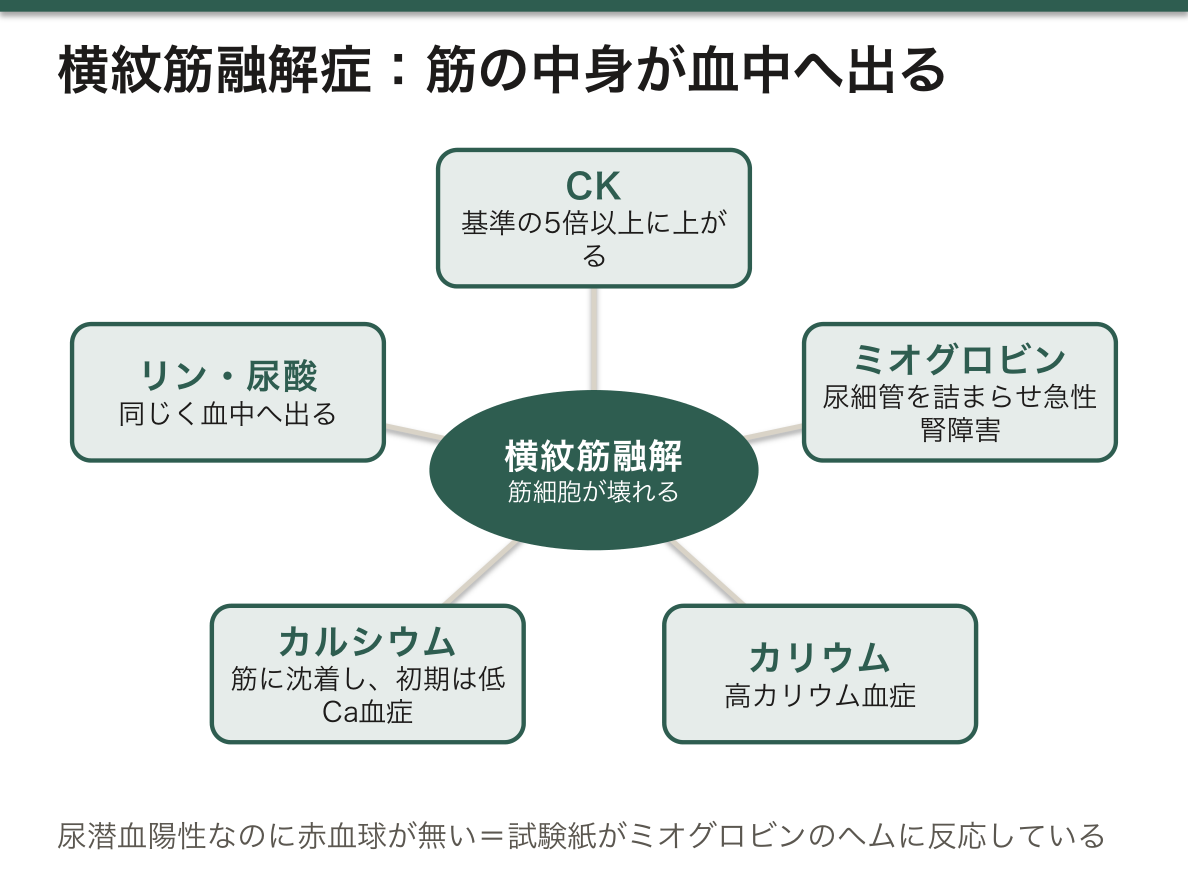
「尿潜血陽性なのに赤血球が無い」という所見が、この病気を最も速く言い当てる(尿検査の章)——「試験紙はヘムに反応するので、ミオグロビンでも陽性になる」。
低カルシウム血症が先に、高カルシウム血症が後に来る理由も機序から出る。壊れた筋にカルシウムが沈着し、回復期に戻ってくる——「だから初期の低カルシウムを、むやみに補正しない」。
圧挫症候群では、救助した直後が最も危ない。血流が戻った瞬間に、カリウムが全身へ流れ込む(クラッシュ症候群の章)——「助け出す前から輸液を始める」。
McArdle 病は、運動の初めに痛くなり、続けると楽になる(second wind)——「グリコーゲンが使えないので、脂肪酸の供給が追いつくまでが辛い」。
逆に脂肪酸酸化の異常では、長時間の運動と絶食で症状が出る(β酸化の章)——「症状が出るタイミングが、詰まった経路を教える」。
スタチンによる筋障害は、フィブラートとの併用で増える。CYP と輸送体の両方で相互作用する(脂質異常症の治療の章)——「筋痛の訴えを、薬の副作用として最初に疑う」。
English version
Core
Rhabdomyolysis — muscle cells break and their contents enter the blood.
- What comes out — creatine kinase, myoglobin, potassium, phosphate, urate, LDH, AST.
- Symptoms — myalgia, weakness, brown urine.
- Tests — a raised CK (over five times the upper limit). The urine dipstick is positive for blood with no red cells seen.
Complications — acute kidney injury (tubular obstruction by myoglobin and direct toxicity), hyperkalaemia, hypocalcaemia (later hypercalcaemia), DIC, compartment syndrome.
Causes — trauma, crush, prolonged immobility, seizures, heat stroke, excessive exercise, drugs (a statin with a fibrate), neuroleptic malignant syndrome, malignant hyperthermia, hypokalaemia.
Treatment — large-volume fluid is central. Choose a fluid without potassium.
Metabolic myopathies — McArdle disease (muscle phosphorylase deficiency), carnitine palmitoyltransferase II deficiency.
Going further
- The finding "dipstick positive for blood with no red cells" names this disease fastest (the chapter on urinalysis) — the strip reacts to haem, so myoglobin makes it positive too.
- Why hypocalcaemia comes first and hypercalcaemia later also follows from the mechanism. Calcium deposits in the damaged muscle and comes back in the recovery phase — so do not correct the early hypocalcaemia indiscriminately.
- In crush syndrome the moment just after rescue is the most dangerous. The instant the flow returns, potassium pours into the circulation (the chapter on crush syndrome) — start fluids before extricating them.
- In McArdle disease it hurts at the start of exercise and eases as it continues (second wind) — glycogen cannot be used, so it is hard until the supply of fatty acid catches up.
- Conversely, in disorders of fatty acid oxidation symptoms appear with prolonged exercise and fasting (the chapter on β-oxidation) — the timing at which symptoms appear tells which pathway is blocked.
- Statin myopathy increases when combined with a fibrate. They interact both through CYP and through transporters (the chapter on the treatment of dyslipidaemia) — suspect the drug first when a patient complains of myalgia.
乳酸は疲労物質ではない — 作られた場所から、使う場所へ運ばれている
乳酸は解糖の行き止まりではなく、細胞のあいだを行き来する燃料になる。
作る側——速筋線維・赤血球・活動中の筋。使う側——遅筋線維・心筋・肝・脳。
運ぶのは MCT(モノカルボン酸輸送体)で、使う側の細胞は乳酸をピルビン酸へ戻して TCA 回路へ入れる。
運動時の筋の酸性化は、乳酸そのものではなく、ATP の加水分解に伴う H⁺ の産生が主とされる——むしろ乳酸の生成は H⁺ を消費する側にある。
乳酸性作業閾値は、産生と除去が釣り合わなくなる運動強度になる。
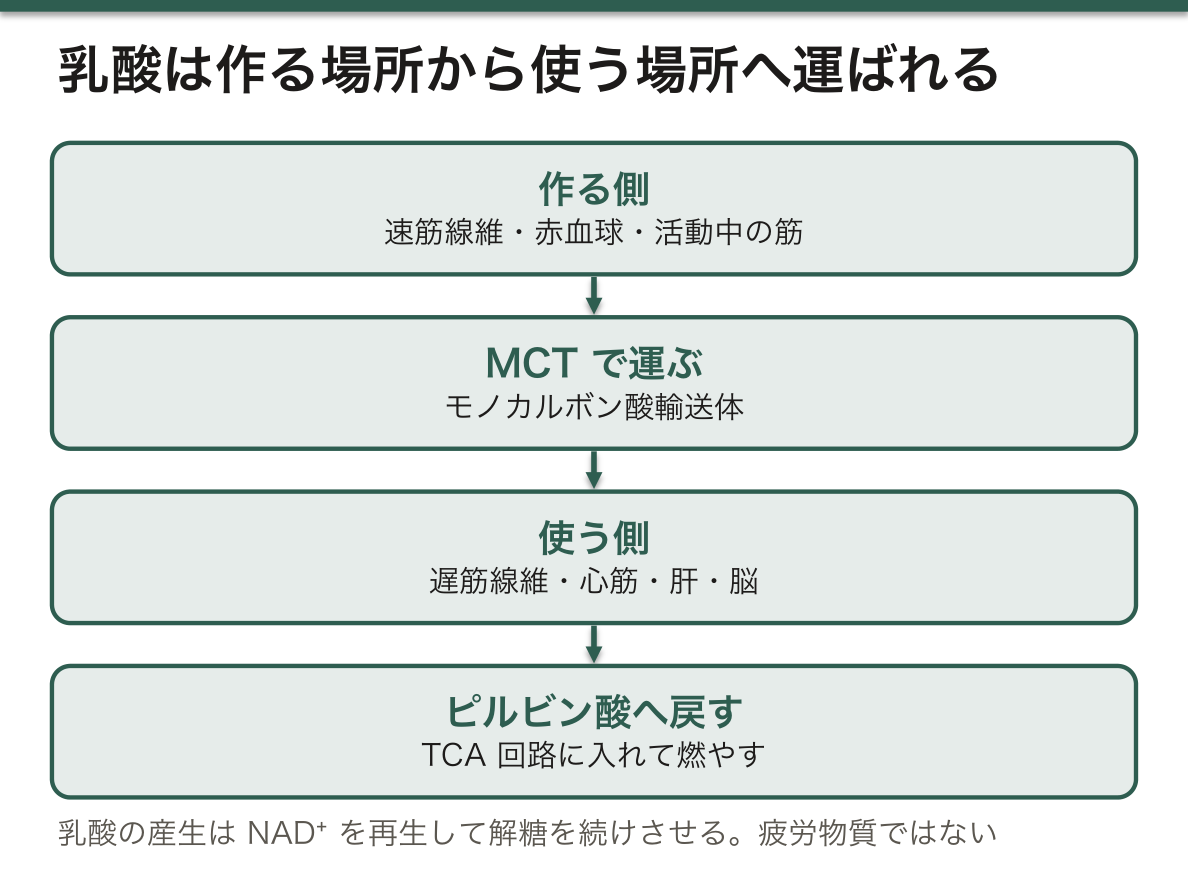
「疲労物質」という言い方が、なぜ改められたのかを押さえておく。乳酸の産生は NAD⁺ を再生して解糖を続けさせる仕組みで、むしろ運動を支えている(乳酸アシドーシスの項)——「相関があった分子を、原因と取り違えていた」。
心筋が乳酸を燃料として使うことは、臨床でも意味を持つ(TCA 回路の章)——「激しい運動中、心臓は筋が作った乳酸を受け取って動いている」。
脳も、低血糖や激しい運動のときは乳酸を使う(血液脳関門の章)——「グルコースだけが脳の燃料である、という説明には例外がある」。
乳酸性作業閾値は、運動処方の指標として使われる(評価と運動処方の章)——「心疾患のリハビリテーションで、安全な強度を決める根拠になる」。
臨床で乳酸を測るときの意味は、これとは別になる(ショックの章)——「運動していない患者の高乳酸は、産生と除去のどちらかが壊れている」。
English version
Core
Lactate is not a dead end of glycolysis but a fuel passing between cells.
Producers — fast fibres, red cells, working muscle. Users — slow fibres, myocardium, liver, brain.
The MCTs (monocarboxylate transporters) carry it, and the using cell returns lactate to pyruvate and puts it into the TCA cycle.
The acidification of muscle during exercise is held to come chiefly not from lactate itself but from the H⁺ produced with the hydrolysis of ATP — the production of lactate is, if anything, on the side that consumes H⁺.
The lactate threshold is the intensity of exercise at which production and removal cease to balance.
Going further
- Note why the phrase "fatigue substance" was revised. The production of lactate is the mechanism regenerating NAD⁺ so that glycolysis can continue; it supports the exercise rather than hindering it (the section on lactic acidosis) — a molecule that correlated being mistaken for the cause.
- That the myocardium uses lactate as fuel matters clinically too (the chapter on the TCA cycle) — during hard exercise the heart works on the lactate the muscles have made.
- The brain uses lactate too in hypoglycaemia and hard exercise (the chapter on the blood–brain barrier) — there are exceptions to the account that glucose is the only fuel of the brain.
- The lactate threshold is used as an index in prescribing exercise (the chapter on assessment and exercise prescription) — the ground for setting a safe intensity in cardiac rehabilitation.
- The meaning of measuring lactate clinically is a separate matter (the chapter on shock) — a high lactate in a patient who is not exercising means that either production or removal is broken.
エネルギーの在庫は、何秒もつのか
筋が使える供給源は、量と速さが逆になっている。
| 供給源 | 持続時間の目安 | 速さ |
|---|---|---|
| ATP そのもの | 1〜2 秒 | 最速 |
| クレアチンリン酸 | 7〜10 秒 | 非常に速い |
| 解糖(乳酸系) | 30 秒〜2 分 | 速い |
| 酸化的リン酸化 | 数時間 | 遅いが大量 |
グリコーゲンは筋に約 300〜400 g、肝に約 100 g——合わせて 1 日ぶんにも満たない。
脂肪は、体脂肪率 20% の成人で 10 万 kcal を超える。
ミオグロビンは、筋内の酸素の一時的な貯蔵になる。
「速く出せるものは少なく、多いものは遅い」という交換関係が、運動の種目を決めている。短距離走・重量挙げ・持久走で、主役になる系が変わる(この章の筋線維の型の項)——「競技の時間が、使う経路を選んでいる」。
グリコーゲンの在庫が少ないことが、持久運動の限界を作っている(グリコーゲンの章)——「枯れると急に動けなくなる(hitting the wall)」。
だから運動中の糖の補給と、運動後の補充のタイミングが問題になる(エネルギー代謝の章)——「グリコーゲンの再合成は、運動直後が最も速い」。
脂肪が桁違いに多いことは、飢餓に耐えられる期間を決めている(飢餓の章)——「問題になるのは脂肪の量ではなく、脳がケトン体に切り替わるまでの時間になる」。
クレアチンリン酸の在庫が数秒しかないことは、蘇生の生理にも通じる(救急の初期対応の章)——「循環が止まった組織に残された時間が、きわめて短い理由になる」。
English version
Core
In the sources available to muscle, amount and speed run opposite to each other.
| Source | Guide to duration | Speed |
|---|---|---|
| ATP itself | 1–2 seconds | Fastest |
| Creatine phosphate | 7–10 seconds | Very fast |
| Glycolysis (the lactate system) | 30 seconds to 2 minutes | Fast |
| Oxidative phosphorylation | Hours | Slow but in quantity |
Glycogen is about 300–400 g in muscle and about 100 g in liver — together not even a day’s worth.
Fat exceeds 100,000 kcal in an adult with 20 per cent body fat.
Myoglobin is a temporary store of oxygen within muscle.
Going further
- The trade-off "what can be released fast is small, what is plentiful is slow" decides the events of sport. The system that takes the leading part changes between sprinting, weightlifting and distance running (the section on fibre types in this chapter) — the duration of the event choosing the pathway used.
- That the store of glycogen is small sets the limit of endurance exercise (the chapter on glycogen) — when it runs out, movement suddenly fails (hitting the wall).
- Hence the question of taking sugar during exercise and the timing of replacement afterwards (the chapter on energy metabolism) — resynthesis of glycogen is fastest immediately after exercise.
- That fat is greater by orders of magnitude sets how long starvation can be endured (the chapter on starvation) — what matters is not the amount of fat but the time until the brain switches to ketone bodies.
- That the store of creatine phosphate is only seconds bears on the physiology of resuscitation too (the chapter on the initial response in emergencies) — the reason the time left to a tissue whose circulation has stopped is extremely short.
遅発性筋痛 — 運動の翌日から痛むのは、乳酸のせいではない
運動の 12〜24 時間後に始まり、24〜72 時間で最も強くなる筋痛がある。乳酸は運動後 1 時間以内にほぼ消えるので、時間が合わない。
実体は筋線維とその周囲の微小な損傷と、それに続く炎症である。
- 伸張性収縮で起きやすい——筋が力を出しながら引き伸ばされる動作(階段を下りる、ゆっくり下ろす)。同じ強度でも短縮性収縮より損傷が大きい
- Z 帯の乱れと膜の傷——カルシウムが流入し、蛋白分解が進む
- 炎症細胞が入り、腫れて痛覚受容器が刺激される——痛みは損傷そのものより炎症で出る
CK は 24〜48 時間後に上がるので、運動歴を知らずに測ると心筋や筋疾患を疑ってしまう。
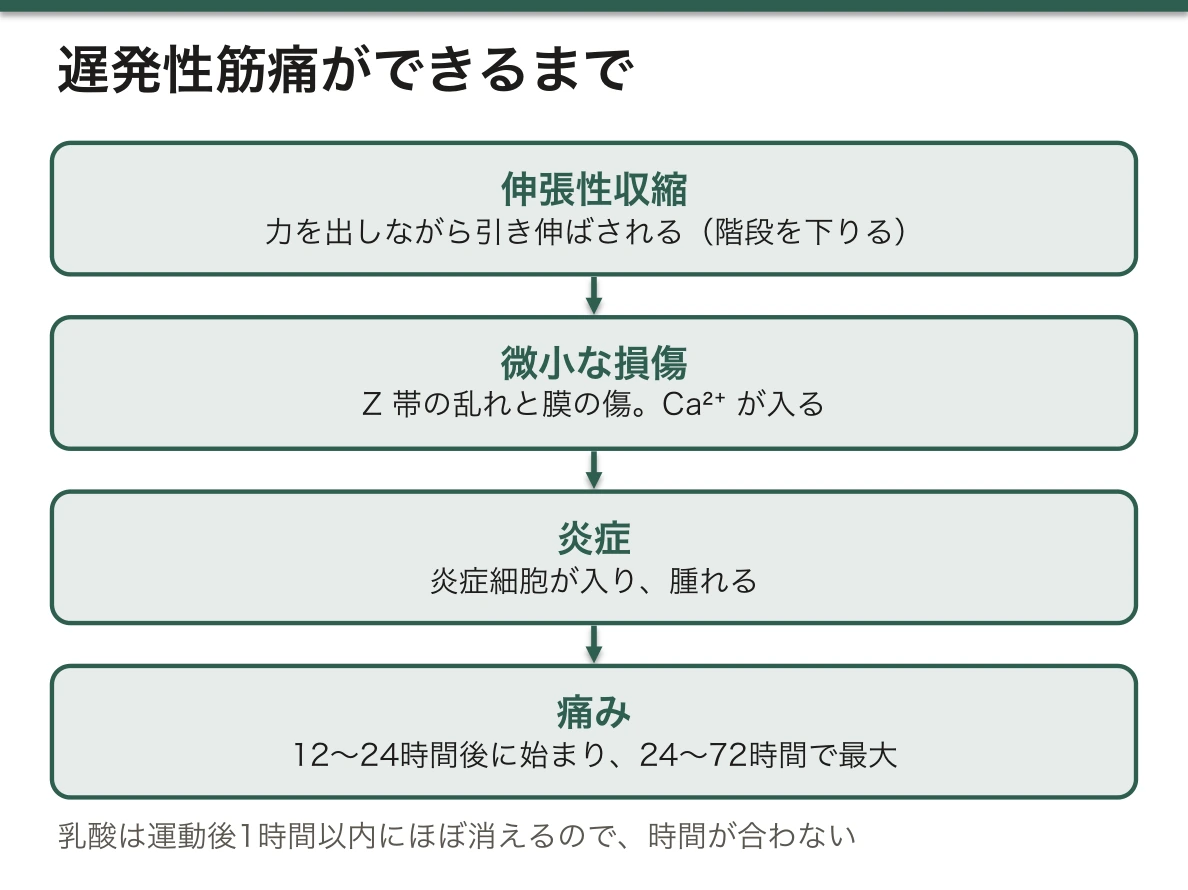
損傷と回復の繰り返しが、筋を強くしている。同じ運動を繰り返すと 2 回目以降は筋痛がずっと軽くなる(反復刺激効果)。壊れて直る過程そのものが適応であるため、「痛みを完全に消すこと」が最善とは限らない。
実際、運動直後の強い抗炎症(高用量 NSAID・大量の抗酸化サプリメント)は、筋肥大と持久力の適応を鈍らせるという報告がある。炎症は修復の一部なので、丸ごと止めると再構築が進まない。
⚠️ ただの筋肉痛と、危険な筋損傷を分ける。
| 遅発性筋痛 | 数日で軽快・尿の色は正常・CK は軽度上昇 | 経過を見てよい |
| 横紋筋融解症 | コーラ色の尿・強い脱力・腫脹・CK が著明高値 | 急性腎障害と高カリウム血症の危険。輸液が要る |
危険因子は慣れない激しい運動・脱水・高温環境・スタチン・遺伝性の代謝性ミオパチー。「初日に張り切った人」がいちばん危ないので、運動指導では強度を段階的に上げることを必ず伝える。
回復を助けるものは地味で、軽い運動(血流を保つ)・十分な蛋白と糖質・睡眠である。ストレッチとマッサージの効果は限定的で、予防にはならない。
CK 高値を見たら直前の運動を聞く。健康診断前日のジム通いで、心疾患を疑われる例がある。
English version
Core
There is a muscle pain that begins 12–24 hours after exercise and is worst at 24–72 hours. Lactate has almost gone within an hour of exercise, so the timing does not fit.
What it actually is is microscopic damage to the muscle fibres and their surroundings, and the inflammation that follows.
- It occurs readily with eccentric contraction — movements in which the muscle is stretched while producing force (going down stairs, lowering something slowly). At the same intensity the damage is greater than with concentric contraction.
- Disarray of the Z lines and damage to the membrane — calcium enters and proteolysis advances.
- Inflammatory cells enter, it swells, and the nociceptors are stimulated — the pain comes from the inflammation rather than from the damage itself.
CK rises 24–48 hours later, so measured without knowing the exercise history it raises the suspicion of cardiac or muscle disease.
Going further
The repetition of damage and recovery is what strengthens muscle. Repeat the same exercise and the soreness is much less from the second time (the repeated bout effect). Because the process of breaking and mending is itself the adaptation, "abolishing the pain completely" is not necessarily best.
Indeed, strong anti-inflammation immediately after exercise (high-dose NSAIDs, large doses of antioxidant supplements) is reported to blunt the adaptations of hypertrophy and endurance. Inflammation is part of repair, and stopping it wholesale prevents the rebuilding.
⚠️ Separate ordinary muscle soreness from dangerous muscle damage.
| Delayed onset muscle soreness | Eases in a few days, the urine is normal in colour, CK mildly raised | It may be watched |
| Rhabdomyolysis | Cola-coloured urine, marked weakness, swelling, a markedly high CK | A risk of acute kidney injury and hyperkalaemia. Fluid is required |
The risk factors are unaccustomed hard exercise, dehydration, a hot environment, statins, an inherited metabolic myopathy. The person who threw themselves into it on the first day is the most at risk, so in prescribing exercise always say to raise the intensity in stages.
What helps recovery is unglamorous — light exercise (maintaining blood flow), ample protein and carbohydrate, and sleep. Stretching and massage have limited effect and do not prevent it.
In the clinic
Seeing a raised CK, ask about exercise just beforehand. There are cases of cardiac disease being suspected after a trip to the gym the day before a health check.
筋を大きくする信号 — 張力と、ロイシンと、mTOR
筋量は合成と分解の差し引きで決まる。1 日のうちで両方が絶えず動いていて、合成が上回った時間の積み重ねが肥大になる。
合成のスイッチは 2 つあり、どちらか片方では足りない。
- 機械的な張力——筋が強い力を出すこと自体が信号になる。重さでも回数でもよく、要は「限界に近いところまで追い込んだか」が効く
- アミノ酸、特にロイシン——mTORC1 を活性化する。1 回あたり 体重 1 kg につき 0.3〜0.4 g の蛋白(ロイシン 2〜3 g)で反応が飽和する
合成の亢進は運動後 24〜48 時間続くので、同じ部位を週 2 回以上刺激するほうが、週 1 回より合理的になる。
高齢者では、同じ刺激で同じだけ反応しない(同化抵抗性)。若年者なら 20 g の蛋白で最大の反応が出るところ、高齢者では 30〜40 g 必要になる。理由は複合的で、内臓での取り込みが増えること、mTOR の感受性が落ちること、毛細血管の反応(アミノ酸を筋へ届ける血流)が鈍ることが挙げられる。
だからサルコペニアの対策は「蛋白を増やす」だけでは足りない。
| 量 | 高齢者では 1.0〜1.2 g/kg/日(若年の推奨より多い) | 腎機能が保たれていることを確認する |
| 配分 | 3 食に均等に分ける | 朝食の蛋白が少ない食習慣は不利。1 食に偏らせても余りは使われない |
| 刺激 | レジスタンス運動が必須 | 栄養だけでは筋にならない。運動が抵抗性を部分的に解除する |
分解の側を止める要因も同じくらい効く。不動は強力で、安静臥床は 1 週間で数 % の筋量を失う。高齢者では入院そのものが筋を減らす——「安静」を漫然と続けないこと自体が治療になるという考え方(早期離床)の根拠がここにある。ステロイド・炎症・低栄養も分解を進める。
入院中の高齢者では、点滴で糖だけ入れて何日も臥床させることの害を意識する。食事と離床の再開が、そのまま予後に効く。
English version
Core
Muscle mass is set by the balance of synthesis and breakdown. Both are moving constantly through the day, and the accumulation of the time in which synthesis exceeds breakdown is hypertrophy.
There are two switches for synthesis, and either alone is not enough.
- Mechanical tension — the muscle producing a strong force is itself the signal. Weight or repetitions, either will do; what tells is whether it was pushed close to the limit.
- Amino acids, especially leucine — they activate mTORC1. The response saturates at 0.3–0.4 g of protein per kg of body weight per occasion (2–3 g of leucine).
The increase in synthesis lasts 24–48 hours after exercise, so stimulating the same region twice a week or more is more rational than once.
Going further
In older people the same stimulus does not give the same response (anabolic resistance). Where 20 g of protein gives the maximal response in a young person, 30–40 g is needed in an older one. The reasons are several: more is taken up in the viscera, the sensitivity of mTOR falls, and the capillary response (the blood flow delivering amino acids to muscle) is blunted.
So measures against sarcopenia are not enough as "increase the protein" alone.
| Amount | In older people 1.0–1.2 g/kg/day (more than the recommendation for the young) | Confirm that renal function is preserved |
| Distribution | Divide it evenly over three meals | A habit of little protein at breakfast is a disadvantage. Loading it into one meal wastes the surplus |
| Stimulus | Resistance exercise is essential | Nutrition alone does not become muscle. Exercise partly lifts the resistance |
The factors that stop the breakdown side tell just as much. Immobility is powerful: bed rest loses several per cent of muscle mass in a week. In an older person admission itself reduces muscle — here lies the ground for the idea (early mobilisation) that not continuing "rest" aimlessly is itself a treatment. Steroids, inflammation and undernutrition also drive breakdown.
In the clinic
In an older inpatient, be aware of the harm of giving only glucose by drip and keeping them in bed for days. Restarting food and getting them up bears directly on the outcome.
まとめ
| 筋線維の型と、エネルギー供給の切り替わり | クレアチンリン酸——クレアチンキナーゼが、ADP に速やかにリン酸を渡す。 |
|---|---|
| 筋が壊れるとき — 横紋筋融解症と、代謝性ミオパチー | 横紋筋融解症——筋細胞が壊れ、中身が血中に出る。 |
| 乳酸は疲労物質ではない — 作られた場所から、使う場所へ運ばれている | 乳酸は解糖の行き止まりではなく、細胞のあいだを行き来する燃料になる。 |
| エネルギーの在庫は、何秒もつのか | 筋が使える供給源は、量と速さが逆になっている。 |
| 遅発性筋痛 — 運動の翌日から痛むのは、乳酸のせいではない | 運動の 12〜24 時間後に始まり、24〜72 時間で最も強くなる筋痛がある。 |
| 筋を大きくする信号 — 張力と、ロイシンと、mTOR | 筋量は合成と分解の差し引きで決まる。1 日のうちで両方が絶えず動いていて、合成が上回った時間の積み重ねが肥大になる。 |
このノートは医学生が授業の内容を自分の言葉でまとめたもので、診療の判断に使うものではありません。誤りに気づいたらお知らせください。